Homemade Welder (Chemistry Behind It)

  • Thread starter Thread starter Nuckelavee
  • Start date Start date
  • Tags Tags
    Homemade
Click For Summary

Discussion Overview

The discussion revolves around the chemistry and mechanics of a homemade AC stick welder, focusing on its operation, potential modifications for flux-cored wire, and the chemical processes occurring in the water used in the welding setup. Participants explore the dynamics of AC versus DC welding, the role of copper electrodes, and the byproducts generated during the welding process.

Discussion Character

  • Exploratory
  • Technical explanation
  • Debate/contested
  • Mathematical reasoning

Main Points Raised

  • Some participants express uncertainty about the operation of the homemade welder, noting the absence of a traditional transformer and questioning the role of the copper solution tank.
  • There is a discussion about the oxidation/reduction of copper in the welding process, with some suggesting that copper dissolves and redeposits on electrodes in AC, while others argue that the net effect is zero.
  • Participants debate the rate of copper consumption, with differing estimates on how much copper is transferred between electrodes during operation.
  • Questions are raised about the chemical byproducts produced in the water during welding, with some participants speculating on the effects of water purity and the presence of salts or copper sulfate.
  • There is inquiry into the differences in heat production, spark size, and energy dynamics between DC and AC welding at the same voltage and amperage, with some participants suggesting that the heat concentration point varies with polarity.
  • Some participants note that the type of welding (e.g., TIG versus stick) may influence the choice between constant current and constant voltage settings.

Areas of Agreement / Disagreement

Participants generally do not reach consensus on several points, including the specifics of copper dissolution, the nature of byproducts, and the comparative effects of AC and DC welding. Multiple competing views remain on these topics.

Contextual Notes

Limitations in the discussion include assumptions about the purity of water, the specific chemical reactions occurring, and the lack of empirical data to support claims about copper consumption rates and byproducts.

Nuckelavee
Messages
4
Reaction score
0
Hi everyone,

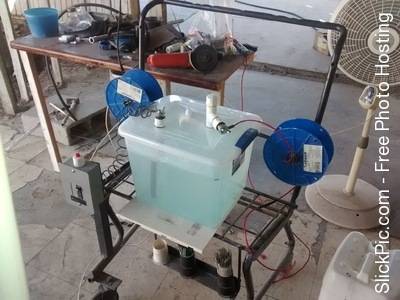
Some time ago i made a DIY AC Stick Welder, while i understand the basics of the machine, heat disipation, AC Arc and etc dynamics, I've some doubt i would like to clear before i proced with some modifications.

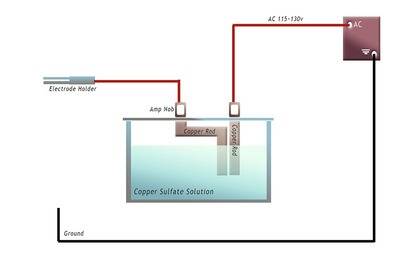
First ill attach its specs and diagram:
20140123121217.jpg

Smeowg.jpg


It works on simple 110~130v, 60hz at max of 50amps

I plan to modify it for Flux cored wire, but according to some ppl it only works on DC which i think its a "lazy answer", there has to be an equivalent on AC in terms of spark size and heat, I've read all about polarity and related stuff and i still don't get an smart complete answer.

Also id like to know what really happens chemically-wise in the water when mi machine is in use and the byproducts of it all.

Thanks in advance!
 
Chemistry news on Phys.org
TBH, I have no idea how it works. All welders I have seen in my life (not that there were many) were built around a huge transformer unit, which I don't see in the one above. Plus, the only thing copper solution tank does is it adds a resistance to the circuit, I always thought you need as low resistance as possible, as you are working with huge currents.

That being said, I know in some setups tanks with immersible electrodes are used for current control - the deeper the electrode goes, the higher the current that flows (rhyme unintended), so perhaps that's just it? If so, the reaction taking place is mostly copper oxidation/reduction. It won't work that well with DC, as in AC electrodes are dissolved and rebuilt in every cycle, in DC one electrode will be constantly dissolved (the copper will be electrodeposited on the other electrode). You can expect transfer of about 30 grams of copper between electrodes per hour when welding with 50 A.
 
Yes, as far as i know that transformer unit has 2 functions, one of them is to transform to DC (if needed) and the other one is to absorb heat and electrical feedback to avoid break switches to pop off when the the stick starts to "short circuit" (or so I've heard), which is also the function of the water solution, also, the copper rods work as you say, the closer they are to each other the stronger the amperage, and voltage(not sure about voltage tho), that why i added a Amp Nob, that just rotates on its axis to tune up the amperage according to the rods distance between each other.

As for the copper oxidation/reduction, its true, although i cannot say it gets consumed as fast as 30grams per hour, it goes no where near that, that said, i can assume that at 60hz the polarity switches so fast that non of the rods gets any actual deposit onto each other, the copper rods just get disolved into the water solution I am guessing.

i haven't tried DC on my machine, but i think it won't be necesary for flux core wire if i find out how to tune it up for lower amps and volts, thing is I am still trying to find a solid answer or the AC to DC heat/flame ratio.
 
Nuckelavee said:
As for the copper oxidation/reduction, its true, although i cannot say it gets consumed as fast as 30grams per hour, it goes no where near that, that said, i can assume that at 60hz the polarity switches so fast that non of the rods gets any actual deposit onto each other, the copper rods just get disolved into the water solution I am guessing.

No, copper dissolves and gets deposited back - as it does it alternatively on both electrodes (that's what AC is about) the net effect is zero.

30 gph would be the case for the DC.
 
No, copper dissolves and gets deposited back - as it does it alternatively on both electrodes (that's what AC is about) the net effect is zero

I think that's more of a theory, there's actually some byproduct left on the water that i cannot identify nor as copper or anything else, i would guess this also has to do with purity in water, salt or copper sulfate.

Anyhow, on the amp/volts subject id like to know if there's a difference on the followin example apart from the arc-blow on DC and polarity. What would be the difference between 50v DC @20amps and 50v AC @20amps (whatever the hertz), all of this in terms of heat production, spark size and any other energy related stuff?
 
Nuckelavee said:
No, copper dissolves and gets deposited back - as it does it alternatively on both electrodes (that's what AC is about) the net effect is zero

I think that's more of a theory, there's actually some byproduct left on the water that i cannot identify nor as copper or anything else, i would guess this also has to do with purity in water, salt or copper sulfate.

There are possible byproducts, but if there is no visible gas production the only way charge can leave one electrode and enter the other electrode is through the copper dissolution and deposition. You have a high current, there is no other way it can flow through the solution.

Anyhow, on the amp/volts subject id like to know if there's a difference on the followin example apart from the arc-blow on DC and polarity. What would be the difference between 50v DC @20amps and 50v AC @20amps (whatever the hertz), all of this in terms of heat production, spark size and any other energy related stuff?

That's an engineering question, you won't get an answer in our neck of woods.
 
Last edited:
Borek said:
There are possible byproducts, but if there is no visible gas production the only way charge can leave one electrode and enter the other electrode is though the copper dissolution and deposition. You have a high current, there is no other way it can flow through the solution.

That's an engineering question, you won't get an answer in our neck of woods.

DC can have either polarity on the 'stick' or the base, depending upon the welder, some are more sophisticated than others, with more control of the amperage, initial strike arc voltage, are some of the settings.

Electrons flow between the rod and base.
Depending upon the polarity of the base/rod, either the base will become hotter and form a larger pool of melted metal, or the rod will become hotter and its melt will become faster.

With AC, as the polarity changes with each cycle, the melt of rod/base is somewhere in between.

You also have constant current and constant voltaqe machines. Depending upon what type of welding you are doing, TIG for example, or regular manual stick, the constant current or the constant voltage is preferred.

As for your question of flux wire core, it may be that a constant voltage and polarity across the arc is preferred, in which case, DC is the only option.

YOU will have to do some investigating yourself on welding, either or both on the internet, or at your local library.

I think that's more of a theory, there's actually some byproduct left on the water that i cannot identify nor as copper or anything else, i would guess this also has to do with purity in water, salt or copper sulfate.

Borek is correct, and its not just a theory with copper electrodes and a copper sulfate solution - that's is the way the current is flowing through your tank. Contamination comes from the water itself if not pure, from the copper electrodes you used which are not going to be 100% pure copper, from dust particles settling on the solution and dissolving into constituent ions.
 
Electrons flow between the rod and base.
Depending upon the polarity of the base/rod, either the base will become hotter and form a larger pool of melted metal, or the rod will become hotter and its melt will become faster.

With AC, as the polarity changes with each cycle, the melt of rod/base is somewhere in between.

You've no idea i much i looked around for this information, according to this the only difference between DC and AC both at identical Volts/Amps is that the heat concentration point vary depending on the direction of the polarity, as for AC the heat concentration point will be always the same as the polarity shifts at 60hz.

You also have constant current and constant voltaqe machines. Depending upon what type of welding you are doing, TIG for example, or regular manual stick, the constant current or the constant voltage is preferred.

As for your question of flux wire core, it may be that a constant voltage and polarity across the arc is preferred, in which case, DC is the only option.

I get what you are saying, if the welding to do is delicate then a thin electrode or wire will be required therefore the arc heat will be best concentrated at the base rather than the electrode since it'll melt way too fast making the welding difficult.

Other than the heat focusing AC and DC are pretty much alike in terms of heat and spark amount, it just behaves differently.

I thank you for this information, i think i'll begin doing trial and error tomorrow morning.:smile: