Homology groups with points identified

  • Context: Graduate 
  • Thread starter Thread starter dkotschessaa
  • Start date Start date
  • Tags Tags
    Groups Points
Click For Summary

Discussion Overview

The discussion revolves around computing homology groups of quotient spaces formed by identifying points on surfaces, specifically a 2-sphere and a torus. Participants explore the implications of point identification on the structure of Δ complexes and the computation of homology groups using various methods, including simplicial and singular homology.

Discussion Character

  • Exploratory
  • Technical explanation
  • Debate/contested
  • Mathematical reasoning

Main Points Raised

  • Some participants express uncertainty about how to compute homology groups when points are identified on surfaces, particularly regarding the structure of Δ complexes.
  • There are suggestions that retriangulation may be necessary to apply simplicial homology effectively.
  • Some participants propose using the Meyer-Vietoris sequence for singular homology, while others question its applicability in simplicial contexts.
  • A participant mentions that identifying points can be homotopically equivalent to attaching cells, which could simplify the computation process.
  • There are discussions about the relationship between Δ complexes and simplicial complexes, with some asserting that the former can be triangulated.
  • One participant suggests that a sphere with three points identified is homotopically equivalent to a sphere with two earrings, which may complicate homology calculations.
  • Concerns are raised about how to handle neighborhoods of identified points when using Meyer-Vietoris in simplicial homology.
  • Participants explore the implications of removing points from simplicial complexes and whether homotopy can be used to address these removals.

Areas of Agreement / Disagreement

Participants express differing views on the best approach to compute homology groups with identified points, with no consensus reached on the necessity of retriangulation or the applicability of Meyer-Vietoris in this context. The discussion remains unresolved regarding the specific structure of the complexes after point identification.

Contextual Notes

Limitations include the potential need for additional definitions and clarifications regarding Δ complexes and simplicial homology. The discussion also highlights the complexity of applying homological techniques to spaces with identified points.

dkotschessaa
Messages
1,063
Reaction score
763
I am looking for some general guidance on questions of the form:

"Using a ## \Delta ## complex, compute the homology groups of the quotient space obtained fromt the 2-sphere ##S^2## by identifying three of its distinct points."

Similarly I have a question about a torus with two points identified.

I have a pretty good idea of how to compute homology groups with a ## \Delta ## complexes now for the Torus, Projective Plane, Klein bottle, etc. But what I am not understanding is what happens when I identify points to one another. i.e. I generally have some polygonal region ##I \times I## divided into triangles, i.e. for the Klein bottle:
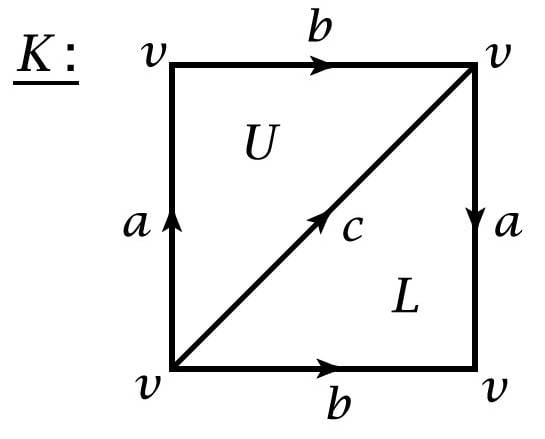
klein-bottle1.jpg


But I don't know what happens to t his structure when I pick some points on them and start identifying them. What does my complex look like?

-Dave K
 
Physics news on Phys.org
If you want to use simplicial homology you would have to retriangulate the space.

BTW: Your diagram is not a triangulation of the Klein bottle.

If you use Singular Homology then the Meyer-Vietoris sequence is the ticket.
 
lavinia said:
If you want to use simplicial homology you would have to retriangulate the space.

BTW: Your diagram is not a triangulation of the Klein bottle.

If you use Singular Homology then the Meyer-Vietoris sequence is the ticket.

The picture indicated is a ##\Delta## complex - it's the one from Hatcher. So, definitely a Klein bottle, not necessarily a triangulation.

I am also still sorting out CW-complexes, vs. ##\Delta## complexes , singular vs. simplicial homology and such ,so bear with me.

But the question does ask specifically about the ##\Delta## complexes.

-Dave K
 
dkotschessaa said:
The picture indicated is a ##\Delta## complex - it's the one from Hatcher. So, definitely a Klein bottle, not necessarily a triangulation.

I am also still sorting out CW-complexes, vs. ##\Delta## complexes , singular vs. simplicial homology and such ,so bear with me.

But the question does ask specifically about the ##\Delta## complexes.

-Dave K
What is a Δ complex?
 
lavinia said:
What is a Δ complex?

I don't know of a very concise definition, sorry. It's on page 102 in Hatcher.
 
dkotschessaa said:
I don't know of a very concise definition, sorry. It's on page 102 in Hatcher.

If I understand it right, a simplicial complex is a Δ-complex. So you could triangulate the space.

You can also notice that attaching a 1 cell with its endpoints to two different vertexes of the surface is homotopically equivalent to identifying the two points.

Take a point in the interior of an n-simplex and subdivide the n simplex with that point as a new vertex. Do the same for the second point in the interior of another simplex. Then identify the two points.
 
Last edited:
lavinia said:
If I understand it right, a simplicial complex is a Δ-complex. So you could triangulate the space.

You can also notice that attaching a 1 cell with its endpoints to two different vertexes of the surface is homotopically equivalent to identifying the two points.

Take a point in the interior of an n-simplex and subdivide the n simplex with that point as a new vertex. Do the same for the second point in the interior of another simplex. Then identify the two vertices.

Thanks for your reply. I was starting to suspect that about the 1 cell. I'll give it a try and get back to you!
 
dkotschessaa said:
Thanks for your reply. I was starting to suspect that about the 1 cell. I'll give it a try and get back to you!

The third paragraph was another way of doing it without attaching a 1 cell.
 
Last edited:
lavinia said:
If you want to use simplicial homology you would have to retriangulate the space.

BTW: Your diagram is not a triangulation of the Klein bottle.

If you use Singular Homology then the Meyer-Vietoris sequence is the ticket.

Doesn't MV apply to all "non-extraordinary" theories?
 
  • #10
WWGD said:
Doesn't MV apply to all "non-extraordinary" theories?

I would think that you would still need to subdivide to get neighborhoods of the identified points. But I am not sure how to do Meyer-Vietoris in simplicial homology - this because simplices are not open sets. Can you explain?
 
Last edited:
  • #11
lavinia said:
I would think that you would still need to subdivide to get neighborhoods of the identified points. But I am not sure how to do Meyer-Vietoris in simplicial homology - this because simplices are not open sets. Can you explain?
Good point, let me think it through some more.
 
  • #12
Using Lavinia's nice remarks, I think one can see that a sphere with three points identified is homotopically the same as a "sphere with (two) earrings", an example Bott gave us to illustrate that homology does not disinguish between spaces all that well. I.e. this has the same homology as a 2-torus.

In general the easiest way for me to compute homology is by the inductive formulas for how it changes under attaching cells. This allowed me e.g. to compute fairly easily the homology of the real grassmannian G(2,4) of real 2-planes (through the origin) in real 4-space, or equivalently the space of projective lines in projective 3-space. These formulas are no doubt a corollary of mayer vietoris sequences, the standard tool.

I like explicit hands - on methods like triangles for getting a concrete feel, but I always recall the remark by Dold that using them to compute homology is like using riemann sums to compute integrals. Of course i do that too, at least at first.
 
  • #13
If you had just identified two points , I think your pace would be homotopic to an ## S^1 ## attached to an ## S^2 ## , but with three points it seems you could attach a half of an ## S^1 ## to the first handle or some variant of it?
 
  • #14
lavinia said:
I would think that you would still need to subdivide to get neighborhoods of the identified points. But I am not sure how to do Meyer-Vietoris in simplicial homology - this because simplices are not open sets. Can you explain?
Maybe using simplicial maps which themselves can be approximated by continuous functions?
 
  • #15
WWGD said:
Maybe using simplicial maps which themselves can be approximated by continuous functions?

Not sure what you mean. I will look up how the excision axiom is satisfied in simplicial homology.
 
  • #16
lavinia said:
Not sure what you mean. I will look up how the excision axiom is satisfied in simplicial homology.

Do you mean a specific argument that we can remove subspaces and then the inclusion induces an isomorphism ? Or a specific example:
How about this, consider a ball , i.e., a 2-simplex :=X , a given point * in the interior of X and a disk D within X containing * , i.e., Y:=X-D , then

## \mathbb Z =H_2( X, X- {pt}) =H_2( X-Y, (X-{pt}) -Y)=H_2(D, D-{pt}) ##?
 
  • #17
WWGD said:
Do you mean a specific argument that we can remove subspaces and then the inclusion induces an isomorphism ? Or a specific example:
How about this, consider a ball , i.e., a 2-simplex :=X , a given point * in the interior of X and a disk D within X containing * , i.e., Y:=X-D , then

## \mathbb Z =H_2( X, X- {pt}) =H_2( X-Y, (X-{pt}) -Y)=H_2(D, D-{pt}) ##?
right but if you remove one a point it is no longer a simplicial complex
 
Last edited:
  • #18
lavinia said:
right but if you rem one a point it is no longer a simplicial complex
But, can we work up to homotopy? D-{pt} retracts to the boundary S^1 , which is a simplex without its interior? EDIT: Or must each step of the homotopy(retract) be represented by a simplex?
 
  • #19
WWGD said:
not sure
 
  • #20
This shouldn't need an MV sequence to do since 1) we never learned it and 2) the question is about ## \Delta## complexes. It should be fairly straightforward. I'm still just not sure what the complex should look like. i.e. I don't know what represents two points being identified on it.
 
  • #21
dkotschessaa said:
This shouldn't need an MV sequence to do since 1) we never learned it and 2) the question is about ## \Delta## complexes. It should be fairly straightforward. I'm still just not sure what the complex should look like. i.e. I don't know what represents two points being identified on it.

I explained in the first post that you need to subdivide the complex so that the two identified points are vertexes and then identify them.

BTW: Did you learn Excision?
The Meyer Vietoris sequence is incredibly important. I suggest that you learn it.
 
  • #22
lavinia said:
I explained in the first post that you need to subdivide the complex so that the two identified points are vertexes and then identify them.

Oh, you did say to retriangulate, but that was all you said . So I didn't understand about the vertices. That makes more sense though and I will give it a try.

BTW: Did you learn Excision?

No.

The Meyer Vietoris sequence is incredibly important. I suggest that you learn it.
I believe you, but I don't have the luxury of time to go outside the tested material. In fact I have... 37 days!
 

Similar threads

  • · Replies 22 ·
Replies
22
Views
8K
Replies
3
Views
3K
  • · Replies 9 ·
Replies
9
Views
4K
  • · Replies 12 ·
Replies
12
Views
5K
  • · Replies 1 ·
Replies
1
Views
6K
  • · Replies 12 ·
Replies
12
Views
5K
  • · Replies 15 ·
Replies
15
Views
3K
  • · Replies 3 ·
Replies
3
Views
2K
  • · Replies 38 ·
2
Replies
38
Views
8K
  • · Replies 5 ·
Replies
5
Views
2K