Horizontal lift, or parallel transport

Click For Summary
SUMMARY

The discussion centers on a specific problem encountered in Nakahara's book, "Geometry, Topology and Physics," regarding the connection theory and the use of the term g_i(t)^{-1} in a mathematical expression. Participants debate the validity of this term in the context of the equation R_{g_i(t)*}\sigma_{i*}X and its implications for the pullback of a right action. The consensus leans towards the notion that the inclusion of g_i(t)^{-1} is indeed correct, despite initial skepticism from some participants. The conversation highlights the complexity of the topic and the necessity for a deeper understanding of the equations presented.

PREREQUISITES
  • Familiarity with differential geometry concepts, particularly connections and pullbacks.
  • Understanding of Lie group actions and their representations.
  • Knowledge of the mathematical notation used in advanced physics texts.
  • Experience with Nakahara's "Geometry, Topology and Physics" as a reference material.
NEXT STEPS
  • Study the concept of connections in differential geometry in greater detail.
  • Review the properties of Lie group actions and their implications in geometry.
  • Examine the pullback operation in the context of differential forms and vector fields.
  • Analyze the equations presented in Nakahara's book, particularly sections related to connection theory.
USEFUL FOR

This discussion is beneficial for graduate students in mathematics or physics, researchers focusing on differential geometry, and anyone seeking to deepen their understanding of connection theory and its applications in theoretical physics.

qinglong.1397
Messages
108
Reaction score
1
Hello, everyone!

I'm studying Nakahara's book, Geometry, Topology and Physics and now studying the connection theory. I come across a problem. Please look at the two attachments.

In the attachment
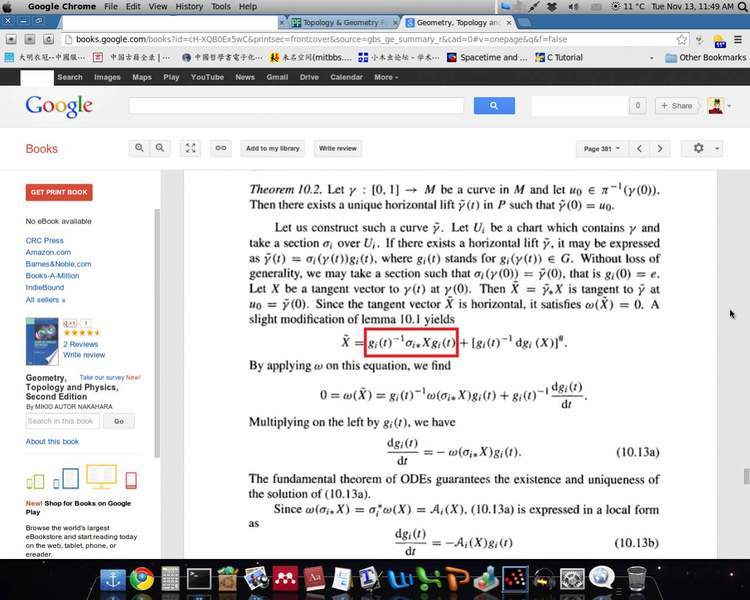
Screenshot-1.jpg
, Nakahara said we could use the similar method in the attachment
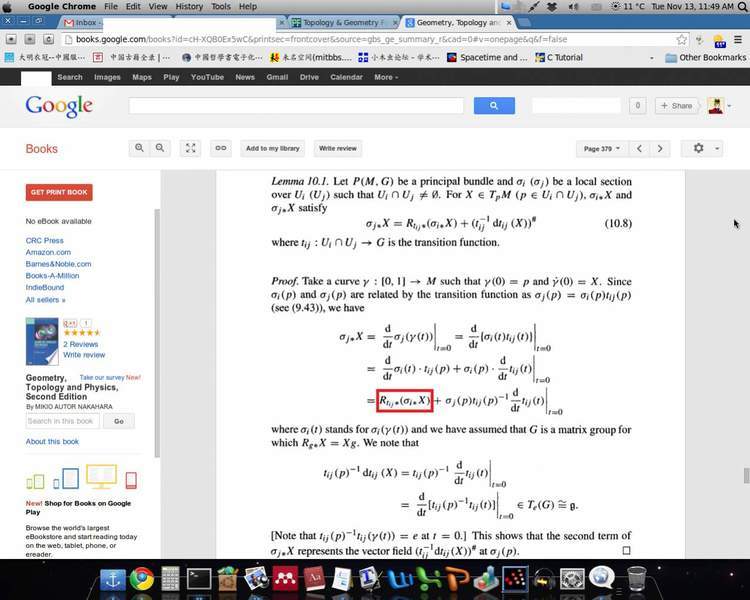
Screenshot.jpg
to get \tilde X, but why does the first term have g_i(t)^{-1}. According to the first figure, the first term should have the following form

R_{g_i(t)*}\sigma_{i*}X

Since R_{g*}X=Xg, it becomes

(\sigma_{i*}X)g_i(t)

So there shouldn't be g_i(t)^{-1}. But why did the author put it there? Thank you!
 
Physics news on Phys.org
Hello.
When I read this chapter I found this strange. I think it's a mistake. The next equation however is right by (10.3b')
 
bloby said:
Hello.
When I read this chapter I found this strange. I think it's a mistake. The next equation however is right by (10.3b')

Hey, thanks for your reply! But what is "the next equation", the second equation in the first attachment? If so, I cannot agree with you, because there is no a pullback of a right action.
 
I have to read this chapter again. Here is what I wrote for me:

0=\omega\left(\tilde{X}\right)=\omega\left(R_{g_{i}*}\left(\sigma_{i*}X\right)\right)+\omega\left(\left[g_{i}^{-1}dg_{i}\left(X\right)\right]^{\#}\right)=R_{g_{i}}^{*}\omega\left(\sigma_{i*}X\right)+g_{i}^{-1}dg_{i}\left(X\right)=g_{i}^{-1}\omega\left(\sigma_{i*}X\right)g_{i}+g_{i}^{-1}\frac{dg_{i}}{dt}
 
0=\omega(\tilde{X})=\omega(R_{g_{i}*}(\sigma_{i*}X))+\omega([g_{i}^{-1}dg_{i}(X)]^{\sharp})=R_{g_{i}}^{*}\omega(\sigma_{i*}X)+g_{i}^{-1}dg_{i}(X)=g_{i}^{-1}\omega(\sigma_{i*}X)g_{i}+g_{i}^{-1}\frac{dg_{i}}{dt}
 
bloby said:
0=\omega(\tilde{X})=\omega(R_{g_{i}*}(\sigma_{i*}X))+\omega([g_{i}^{-1}dg_{i}(X)]^{\sharp})=R_{g_{i}}^{*}\omega(\sigma_{i*}X)+g_{i}^{-1}dg_{i}(X)=g_{i}^{-1}\omega(\sigma_{i*}X)g_{i}+g_{i}^{-1}\frac{dg_{i}}{dt}

Great! Thank you very much!
 

Similar threads

  • · Replies 21 ·
Replies
21
Views
1K
  • · Replies 2 ·
Replies
2
Views
2K
  • · Replies 7 ·
Replies
7
Views
2K
  • · Replies 9 ·
Replies
9
Views
3K
  • · Replies 22 ·
Replies
22
Views
6K
  • · Replies 9 ·
Replies
9
Views
4K
Replies
7
Views
1K
Replies
3
Views
7K
  • · Replies 13 ·
Replies
13
Views
2K
  • · Replies 5 ·
Replies
5
Views
2K