Conservation of dot product with parallel transport

Click For Summary

Discussion Overview

The discussion revolves around the concept of parallel transport in the context of vector fields and the conservation of the dot product between a transported vector and a tangent vector. Participants explore the implications of parallel transport, its definitions, and its mathematical expressions, particularly in relation to curved and flat spaces.

Discussion Character

  • Exploratory
  • Technical explanation
  • Mathematical reasoning
  • Debate/contested

Main Points Raised

  • One participant questions why parallel transport is said to preserve the dot product, suggesting it may relate to the angle between the tangent and transported vectors remaining constant.
  • Another participant asserts that the equation related to parallel transport does not need demonstration, as it is part of the definition, but emphasizes that demonstrating the conservation of the dot product requires integration.
  • A participant provides a derivation for the expression related to parallel transport in flat space, indicating that the components do not vary during transport.
  • There is a suggestion to transform the problem into polar coordinates, with a subsequent participant questioning the relevance of polar coordinates in flat space versus curved space.
  • One participant computes the equations for parallel transport in polar coordinates and seeks to understand the implications for the conservation of the dot product.
  • Another participant advises taking the directional derivative of the dot product of the parallel transported fields to demonstrate conservation, but this advice leads to further questions about the approach to take.

Areas of Agreement / Disagreement

Participants express differing views on the necessity of demonstrating certain equations and the relevance of coordinate systems. There is no consensus on the best approach to demonstrate the conservation of the dot product, indicating ongoing debate and exploration of the topic.

Contextual Notes

Participants reference specific mathematical expressions and definitions related to parallel transport, indicating that the discussion is grounded in advanced concepts of differential geometry. Limitations in understanding and application of these concepts are evident, particularly in transitioning from flat to curved spaces.

fab13
Messages
300
Reaction score
7
Hello, I have 2 questions regarding similar issues :

1*)

Why does one say that parallel transport preserves the value of dot product (scalar product) between the transported vector and the tangent vector ?

Is it due to the fact that angle between the tangent vector and transported vector is always the same during the operation of transport (which is the definition of parallel transport) ?

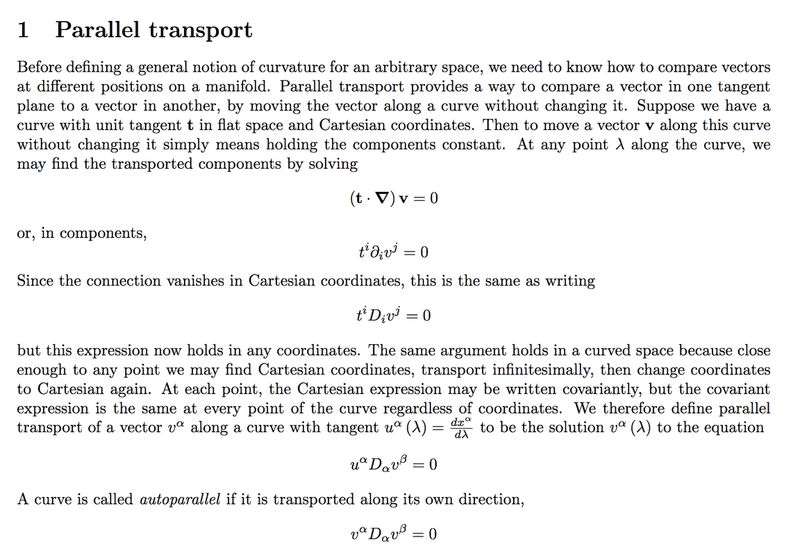
2*) From the following link http://www.physics.usu.edu/Wheeler/GenRel2013/Notes/Geodesics.pdf and more especially the following extract ;
Capture_d_e_cran_2017_01_15_a_23_18_38.png


I don't understand the first relation, i.e : $$(\mathbf{t} \cdot \mathbf{\nabla})\,\mathbf{v}=0\quad\quad(1)$$

which actually is equal to : $$t^{i}\partial_{i}v^{j}=0\quad\quad(2)$$

How can we demonstrate the equation (1) above ?

Is there a link with my first question, i.e it relates to the conservation of dot product value between $$\mathbf{t}$$ tangent vector and $$\mathbf{v}$$ vector ?

Thanks for your help
 
Physics news on Phys.org
fab13 said:
How can we demonstrate the equation (1) above ?
That is part of the definition of parallel transport, so it doesn't need to be demonstrated. If it doesn't hold then the vector field ##\mathbf v## is not a parallel transport.

What does need to be demonstrated is that a consequence of that definition is that the values of the dot product between the tangent and the transported vector are the same at any two points along the curve - what you describe as 'conservation of the dot product'. Integration is required to demonstrate that.
 
andrewkirk said:
That is part of the definition of parallel transport, so it doesn't need to be demonstrated. If it doesn't hold then the vector field ##\mathbf v## is not a parallel transport.

What does need to be demonstrated is that a consequence of that definition is that the values of the dot product between the tangent and the transported vector are the same at any two points along the curve - what you describe as 'conservation of the dot product'. Integration is required to demonstrate that.

ok, I have found why equation (1) has this expression. Taking ##\tau## an affine parameter, we can write

$$ t^{i}\partial_{i}v^{j} = \dfrac{\text{d}x^{i}}{\text{d}\tau}\,\dfrac{\partial v^{j}}{\partial x^{i}} = \dfrac{\text{d} v^{j}}{\text{d}\tau}\quad\quad (2) $$

So in flat space (i.e Euclidean), the straight line parameterized by ##\tau## and on which the vector ##\vec{v}=v^{i}\,\vec{e_{i}}## is transported, makes vanish the expression ##\dfrac{\text{d} v^{j}}{\text{d}\tau}## because the components doesn't vary during the transport.

Now, I have to generalize this Euclidean example to Curved space and undertsand in this case the using of Covariant Derivative which replaces the expression above ##(2)## with :

$$\dfrac{D\,v^{j}}{\text{d}\tau}=\dfrac{\text{d}x^{i}}{\text{d}\tau}\,\nabla_{i} v^{j}=t^{i} \,\nabla_{i} v^{j}=0$$ with ##t^{i}=\dfrac{\text{d}x^{i}}{\text{d}\tau}##

Thanks
 
I suggest starting by transforming the Euclidean two-dimensional case to polar coordinates.
 
What do you mean ? The using of polar coordinates in 2D classic space is still a flat space, geodesics are still straight lines, I should rather start by the surface of a 2D sphere, shoudn't I ?
 
fab13 said:
What do you mean ? The using of polar coordinates in 2D classic space is still a flat space, geodesics are still straight lines, I should rather start by the surface of a 2D sphere, shoudn't I ?
You are aware that even a flat space have non-zero Christoffel symbols in curvilinear coordinates, no? You should start with polar coordinates and check the form of the resulting equations for the parallel transported vector components. The property you are talking about is not particular for a curved space.

Edit: In fact, this is exactly what the text you quoted does. Starts from a Cartesian coordinate system and then uses that the partial and covariant derivatives are the same in that system to rewrite it on a covariant form in an arbitrary system.
 
Last edited:
Orodruin,

as you said, I have computed the equations for parallel transport vector, I get :

$$D A^{\rho}=dA^{\rho}-\rho\,A^{\theta}\,\text{d}\theta$$
and
$$D A^{\theta}=dA^{\theta}+\dfrac{1}{\rho}(A^{\rho}\,\text{d}\theta+A^{\theta}\,\text{d}\rho)$$

By definition of parallel transport, I can write : ##D A^{\rho}=D A^{\theta}=0##

What can I conclude about the property that I am looking for, i.e the conservation of dot product ?

Thanks
 
fab13 said:
What can I conclude about the property that I am looking for, i.e the conservation of dot product ?
For that you need to take the directional derivative of the dot product of the parallel transported fields along the curve taking into account that the vector components satisfy the parallel transport equations.
 
Orodruin said:
For that you need to take the directional derivative of the dot product of the parallel transported fields along the curve taking into account that the vector components satisfy the parallel transport equations.

I didn't understand what you mean, do I have to start with :

$$\text{d}(\vec{A}\cdot\vec{n}) = \text{d}(A_{i}\dfrac{\text{d}y^{i}}{\text{d}\tau})=0$$

??
 
  • #10
Orodruin said:
For that you need to take the directional derivative of the dot product of the parallel transported fields along the curve taking into account that the vector components satisfy the parallel transport equations.

Dear Orodruin,

could you help me about what you told me to do, i.e take the directional derivative of the dot product of the parallel and demonstrate the conservation.

Thanks
 

Similar threads

  • · Replies 12 ·
Replies
12
Views
3K
  • · Replies 6 ·
Replies
6
Views
5K
  • · Replies 17 ·
Replies
17
Views
3K
  • · Replies 9 ·
Replies
9
Views
8K
  • · Replies 2 ·
Replies
2
Views
2K
  • · Replies 4 ·
Replies
4
Views
2K
  • · Replies 58 ·
2
Replies
58
Views
6K
  • · Replies 0 ·
Replies
0
Views
2K
  • · Replies 21 ·
Replies
21
Views
1K
  • · Replies 36 ·
2
Replies
36
Views
6K