yucheng
- 232
- 57
- TL;DR
- I hope to use experiments (and their theoretical analysis!) to inspire my studies!
inspiration:
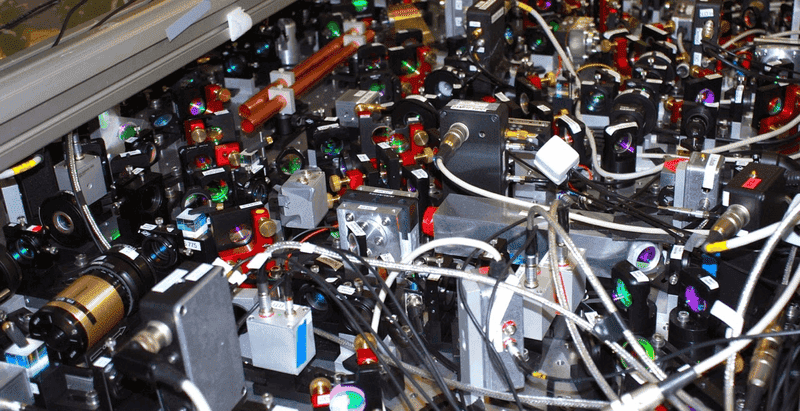
How are these experiments designed, analyzed? Some hints I've come across:
Of course, then there's the more vigorous analysis on quantum aspects like quantum state tomography, ##g^{(2)}## correlation function, spectral analysis.... etc.
Do you have any examples of this sort of analysis/calculations being done? Do you know where to look for more references on designing and analyzing such experiments?Thanks in advance!P.S. I remember having seen 2 books:
Building electro-optical systems by Hobbs
A first course in laboratory optics by Gretarsson
- How does one predict the effects of small modifications (ordering of optical devices etc)? https://www.physicsforums.com/threa...m-et-al-1999-with-small-modification.1047803/
- In chapter 5 and 6 of A Guide to Experiments in Quantum Optics, the authors deal with the description of cavities, beam splitters and lasers.
- Optical experiments are very complicated: http://www.2physics.com/2014/03/quantum-up-conversion-of-squeezed.html
How are these experiments designed, analyzed? Some hints I've come across:
- linear optical elements + Fourier Optics allow one to propagate beams and to know their modified characteristics; ABCD matrix analysis
- Beam characteristics (modes etc) and propagation?
- Matrix optics
- Jones calculus
Of course, then there's the more vigorous analysis on quantum aspects like quantum state tomography, ##g^{(2)}## correlation function, spectral analysis.... etc.
Do you have any examples of this sort of analysis/calculations being done? Do you know where to look for more references on designing and analyzing such experiments?Thanks in advance!P.S. I remember having seen 2 books:
Building electro-optical systems by Hobbs
A first course in laboratory optics by Gretarsson
Last edited: