How can a Lissajous Curve be represented in 3D?

  • Context: Undergrad 
  • Thread starter Thread starter tejolson
  • Start date Start date
  • Tags Tags
    3d Curve
Click For Summary

Discussion Overview

The discussion revolves around the representation of Lissajous Curves in three dimensions, exploring the relationship between their two-dimensional forms and potential three-dimensional interpretations. Participants examine both mathematical and physical perspectives, including real-world applications and experimental observations.

Discussion Character

  • Exploratory
  • Debate/contested
  • Technical explanation

Main Points Raised

  • One participant asserts that there is only one way to represent a Lissajous Curve in 3D if it is to correspond to a real-world example.
  • Another participant questions the necessity of a 3D representation, suggesting that the concept may be taken too far.
  • A third participant emphasizes the physical aspect of Lissajous Curves, mentioning their creation with light and mirrors, and speculates on the visibility of a 3D representation of light.
  • There is a mention of a connection between Lissajous Curves, wave functions, and binomial distribution in the context of quantum physics.
  • A later reply references a historical experiment indicating that the 3D version of the Lissajous figure exists in the x,z or y,z plane, expressing a desire for more information about the experiment and its details.

Areas of Agreement / Disagreement

Participants express differing views on the necessity and existence of a 3D representation of Lissajous Curves, with some asserting that it is essential while others challenge this notion. The discussion remains unresolved regarding the specifics of 3D representations and their implications.

Contextual Notes

Participants reference various assumptions about the nature of dimensions and representations, as well as the historical context of experiments related to Lissajous Curves. There are unresolved questions about the visibility of light and the implications of quantum physics on the discussion.

tejolson
Messages
8
Reaction score
0
I'm trying to figure out how to do a Lissajous Curve in 3d. It has a 2d shape in the real world, so if it's in the real world, then there must be a 3d shape to it.

Here is the crazy version, it has 8 variants of the last pic layered and it's at 45 45 0
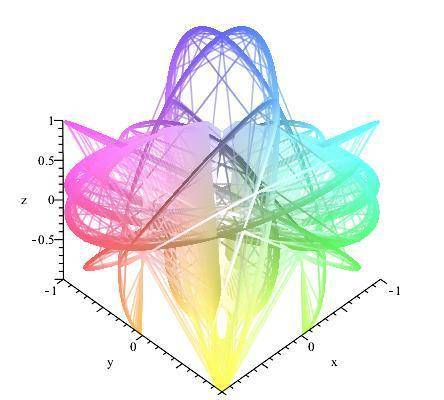
attachment.php?attachmentid=58007&stc=1&d=1366341051.jpg


This is the one above and it is at 0 0 0
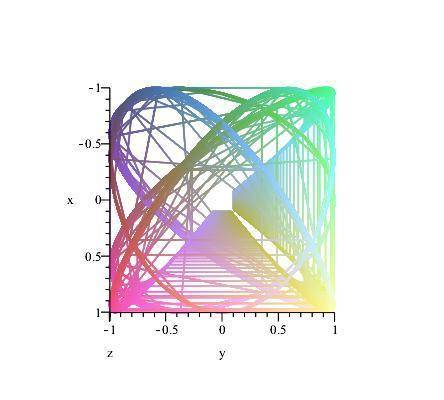
attachment.php?attachmentid=58008&stc=1&d=1366341051.jpg


Here is my version of that Lissajous by itself.
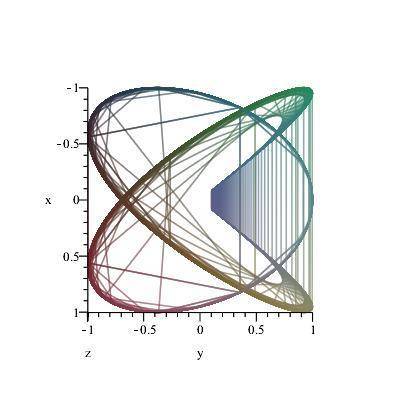
attachment.php?attachmentid=58009&stc=1&d=1366341051.jpg


There are a million different ways to make pretty shapes out of that curve, but I'm pretty sure there is only one way it can be represented in 3d if it is to represent a real world example.
 

Attachments

  • s 4, c 5.jpg
    s 4, c 5.jpg
    21.5 KB · Views: 1,378
  • s 4, c 5, top.jpg
    s 4, c 5, top.jpg
    18 KB · Views: 724
  • s 4, c 5, simple.jpg
    s 4, c 5, simple.jpg
    18.1 KB · Views: 1,042
Physics news on Phys.org
tejolson said:
It has a 2d shape in the real world, so if it's in the real world, then there must be a 3d shape to it.

Why? Do you not believe in flat things? Yes, in the real world even a piece of thin paper has some thickness, so technically you are right, but I think you are carrying the concept to a point where it does not helpfully go.

... but I'm pretty sure there is only one way it can be represented in 3d if it is to represent a real world example.

Why? Why should it have ANY 3D representation?
 
You're talking about a math function, I'm talking about something real. It is made with light. Some guy used two mirrors to make it. It's in 2d because it was viewed in 2d as it reflected off the wall. As I understand it there is a way to slow down light in a vacuum. Maybe I can see a 3d representation that way. But I'm thinking it won't work because a photon is to small to see?

It's a wave function that uses binomial distribution. From what I understand quantum physics uses probability, and binomial distribution is part of probability. So I'm thinking there is a connection and I want to understand it.


attachment.php?attachmentid=58024&stc=1&d=1366379070.jpg
 

Attachments

  • helment.jpg
    helment.jpg
    26.4 KB · Views: 772
Last edited:
Yup, I'm right. Apparently there was an experiment done a long long time ago. A professor told me the 3d version of the x,z or y,z plane is itself a Lissajous figure. So that makes those figures above correct. Unfortunately this means this stuff is already known. And since it's already known then it's been done and it does not need to be redone. If anyone knows who did this experiment in 3D, I would very much like to know. The professor that talked to me was unsure about the details.
 

Similar threads

  • · Replies 6 ·
Replies
6
Views
777
  • · Replies 2 ·
Replies
2
Views
2K
  • · Replies 4 ·
Replies
4
Views
2K
  • · Replies 1 ·
Replies
1
Views
2K
  • · Replies 2 ·
Replies
2
Views
2K
  • · Replies 1 ·
Replies
1
Views
3K
  • · Replies 6 ·
Replies
6
Views
2K
  • · Replies 5 ·
Replies
5
Views
5K
  • · Replies 29 ·
Replies
29
Views
4K
  • · Replies 10 ·
Replies
10
Views
3K