How can I calculate the energy needed for ferromagnetic hysteresis?

Click For Summary

Homework Help Overview

The problem involves calculating the energy needed for ferromagnetic hysteresis in a toroidal material subjected to a magnetic field generated by a coil of copper wire. The context includes understanding the relationship between the magnetic field strength (H) and magnetic flux density (B) as the material undergoes magnetization and hysteresis.

Discussion Character

  • Exploratory, Conceptual clarification, Assumption checking

Approaches and Questions Raised

  • Participants discuss the derivation of expressions for H and B fields based on given parameters and equations. Questions arise regarding the nature of the hysteresis curve and whether it is parameterized by time or requires adjustments to the current. There is also uncertainty about how to calculate the energy from the hysteresis loop.

Discussion Status

Some participants have provided guidance on the use of the area under the hysteresis curve to determine energy, while others question the applicability of magnetic susceptibility in this context. Multiple interpretations of the problem are being explored, particularly regarding the integration of H and B and the method for estimating energy.

Contextual Notes

Participants note that the susceptibility is only relevant for part (a) of the problem and that the relationship between B and H varies along the hysteresis curve, complicating the calculation of energy. There is an emphasis on the need to approximate the area under the curve rather than relying on a single equation.

Tomsk
Messages
227
Reaction score
0

Homework Statement


It's a past paper question, but I just don't understand it. I must have missed something here...

The figure [I can't find a decent one to put here] shows a coil of copper wire wrapped around a torus of material. The copper wire makes N turns and carries a current I. The torus has major radius R and minor radius r, where r<<R. Assume that the magnetic is entirely within the material.
(a) The material has a small, constant, positive magnetic susteptibility \chi. Obtain expressions for the H and B fields. [5 marks]
(b) The material is ferromagnetic but owing to heat treatment it is initially unmagnetized.
BHCurve.gif

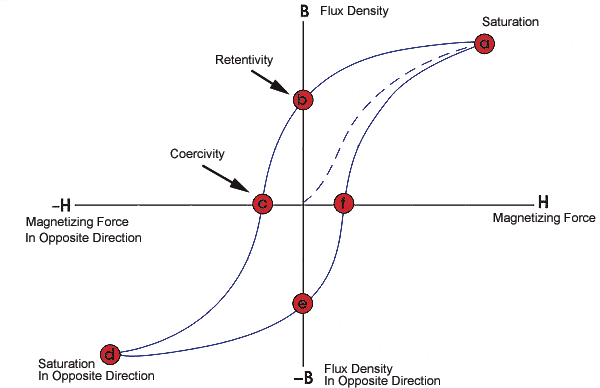
The graph [this is just one I got off the internet, not the actual one] shows the experimentally measured relationship between H and B as the material is first magnetized along the dotted curve to point a, then taken around the hysteresis loop. Given that R = 0.2m and r=0.02m estimate the energy needed to magnetize the material and the energy needed to take the material around the hysteresis loop. (on the actual graph, H stays between +-5*10^4 Am^-1 and B stays between 1.5 and -1.5 T) [7 marks]

Homework Equations


Maxwell's equations, \frac{B}{\mu_{0}} = H + M, M=\chi H change in stored energy = H.dB

The Attempt at a Solution


(a) \nabla\times H = J_{free}(because\epsilon_{0} \partial D/\partial t = 0)
\int H.dl = \int J.dA
H.2\pi R = NI
H=\frac{NI}{2\pi R}
B=\mu_{0}(1+\chi)H
B=\mu_{0}(1+\chi)\frac{NI}{2\pi R}
Is that OK?

(b)This is where I get stuck. I'm just not sure how it works. Is that curve parameterised by time, or not? I.e, does the system move round the curve automatically once you switch on the current (and have moved it from its equilibrium position) because of the magnetization (if so how?), in the way that a pendulum tries to get to it's equilibrium position, or do you have to adjust the current (or something else?) to change the applied magnetic field, and when you do you find that it moves around that curve? And how do I get from there to the energy required?
 
Last edited:
Physics news on Phys.org
You can't use the susceptiblity in ferromagnetism.
The energy is given by \integral H.dB, the area under the hysteresis curve.
 
Thanks for the reply. Why can I not use susceptibility? I can't think why they would have given it to me otherwise... And would I want to find an equation for B in terms of H, and integrate that, or do I just work out the area approximately by looking at the graph? I would have thought that wouldn't be very accurate...
 
The ratio B/H is different for every point on the curve.
The susceptibility was given only for part a.
There is no equation for the curve since it is different for different materials.
You do have to just find the appropriate area.
 

Similar threads

Replies
3
Views
4K
  • · Replies 9 ·
Replies
9
Views
4K
  • · Replies 22 ·
Replies
22
Views
5K
  • · Replies 1 ·
Replies
1
Views
6K
Replies
1
Views
2K
  • · Replies 1 ·
Replies
1
Views
9K
  • · Replies 7 ·
Replies
7
Views
2K
  • · Replies 6 ·
Replies
6
Views
4K
Replies
7
Views
2K
  • · Replies 17 ·
Replies
17
Views
2K