How can I calculate the length and angle of a tube bend using only a calculator?

  • Level: High School 
  • Thread starter Thread starter Good4you
  • Start date Start date
  • Tags Tags
    Bending Tube
Join the discussion
Registration is free. Start your own thread to ask a follow-up.
7 replies · 7K views
Good4you
Messages
37
Reaction score
0
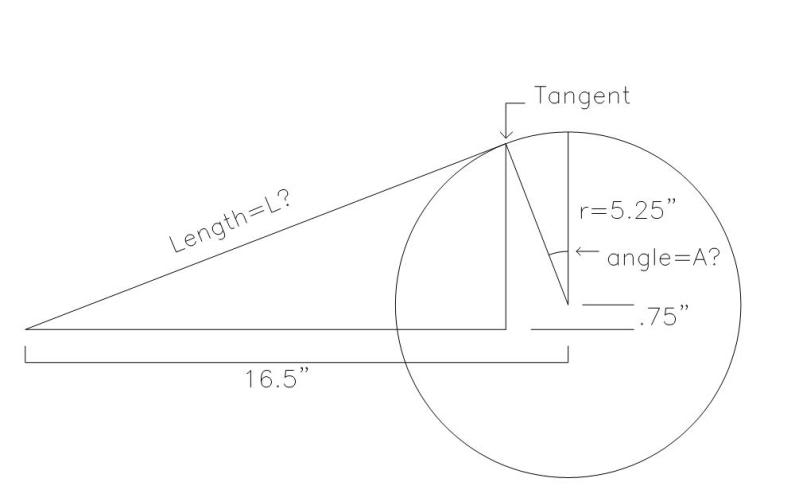
I guess it has been too long since i have had to use any math beyond arithmetic. I am working on fabricating some tube work, and these similar shapes keep coming up. I keep thinking i can calculate them out, but for some reason i always get stumped and feel like i am missing some information. I know this should be easy and the information must be there because i can draw the darn thing in cad. But when working in the garage i do not always have access to a computer, and would like to be able to do these calculations with just a calculator.

Can someone help me find the length, and angle below.
tangent.jpg
 
Mathematics news on Phys.org
arg, figured it out, it was easy:
L=((.75^2+16.5^2)-5.25^2)^.5

A=Tan^-1(.75/16.5)+tan^-1(5.25/(.75^2+16.5^2)^.5)
 
Your formula for the angle is wrong, it should be:

[tex]sin(A)=\frac{rd+\sqrt{d^2+h^2-r^2}}{d^2+h^2}[/tex]

where

[tex]d=16.5[/tex]

[tex]h=0.75[/tex]
 
Mentallic, can you please explain how you got that result?
 
Certainly, but before I show you, I should fix up my little typo :redface:

[tex]L=\sqrt{d^2+h^2-r^2}[/tex]

[tex]sin(A)=\frac{rd+h\sqrt{d^2+h^2-r^2}}{d^2+h^2}[/tex]

We will let the bottom side of that big triangle with hypotenuse [itex]L[/itex] be [itex]m[/itex], so the little distance between the centre of the circle and the side of that triangle is [itex]d-m[/itex].

[tex]d-m=rsinA[/tex], you can probably figure why this is so for yourself.

There are two parallel lines that are vertical, the radius and the side of that triangle. So the angle between the side of the triangle and the other radius connecting it is A. Also, with a big of filling in angles, the very left point on the triangle subtends an angle A too.

So, [tex]cosA=\frac{m}{L}[/tex] in that big triangle.

Combining these two equations by eliminating m, [tex]LcosA=d-rsinA[/tex]

Now for some algebra:

[tex]L\sqrt{1-sin^2A}=d-rsinA[/tex]

[tex]L^2(1-sin^2A)=d^2-2drsinA+r^2sin^2A[/tex]

[tex]L^2sin^2A+r^2sin^2A-2drsinA-L^2+d^2=0[/tex]

[tex]\left(L^2+r^2\right)sin^2A+\left(-2dr\right)sinA+\left(d^2-L^2\right)=0[/tex]

I put them all in brackets to easily notice that the quadratic formula is going to be used here.

[tex]sinA=\frac{2dr\pm\sqrt{4d^2r^2-4(L^2+r^2)(d^2-L^2)}}{2(L^2+r^2)}[/tex]

substituting [tex]L^2=d^2+h^2-r^2[/tex]

[tex]sinA=\frac{2dr\pm\sqrt{4d^2r^2-4(d^2+h^2)(-h^2+r^2)}}{2(d^2+h^2)}[/tex]

[tex]sinA=\frac{2dr\pm\sqrt{4d^2r^2+4d^h^2-4d^2r^2+4h^4-4h^2r^2}}{2(d^2+h^2)}[/tex]

[tex]sinA=\frac{2dr\pm\sqrt{4h^2(d^2+h^2-r^2)}}{2(d^2+h^2)}[/tex]

[tex]sinA=\frac{dr\pm h\sqrt{d^2+h^2-r^2}}{d^2+h^2}[/tex]

Now to figure out which solution is correct, the plus of minus, I just used simple numbers for d, h and r and found which fits the problem. If anyone could think of a more elegant way I would like to hear about it.

Just as a notice, if you use some random numbers to try, the problem cannot be physically made if [tex]d^2+h^2-r^2<0[/tex] or, [tex]r>\sqrt{d^2+h^2}[/tex] since it is not possible for the length between the centre of the circle and the end point of the triangle to be shorter than the radius, else the end point of the triangle will somehow be in the circle :smile:

So finally, [tex]sinA=\frac{rd+h\sqrt{L}}{d^2+h^2}[/tex]
 
Last edited:
hmm. interesting, that works too.
My equation had a typo as well, let's try again.

A=Tan^-1(Y/X)+sin^-1(R/(Y^2+X^2)^.5)
X=16.5
Y=.75
The Tan portion of the equation is for the leftmost angle of the red triangle, and the sin portion is for the leftmost angle of the blue triangle, also assuming the hypotenuse of each triangle is equal to each other.

Red angle plus blue angle (tan +sin) gives you the angle of the "L" leg to the horizontal; which is also equal to A.


xyr.jpg
 
Ahh nice, I like your solution :smile:
The restriction that [tex]d^2+h^2-r^2\geq 0[/tex] is also present in a slightly different form in yours.

For [tex]sin^{-1}x[/tex] to exist, [tex]-1\leq x\leq 1[/tex]

Going from the restriction, [tex]r^2\leq d^2+h^2[/tex]

[tex]\frac{r^2}{d^2+h^2}\leq 1[/tex]

[tex]-1\leq \frac{r}{\sqrt{d^2+h^2}}\leq 1[/tex]

which is what you'll find in your arcsin portion of the answer.