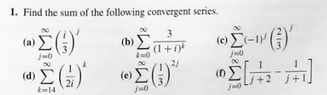
How can I solve power series questions 1a, 1c, and 1f?

  • Context: MHB 
  • Thread starter Thread starter nacho-man
  • Start date Start date
Click For Summary
SUMMARY

The discussion focuses on solving power series questions 1a, 1c, and 1f, specifically involving complex numbers and geometric series. For question 1a, the series $\displaystyle\sum_{j=0}^{\infty} \left(\frac{i}{3}\right)^j$ is identified as geometric with a sum of $\frac{1}{1-\frac{i}{3}}$, which simplifies to $\frac{9+3i}{10}$. Question 1c is rewritten as $\displaystyle\sum_{j=0}^{\infty}\left(-\frac{2}{3}\right)^j$, while question 1f is recognized as a telescoping sum, leading to a limit evaluation. The use of the power series formula $\frac{1}{1-z} = \sum_{k=0}^{\infty}z^k$ is crucial for these calculations.

PREREQUISITES
  • Understanding of geometric series and convergence criteria
  • Familiarity with complex numbers and their properties
  • Knowledge of power series and their summation techniques
  • Ability to manipulate algebraic expressions involving complex numbers
NEXT STEPS
  • Study the properties of geometric series and their convergence
  • Learn about complex number manipulation and conjugates
  • Explore telescoping series and their applications in calculus
  • Review the derivation and application of the power series formula $\frac{1}{1-z} = \sum_{k=0}^{\infty}z^k$
USEFUL FOR

Students and educators in mathematics, particularly those focusing on calculus and complex analysis, will benefit from this discussion. It is especially relevant for anyone tackling power series and their applications in problem-solving.

nacho-man
Messages
166
Reaction score
0
Please refer to the attached image.

How do I do these questions, In particular
1a, 1c and 1f.

Could anyone give me a hint to get me started with either of these?

Thanks.
 

Attachments

  • q3.png
    q3.png
    13.8 KB · Views: 106
Physics news on Phys.org
nacho said:
Please refer to the attached image.

How do I do these questions, In particular
1a, 1c and 1f.

Could anyone give me a hint to get me started with either of these?

Thanks.

Don't let the $i$'s get to you! For instance, in 1(a), $\displaystyle\sum_{j=0}^{\infty} \left(\frac{i}{3}\right)^j$ is geometric since $\left|\dfrac{i}{3}\right| = \dfrac{|i|}{3} = \dfrac{1}{3} < 1$.

Note that you can rewrite 1(c) as $\displaystyle\sum_{j=0}^{\infty}\left(-\frac{2}{3}\right)^j$.

Note that 1(f) is a telescoping sum; with that said, we see that

\[\sum_{j=0}^{\infty} \left[\frac{1}{j+2} - \frac{1}{j+1}\right] = \lim_{n\to\infty} \sum_{j=0}^n \left[\frac{1}{j+2} - \frac{1}{j+1}\right] = \ldots\]
 
Thanks for that.

Although, for
1a) it says that the sum of the series is
$\frac{1}{1-\frac{i}{3}}$ $ = $ $\frac{9+3i}{10}$

Why is this? I am unsure how they get to the first term of $\frac{1}{1-\frac{i}{3}}$
 
nacho said:
Thanks for that.

Although, for
1a) it says that the sum of the series is
$\frac{1}{1-\frac{i}{3}}$ $ = $ $\frac{9+3i}{10}$

Why is this? I am unsure how they get to the first term of $\frac{1}{1-\frac{i}{3}}$

Note that

\[\frac{1}{1-\dfrac{i}{3}} = \frac{3}{3\left(1-\dfrac{i}{3}\right)} = \frac{3}{3-i}\]

Now conjugate and you'll get the desired result.
 
Chris L T521 said:
Note that

\[\frac{1}{1-\dfrac{i}{3}} = \frac{3}{3\left(1-\dfrac{i}{3}\right)} = \frac{3}{3-i}\]

Now conjugate and you'll get the desired result.

this i understood,
what i did not know was how they arrived at the sum being equal to
$\frac{1}{1-\dfrac{i}{3}}$
 
Use that power series

$$\frac{1}{1-z} = \sum_{k=0}^{\infty}z^k \,\,\,\,\,\,\, |z|<1$$
 
ZaidAlyafey said:
Use that power series

$$\frac{1}{1-z} = \sum_{k=0}^{\infty}z^k \,\,\,\,\,\,\, |z|<1$$

thanks!
 

Similar threads

  • · Replies 8 ·
Replies
8
Views
4K
  • · Replies 2 ·
Replies
2
Views
1K
  • · Replies 2 ·
Replies
2
Views
2K
Replies
3
Views
2K
  • · Replies 11 ·
Replies
11
Views
1K
  • · Replies 1 ·
Replies
1
Views
2K
  • · Replies 3 ·
Replies
3
Views
2K
  • · Replies 5 ·
Replies
5
Views
4K
  • · Replies 7 ·
Replies
7
Views
2K
  • · Replies 5 ·
Replies
5
Views
3K