Discussion Overview
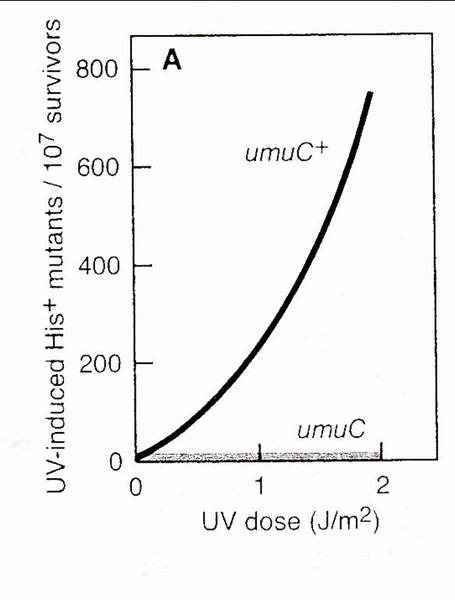
The discussion revolves around the methodology for measuring total cell counts and determining the number of His+ revertant colonies in a bacterial genetics experiment. Participants explore the experimental design, including dilution factors and plating techniques, to understand how to arrive at the figure of 10^7 survivors.
Discussion Character
- Exploratory
- Technical explanation
- Debate/contested
- Mathematical reasoning
Main Points Raised
- Some participants suggest that to measure His+ revertants, it is necessary to plate the same concentration of cells used to measure total cell count.
- One participant proposes that the total cell number is determined by starting with a large number of cells, such as 1*10^14, and applying a mutagenesis treatment.
- Another participant questions how every time point could consistently show 10^7 survivors, suggesting a calculation involving the ratio of mutants to survivors.
- There is a discussion about the need for a survival plate (min+his) to measure total survival before replica plating onto a mutant plate (min-his) to ensure that mutants originated from survivors.
- Some participants express confusion about the lack of context provided for the experiment and the necessity of dilutions to achieve countable colony numbers.
- One participant argues against the need for replica plating, suggesting that dilutions are sufficient for measuring small frequencies of revertants.
Areas of Agreement / Disagreement
Participants express differing views on the methodology for measuring total cells and revertants, with no consensus reached on the best approach or the initial total cell count. The discussion remains unresolved regarding the specific experimental design and calculations.
Contextual Notes
Participants note the absence of detailed experimental context, including specific time points and the exact methodology used for measuring cell counts. There are also unresolved questions about the assumptions underlying the calculations presented.