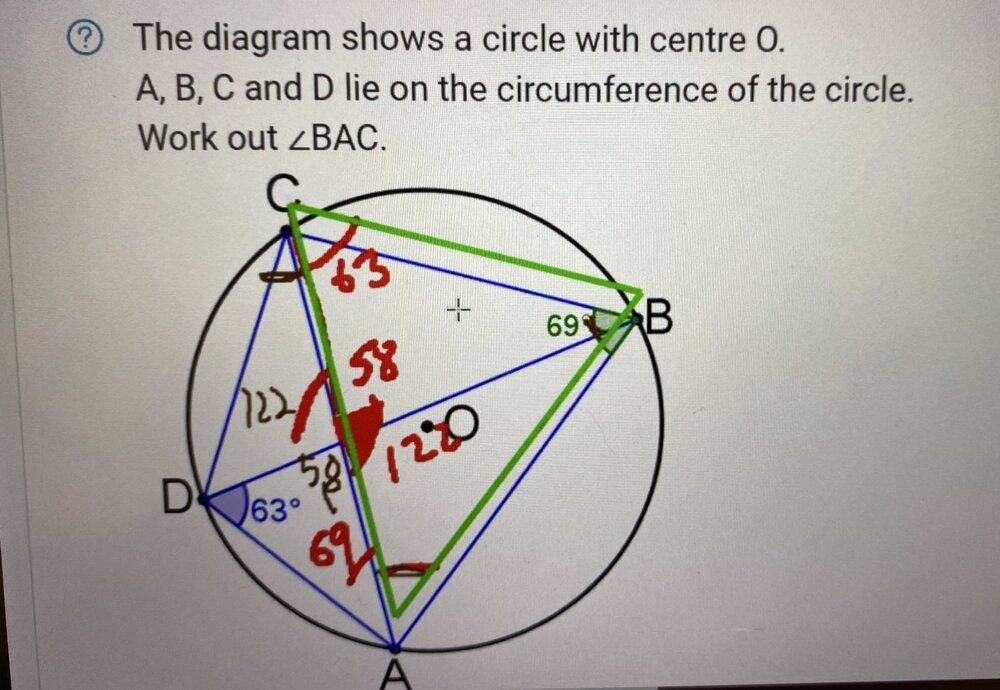
How Do I Calculate Angle BAC if Angle CBA is 69 Degrees?

  • Thread starter Thread starter Natasha1
  • Start date Start date
  • Tags Tags
    Angle
Click For Summary
SUMMARY

The calculation of angle BAC, given that angle CBA is 69 degrees, results in an angle measurement of 48 degrees. This conclusion is drawn from the inscribed angle theorem and the properties of quadrilaterals inscribed in a circle, where the sum of opposite angles equals 180 degrees. The confusion in the discussion arises from the misinterpretation of angle markings, particularly the distinction between angles CBA and CBD. Ultimately, the correct identification of angles leads to the accurate calculation of BAC.

PREREQUISITES
  • Understanding of the inscribed angle theorem
  • Knowledge of properties of quadrilaterals inscribed in a circle
  • Familiarity with angle relationships in geometric figures
  • Ability to interpret geometric diagrams accurately
NEXT STEPS
  • Study the inscribed angle theorem in detail
  • Explore properties of cyclic quadrilaterals
  • Practice solving for unknown angles in various geometric configurations
  • Learn about the implications of angle relationships in triangle geometry
USEFUL FOR

Students studying geometry, educators teaching geometric principles, and anyone interested in mastering angle calculations in circular and triangular configurations.

Natasha1
Messages
494
Reaction score
9
Homework Statement
The diagram shows a circle with centre O.
Relevant Equations
A, B, C and D lie on the circumference of the circle. Work out angle BAC
Please see attached drawing which I have written my work (in colour).

Despite spending 1h on it I still can’t understand how to find angle BAC.

776B6095-1913-4498-8E36-8FE05139D586.jpeg
 
Last edited by a moderator:
Physics news on Phys.org
I found it! It’s 48 degrees
 
1) For a quadrilateral inscribed in a circle, the sum of opposite angles equals to 180 degrees.
2) Inscribed angle theorem
 
  • Like
Likes   Reactions: Delta2
Natasha1 said:
I found it! It’s 48 degrees
In that case BD would be parallel to BA which it is plainly not. There is a 48 degree angle where you've marked 58. I'm not sure we can solve for BAC since chord DA's length can be shrunk or stretched without materially affecting the rest of the given geometry. Sum of angles BAC and ABD should be 48 by exterior angle thm.
 
Last edited:
neilparker62 said:
I'm not sure we can solve for BAC since chord DA's length can be shrunk or stretched without materially affecting the rest of the given geometry.
Not by moving A because that would change ABC, and if you move D then BAC doesn't change anyway.
neilparker62 said:
In that case BD would be parallel to BA

How do you deduce that? I agree with 48 degrees.
 
Maybe I am misinterpreting the marked angles ? Why has the OP marked 58 degrees when the other 2 angles in the triangle are 63 and 69 degrees. I think the confusion arises because I thought (and it looks like the OP also initially thought) that the measure of angle CBD was 69 degrees. But now I see it's CBA which is 69 degrees. Then the 48 degree answer makes sense.

If a person thought CBD was 69 degrees, he/she would also mark CAD as 69 degrees as appears to be the case.
 
Last edited:
neilparker62 said:
it's CBA which is 69 degrees
Yes.
 

Similar threads

  • · Replies 9 ·
Replies
9
Views
4K
  • · Replies 13 ·
Replies
13
Views
3K
  • · Replies 15 ·
Replies
15
Views
1K
  • · Replies 4 ·
Replies
4
Views
3K
  • · Replies 5 ·
Replies
5
Views
2K
  • · Replies 2 ·
Replies
2
Views
4K
Replies
1
Views
2K
  • · Replies 22 ·
Replies
22
Views
4K
  • · Replies 5 ·
Replies
5
Views
3K
Replies
6
Views
2K