How do I factorise polynomials using a new method?

  • Context: Undergrad 
  • Thread starter Thread starter Hawksteinman
  • Start date Start date
  • Tags Tags
    Polynomial
Click For Summary

Discussion Overview

The discussion revolves around the factorization of polynomials, specifically using a method that involves substitution and multiplication by coefficients. Participants are exploring the validity and application of this method in the context of their mathematics coursework.

Discussion Character

  • Exploratory
  • Technical explanation
  • Debate/contested
  • Mathematical reasoning

Main Points Raised

  • One participant expresses uncertainty about their factorization method, having not used it before and referencing a workbook example.
  • Several participants comment on the readability of an image shared, questioning the clarity of the mathematical expressions presented.
  • Some participants argue that the initial multiplication by the coefficient is unnecessary and complicates the factorization process.
  • Another participant suggests a substitution method involving multiplying the polynomial by the coefficient of the leading term, followed by substitution with a new variable.
  • There is a discussion about the implications of multiplying and then dividing by the same coefficient, with some participants questioning its utility in this context.
  • One participant asserts that the substitution method can reduce complexity, while others challenge the necessity of this approach for the problem at hand.
  • There are repeated assertions that the factorization presented in the image is incorrect, with alternative factorizations proposed.

Areas of Agreement / Disagreement

Participants do not reach a consensus on the validity of the proposed factorization method or the necessity of the initial multiplication step. Multiple competing views remain regarding the best approach to factorizing the polynomial.

Contextual Notes

Some participants highlight the limitations of the shared image, noting that it affects the clarity of the discussion. There are also unresolved questions about the mathematical steps involved in the proposed methods.

Hawksteinman
Messages
59
Reaction score
23
As part of my degree in physics with Astrophysics, I have to do some maths modules. In the maths lectures, the lecturer just goes though a giant 212 page work booklet explaining everything as she goes along. Me and a friend only do the work booklet in the lectures and we're already on page 33 while everyone else is on page 14.

I am not sure if I have done these questions correctly (page 21), because I've never used this method of factorising polynomials before (there was an example of how to do it in the workbook)
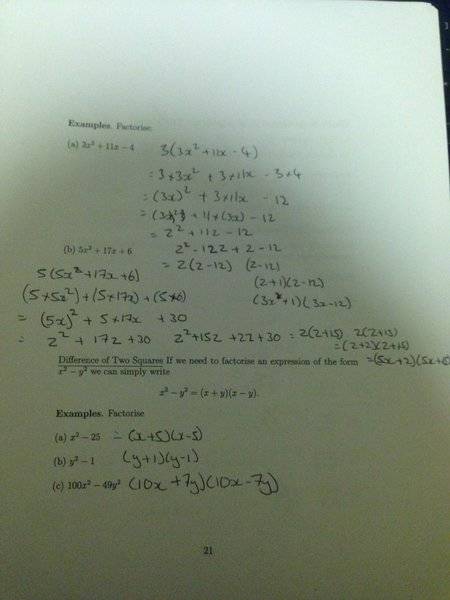
IMG_0526.JPG
 
Mathematics news on Phys.org
PS that's a z I'm using as another variable :o
 
The image is very hard to read. The bottom 3 lines look OK, but I can't decipher the rest.
 
  • Like
Likes   Reactions: sirios
Very hard to read!
Does the first one read ##3x^2+11x-4##?
If so your factorization is incorrect.
3 is not a GCF of the trinomial and you would have to look at the factors of ##3x^2## and ##-4##.
You can check the solution by FOILing it back into the original expression.
 
DS2C said:
Very hard to read!
Does the first one read ##3x^2+11x-4##?
If so your factorization is incorrect.
3 is not a GCF of the trinomial and you would have to look at the factors of ##3x^2## and ##-4##.
You can check the solution by FOILing it back into the original expression.

It is, but I was using the method we were told to use where you multiply the whole expression by the coefficient :/
 
You are probably in a higher math than I, but we are doing factorization right now.
As a helpful guide, here's a pic of my notes that relates to the first problem. Try and apply them to your first problem. Hopefully they're legible enough.
 

Attachments

  • IMG_3808.JPG
    IMG_3808.JPG
    27.8 KB · Views: 587
Last edited by a moderator:
  • Like
Likes   Reactions: Hawksteinman
I'd say, the method you are trying to apply is a kind of substitution. You first multiply the polynomial with the coefficient of the ##x^2## term, so you get:
##(5x)^2+17\cdot(5x)+30##
Now substitute a new variable, say u, for 5x
##u^2+17u+30##
Factorise by educated guessing (the product of the two numbers must be 30, the sum must be 17) :
##(u+2)(u+15)##
Substitute the 5x back:
##(5x+2)(5x+15)##
Factorise the second parenthesis:
##(5x+2)(x+3)\cdot5##
Discard the factor 5 and you are left with the solution:
##(5x+2)(x+3)##
 
  • Like
Likes   Reactions: Hawksteinman
Two things:
  1. The image is extremely difficult to read. If you are going to post an image (which is generally frowned on here because so many of them are just as unreadable as yours), at least make sure that the work is properly lit before taking a photo.
  2. What did you multiply by 3 right away? That makes no sense. The factorization problem you posted can be done in two lines:
    ##3x^2 + 11x - 4##
    ##= (3x - 1)(x + 4)## Done.
Everything you have in the photo can be done using either BBCode or (better) LaTeX. We have tutorials on each of these. On the menu bar across the top, one of the choices is INFO. Under this item is a drop -down menu with a choice of Help/How-to. The BBCode and LaTeX tutorials are listed under this menu choice.

Finally, I moved your thread to General Math, as it had nothing to do with Linear Algebra or Abstract Algebra.
 
Hawksteinman said:
It is, but I was using the method we were told to use where you multiply the whole expression by the coefficient :/
If you have something like ##3(x^2+4x-5)##, sure, but you don't have that.
What you could do here would be ##3x^2 +11 x -4=3\left(x^2+ \frac{11}{3} x - \frac{4}{3}\right)##, but that doesn't help.

You can't just multiply the expression by 3, that changes its value (instead of just how it is presented).
 
  • #10
mfb said:
If you have something like ##3(x^2+4x-5)##, sure, but you don't have that.
What you could do here would be ##3x^2 +11 x -4=3\left(x^2+ \frac{11}{3} x - \frac{4}{3}\right)##, but that doesn't help.

You can't just multiply the expression by 3, that changes its value (instead of just how it is presented).

Yes and you divide it by three again at the end :)
 
  • #11
Hawksteinman said:
Yes and you divide it by three again at the end :)
Seems like wasted effort if you multiply by 3 in the beginning, and then divide by 3 at the end. This might be useful to do if there was a point to it, but here there isn't.
 
  • #12
Mark44 said:
Seems like wasted effort if you multiply by 3 in the beginning, and then divide by 3 at the end. This might be useful to do if there was a point to it, but here there isn't.

Of course there is. It is done in order to substitute 3x with another variable, which reduces the complexity of the original term. A substititution/back-substitution method as used for similar purposes elsewhere... maybe not really needed for this kind of problem, I agree, but usefull still.
 
  • #13
I don't see the point, but then you still need to keep the factor 1/3 in the equation. Otherwise it is not an equation any more. You can't just say "5=3*5" because you want a factor 3, and what was done here is equivalent.
 
  • #14
That's why one has to divide by 3 in the end. See my post #7.
 
  • #15
mathman said:
The image is very hard to read. The bottom 3 lines look OK, but I can't decipher the rest.
I agree
 
  • #16
bluenoise said:
That's why one has to divide by 3 in the end. See my post #7.
5=3*5 doesn't get right just because you write 3*5=5 somewhere later (which is wrong as well).
You can write 5=1/3 * 3 * 5 = 1/3 * (whatever) = ... = 5, that is correct.
 

Similar threads

  • · Replies 3 ·
Replies
3
Views
2K
  • · Replies 6 ·
Replies
6
Views
2K
  • · Replies 2 ·
Replies
2
Views
3K
  • · Replies 2 ·
Replies
2
Views
2K
Replies
2
Views
1K
  • · Replies 5 ·
Replies
5
Views
2K
  • Sticky
  • · Replies 0 ·
Replies
0
Views
5K
  • · Replies 20 ·
Replies
20
Views
5K
  • · Replies 13 ·
Replies
13
Views
3K
  • · Replies 2 ·
Replies
2
Views
2K