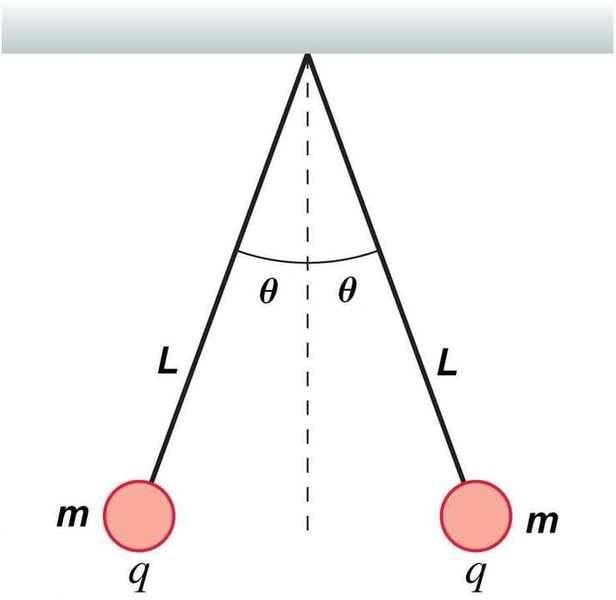
How do I find Q without having a distance r?

  • Thread starter Thread starter BuBbLeS01
  • Start date Start date
Join the discussion
Registration is free. Ask a follow-up in this thread, or start your own.
14 replies · 6K views
BuBbLeS01
Messages
602
Reaction score
0
Charges...please help!

Homework Statement


8ayuy3l.jpg


Two 3.52 g point charges on 7.49-m-long threads repel each other after being equally charged. What is the charge q? (θ=31°.)


Homework Equations


F = KQQ/R^2


The Attempt at a Solution


How do I find Q without having a distance r?
 
Physics news on Phys.org
BuBbLeS01 said:
How do I find Q without having a distance r?
You are given the thread length and the angle--use that to figure out the distance.
 
Oh yea...so the length from the center to one of the masses is 3.858 m.
So I can do...
F = K*Q*Q/r^2
F = K*Q^2/ r^2
An wouldn't F = 0 since they cancel each other out?
 
Since the masses are in equilibrium, the net force on each is zero. What forces act on each mass?
 
BuBbLeS01 said:
Tension
That's one force. List them all. (And draw yourself a free body diagram showing how the force act on each mass.)
 
Tension and weight are the forces
 
So do I include the electric force? Like...
T - W + Fel = 0
 
BuBbLeS01 said:
Tension and weight are the forces
Don't forget the electrostatic force!
 
BuBbLeS01 said:
So do I include the electric force? Like...
T - W + Fel = 0
Yes, but realize that forces are vectors--direction counts. Set up two equations: One for the horizontal components, one for the vertical components. Combine these to solve for the charge.
 
X.) TSINθ + qE = 0
y.) TCOSθ - mg = 0

T = mg/COSθ
mg/COSθ * SINθ + qE
q = -mg*TANθ/E
 
BuBbLeS01 said:
X.) TSINθ + qE = 0
y.) TCOSθ - mg = 0
I'd write that first equation as:
Tsinθ - qE = 0 (since the force components are in opposite directions)

Realize that E is also a function of q, so rewrite that in terms of k, q, and r (which you figured out).

Otherwise, you are on the right track.
 
Okay so I end up with...
-q = -(mg*tanθ) / (kq/r^2)
q = (mg*tanθ) / (kq/r^2)
and the q's cancel?
= (mg*tanθ) / (k/r^2)
 
BuBbLeS01 said:
Okay so I end up with...
-q = -(mg*tanθ) / (kq/r^2)
q = (mg*tanθ) / (kq/r^2)
and the q's cancel?
The q's don't cancel. And when you divide by a fraction, simplify the result. (Invert and multiply.)