How Do Planetary Distances Influence Retrograde Motion Durations?

Click For Summary
The discussion focuses on the mathematical relationship between planetary distances from the Sun and the duration of retrograde motion for outer planets. Retrograde motion occurs only for planets beyond Earth, and the participants explore how to model this using orbital geometry and velocities. They emphasize the need to calculate the angle of the planet's position over time and differentiate this to find when the motion is negative. The conversation includes references to angular velocity and the gravitational constant as part of the calculations. Ultimately, the participants aim to derive an equation that accurately represents the retrograde motion duration based on these factors.
RingNebula57
Messages
56
Reaction score
2
How can we relate mathematically the time interval in which a planet is in retrograde motion and the devided distances from the sun of the planets ?

My first drawing was this:
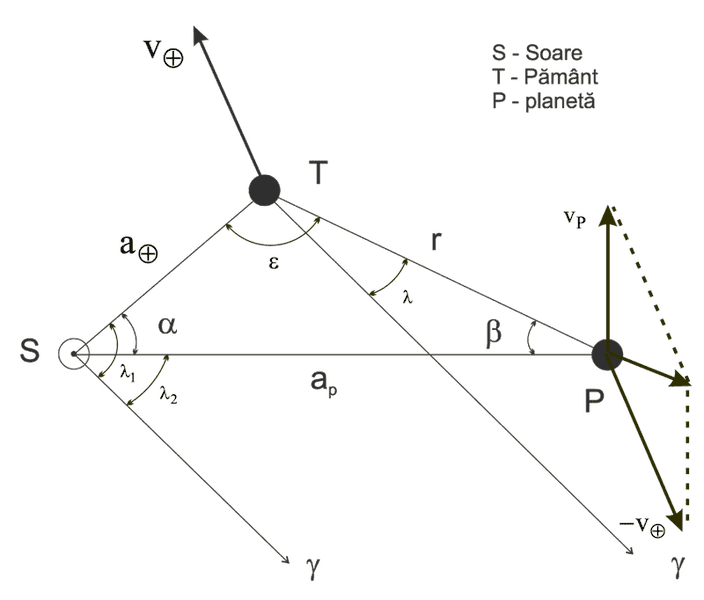
nothing.png
Where S is thee sun , P is the planet, T si the Earth. The v's are the corespondent speeds

If we take a look at it we can say that:r x cos(lambda)= ap x cos(labda2) - ao x cos(lambda1) , same for sine

What next?

Oh, and gamma is the vernal point
 
Astronomy news on Phys.org
It seems complicated. Here's what I understand from your question (correct me if I am wrong):

You are looking for the time interval in which the planet is in retrograde motion (let's call it ##t_\text{retro}##). Retrograde motion only happens for planets farther than Earth, from the Sun. The information you have is the distances of the planets from the Sun.

Now, will you consider your orbits to be perfectly circular, each planet has a constant velocity?
 
Here's a youtube for an animation I whipped up to show just what you are up against.


You are basically looking for the period during which the white dot moves backward. First you are going to have to work out the geometry that give you the angle the position(as an angle) of the white dot for any given positions of the Earth and the outer planet. Then you have to incorporate how these positions change with time ( using the orbital velocities of both to work out how the position of the white dot change with time. And once you get an equation that represents that, you will need to differentiate it to find the rate at which the position of the white dot changes with time, and then from this determine for how much of one cycle this value is negative.

I'll start you off with one hint. The angular velocity of either planet (in radian/sec) will be equal to

\omega = \sqrt{\frac{GM}{r^3}}

where G is the gravitational constant, M is the mass of the Sun and r is the radius of the planet's orbit.
 
  • Like
Likes RingNebula57
RingNebula57 said:
How can we relate mathematically the time interval in which a planet is in retrograde motion and the devided distances from the sun of the planets ?

My first drawing was this:
View attachment 84870 Where S is thee sun , P is the planet, T si the Earth. The v's are the corespondent speeds

If we take a look at it we can say that:r x cos(lambda)= ap x cos(labda2) - ao x cos(lambda1) , same for sine

What next?
ecastro said:
It seems complicated. Here's what I understand from your question (correct me if I am wrong):

You are looking for the time interval in which the planet is in retrograde motion (let's call it ##t_\text{retro}##). Retrograde motion only happens for planets farther than Earth, from the Sun. The information you have is the distances of the planets from the Sun.

Now, will you consider your orbits to be perfectly circular, each planet has a constant velocity?
ecastro said:
It seems complicated. Here's what I understand from your question (correct me if I am wrong):

You are looking for the time interval in which the planet is in retrograde motion (let's call it ##t_\text{retro}##). Retrograde motion only happens for planets farther than Earth, from the Sun. The information you have is the distances of the planets from the Sun.

Now, will you consider your orbits to be perfectly circular, each planet has a constant velocity?
ecastro said:
It seems complicated. Here's what I understand from your question (correct me if I am wrong):

You are looking for the time interval in which the planet is in retrograde motion (let's call it ##t_\text{retro}##). Retrograde motion only happens for planets farther than Earth, from the Sun. The information you have is the distances of the planets from the Sun.

Now, will you consider your orbits to be perfectly circular, each planet has a constant velocity?
Yes, they are circular, but anyway , I figured it out... You have to extract "d" from one equation in terms of the lambda's and the central distances, plug it in the other, differentiate the equation with dt. The condition at start and end of retrograde motion is d(lambda)/dt=0 , so notating d(lambda2)/dt and d(lambda1)/dt with the angular speeds omega1 and omega2 one can calculate and obtain the needed answer
 
  • Like
Likes ecastro
Hi, I saw someone with an avatar on a different forum that turns out to be the sombrero galaxy. AI says, too distant to know much about, aside from billions of starts, potentially tons of planets, and a supermassive black hole in the center. I find that setup fascinating, despite knowing close to nothing about the universe. So I ask: could anyone point me in the direction of, or provide information about this galaxy? I do not trust AI beyond general information, and I like to go pretty...

Similar threads

Replies
3
Views
3K
  • · Replies 0 ·
Replies
0
Views
5K
  • · Replies 3 ·
Replies
3
Views
8K