How Do Probability Formulas for Bayes Theorem and Exponential Distribution Work?

  • Context:
  • Thread starter Thread starter Longines
  • Start date Start date
  • Tags Tags
    Parameters
Join the discussion
Ask a follow-up here, or get your own question answered by working scientists, mathematicians and engineers — people, not an autocomplete.
Real named experts · corrections over time · the nuance an AI answer skips
2 replies · 1K views
Longines
Messages
9
Reaction score
0
Hey guys,

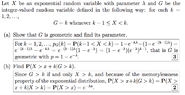
I don't understand how this question works... I don't understand the answers either. Could someone take me through this step-by-step?

See attached image:
 

Attachments

  • Screenshot 2014-09-20 20.20.08.png
    Screenshot 2014-09-20 20.20.08.png
    39.1 KB · Views: 118
Physics news on Phys.org
Longines said:
Hey guys,

I don't understand how this question works... I don't understand the answers either. Could someone take me through this step-by-step?

See attached image:

a) is...

$\displaystyle P \{ G = k\} = \int_{k-1}^{k} e^{- \lambda\ x}\ d x = e^{\lambda\ k} (e^{\lambda} - 1)\ (1)$

b) for the Bayes theorem is...

$\displaystyle P\{X > k + x| G > k \} = \frac{P \{ X > k + x \}}{P\{X>k \}} = \frac{e^{- \lambda\ (k + x)}}{e^{- \lambda\ k}} = e^{- \lambda\ x}\ (2) $

Kind regards

$\chi$ $\sigma$
 
chisigma said:
a) is...

$\displaystyle P \{ G = k\} = \int_{k-1}^{k} e^{- \lambda\ x}\ d x = e^{\lambda\ k} (e^{\lambda} - 1)\ (1)$

b) for the Bayes theorem is...

$\displaystyle P\{X > k + x| G > k \} = \frac{P \{ X > k + x \}}{P\{X>k \}} = \frac{e^{- \lambda\ (k + x)}}{e^{- \lambda\ k}} = e^{- \lambda\ x}\ (2) $

Kind regards

$\chi$ $\sigma$
Lol... once again, a simple step that I did not see.

Thank you