How Do Pulley Systems Affect the Force Needed to Lift Weights?

  • Thread starter Thread starter ciubba
  • Start date Start date
  • Tags Tags
    Conceptual Pulley
Join the discussion
Ask a follow-up here, or get your own question answered by working scientists, mathematicians and engineers — people, not an autocomplete.
Real named experts · corrections over time · the nuance an AI answer skips
1 reply · 5K views
ciubba
Messages
65
Reaction score
2
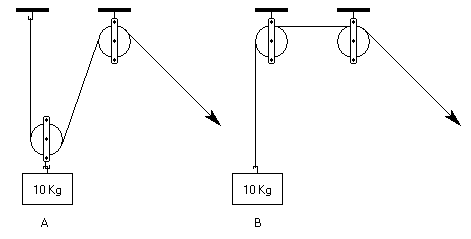
I am having trouble understanding the distribution of forces present within a pulley system; namely, how the number of sections of rope that supports an item manages to decrease the force necessary to move it.

For example, look at this picture
AA0809.gif


I am aware that system A only requires 5 kg force to elevate while system B requires a 10 kg force; that being said, I do not understand why that is true.

AA0808.gif


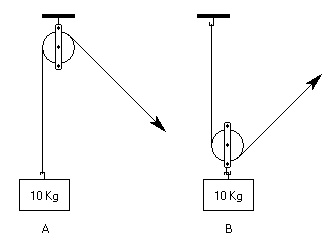
In this picture, it would appear that both weights are supported by the same number of rope-sections, yet B requires less force to elevate.
 
Physics news on Phys.org
ciubba said:
I am having trouble understanding the distribution of forces present within a pulley system; namely, how the number of sections of rope that supports an item manages to decrease the force necessary to move it.

For example, look at this picture

AA0809.gif


I am aware that system A only requires 5 kg force to elevate while system B requires a 10 kg force; that being said, I do not understand why that is true.
The amount of force that the ropes exert on the mass depends on the tension in the rope and how many rope segments are pulling up on the mass. In B there is only one segment pulling up on the mass, thus the tension in the rope must equal the weight. In A there are two segments pulling up on the mass, so the amount of tension required is less.


AA0808.gif


In this picture, it would appear that both weights are supported by the same number of rope-sections, yet B requires less force to elevate.
If you draw an imaginary box around the mass (including the attached pulley in B), you'll see that B has two segments pulling up on the mass.