How Do You Calculate the Forces Acting on Grandma and Her Chair?

  • Thread starter Thread starter starprincess
  • Start date Start date
  • Tags Tags
    Force
Click For Summary
SUMMARY

This discussion focuses on calculating the forces acting on Grandma and her chair, specifically addressing problems related to horizontal force, weight, and acceleration. Grandma exerts a horizontal force of 100N on her 700N chair, which has a total weight of 500N. The system accelerates at 0.200 m/s², necessitating the consideration of friction and normal forces. Participants emphasize the importance of using the Pythagorean theorem to determine resultant forces and angles based on scalar components.

PREREQUISITES
  • Understanding of Newton's laws of motion
  • Knowledge of force components and vector addition
  • Familiarity with the Pythagorean theorem
  • Basic concepts of friction and normal force
NEXT STEPS
  • Study Newton's second law of motion in detail
  • Learn how to resolve forces into x and y components
  • Practice problems involving friction and normal forces
  • Explore vector addition techniques for resultant forces
USEFUL FOR

This discussion is beneficial for physics students, educators, and anyone interested in understanding the dynamics of forces in a practical scenario involving motion and friction.

starprincess
Messages
7
Reaction score
0
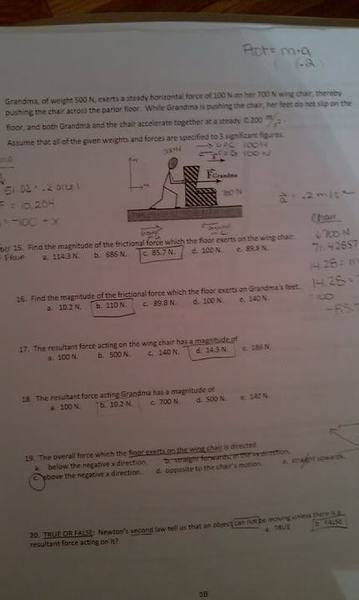
Hello everyone, I am having some trouble with some problems. For the first picture I do not understand how to do #19. Please help me! Thank you!

Homework Statement


Grandma, of weight 500N, exerts a steady horizontal force of 100N on her 700N wing chair, thereby pushing chair across the parlor floor. While Grandma is pushing the chair, her feet do not slip on the floor, and both Grandma and the chair accelerate together at a steady 0.200 m/s^2.
Homework Equations


The Attempt at a Solution


IMAG0126.jpg


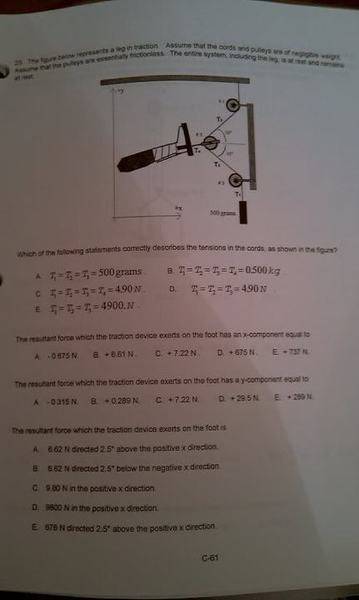
For the second picture, I do not know how to solve the last question on resultant force of the traction device that exerts on the foot. Please refer to picture:
IMAG0125.jpg


For my attempt, I came up with my x and y scalar components and tried adding them but nothing came out to be any of the values. I am just very confused with this problem.
 
Physics news on Phys.org
You're right for 19. There are two forces acting on the chair: the normal force and friction. We know there must be friction because the chair would have a higher acceleration otherwise.

For 25, I assume you've solved the other three parts (and so have your x- and y- components). Now, as with any vector whose components are known, use the Pythagorean theorem to get the magnitude of the resultant traction. To get its angle, take the inverse tangent of the y component over the x component.
 

Similar threads

  • · Replies 20 ·
Replies
20
Views
5K
Replies
1
Views
3K
  • · Replies 1 ·
Replies
1
Views
1K
  • · Replies 3 ·
Replies
3
Views
3K
Replies
15
Views
3K
  • · Replies 1 ·
Replies
1
Views
1K
  • · Replies 1 ·
Replies
1
Views
6K
  • · Replies 5 ·
Replies
5
Views
2K
  • · Replies 2 ·
Replies
2
Views
2K
  • · Replies 4 ·
Replies
4
Views
2K