How Do You Calculate the Probability of a Rat Being in Room 4 After Two Moves?

  • Context: Undergrad 
  • Thread starter Thread starter JeffNYC
  • Start date Start date
  • Tags Tags
    Chain Markov chain
Click For Summary
SUMMARY

The discussion focuses on calculating the probability of a rat being in room 4 after two moves, starting from room 1. The transition probability matrix is established as follows: A = [[0, 1/3, 1/3, 1/3], [1/2, 0, 0, 1/2], [1/2, 0, 0, 1/2], [1/3, 1/3, 1/3, 0]]. To determine the probability of the rat being in room 4 after two moves, one must compute A² multiplied by the initial probability vector [1, 0, 0, 0]. This method ensures accurate probability calculations based on the defined transitions between rooms.

PREREQUISITES
  • Understanding of Markov chains and transition matrices
  • Familiarity with matrix multiplication
  • Basic probability theory
  • Knowledge of initial state vectors in probability calculations
NEXT STEPS
  • Learn matrix exponentiation techniques for Markov processes
  • Explore applications of transition matrices in real-world scenarios
  • Study the properties of Markov chains, including stationary distributions
  • Investigate advanced probability topics such as stochastic processes
USEFUL FOR

Students in mathematics or statistics, data scientists working with probabilistic models, and anyone interested in understanding Markov processes and their applications in real-life scenarios.

JeffNYC
Messages
26
Reaction score
0
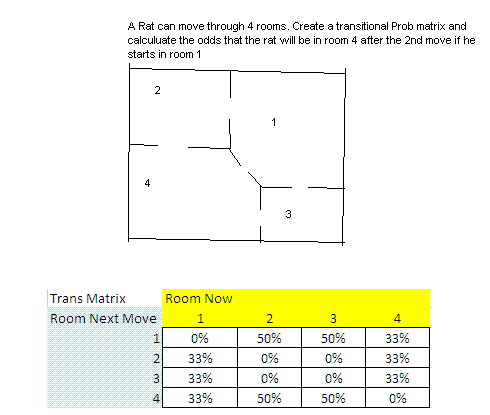
I've attached the diagram of 4 rooms, which a rat must move through. Each period he changes his room (his state). As you can see if you click on the image, the rat cannot access room 2 from 3, vice versa.

If I assume the rat begins in room 1, how do I calculate the probability he will be in room 4 after his second move? I have the transitional probability matrix correct, I'm just not sure how to move forward.
rat markov chain.GIF


Thank you,

Jeff
 
Physics news on Phys.org
Set up the "transition matrix". According to your picture, if the rat is in room 1, the is a 1/3 chance he will move to each of 2, 3, 4. That means you want your first column to be [0 1/3 1/3 1/3]. That's because you will be multiplying the matrix by a column matrix with entries representing the probability the rat is in room 1, 2, 3, or 4 respectively. If you know for certain the rat is in room 1, then your column matrix is [1 0 0 0] and it is the first column of the matrix that multiplies that first 1.

Similarly, if the rat is in room 2 the probability is 1/2 that it will move to room 1 and 1/2 that it will move to room 4: the second column in your matrix must be [1/2 0 0 1/2].

If the rat is in room 3 the probability is also 1/2 that it will move to room 1 and 1/2 that it will move to room 4 so your third column is the same as the second column.

Finally, if the rat is in room 3, the probability is 1/3 that it will move to room 1, 1/3 that it will move to room 2, and 1/3 that it will move to room 3 so the fourth column is [1/3 1/3 1/3 0].

Your transition matrix is
[tex]A= \left[\begin{array}{cccc} 0 & \frac{1}{3} & \frac{1}{3} & \frac{1}{3} \\ \frac{1}{2} & 0 & 0 \frac{1}{2} \\ \frac{1}{2} & 0 & 0 \frac{1}{2} \\ \frac{1}{3} & \frac{1}{3} & \frac{1}{3} & 0\end{array}\right][/tex]

Is that what you have?

To find "the probability he will be in room 4 after his second move If the rat begins in room 1" you need to calculate A2 times the column matrix [1 0 0 0].
 
Thanks - that's what I thought, but I wasn't sure about the treatment of the initial probability vector.

Jeff
 

Similar threads

Replies
1
Views
4K
Replies
9
Views
3K
  • · Replies 93 ·
4
Replies
93
Views
8K
Replies
1
Views
4K
Replies
6
Views
3K
  • · Replies 9 ·
Replies
9
Views
4K
  • · Replies 2 ·
Replies
2
Views
2K
Replies
1
Views
2K
  • · Replies 1 ·
Replies
1
Views
4K
  • · Replies 7 ·
Replies
7
Views
3K