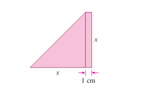
paulmdrdo1 Messages 382 Reaction score 0 Thread starter Jun 4, 2014 #1 Find the length x if the shaded area is 1200 cm^2 I tried to solve this is what I get since $A_{triangle}=(\frac{1}{2})({x-1})(x)$ and $A_{rectangle}=x$ $A_{rectangle}+A_{triangle}=2400$ Is the set-up of my equation correct? Attachments stewart problem 1.3.png 1,002 bytes · Views: 137
Find the length x if the shaded area is 1200 cm^2 I tried to solve this is what I get since $A_{triangle}=(\frac{1}{2})({x-1})(x)$ and $A_{rectangle}=x$ $A_{rectangle}+A_{triangle}=2400$ Is the set-up of my equation correct?
MarkFL Gold Member MHB Messages 13,284 Reaction score 12 Jun 4, 2014 #2 Why are you using $x-1$ in the area of the triangle?
paulmdrdo1 Messages 382 Reaction score 0 Jun 4, 2014 #3 MarkFL said: Why are you using $x-1$ in the area of the triangle? I see it. $A_{TRI}=\frac{1}{2}(x^2)$ now I will have $\frac{1}{2}(x^2)+x=2400$ solving for x $(x-48)(x+50)=0$ $x=48 in.$ :D
MarkFL said: Why are you using $x-1$ in the area of the triangle? I see it. $A_{TRI}=\frac{1}{2}(x^2)$ now I will have $\frac{1}{2}(x^2)+x=2400$ solving for x $(x-48)(x+50)=0$ $x=48 in.$ :D
MarkFL Gold Member MHB Messages 13,284 Reaction score 12 Jun 4, 2014 #4 Well, you actually have: $$\frac{1}{2}x^2+x=1200$$ or: $$x^2+2x-2400=0$$ $$(x+50)(x-48)=0$$ Discarding the negative root, we then find: $$x=48\text{ cm}$$
Well, you actually have: $$\frac{1}{2}x^2+x=1200$$ or: $$x^2+2x-2400=0$$ $$(x+50)(x-48)=0$$ Discarding the negative root, we then find: $$x=48\text{ cm}$$