How do you indicate transient terms when y just equals 1 ?

  • Context: Undergrad 
  • Thread starter Thread starter Jeff12341234
  • Start date Start date
  • Tags Tags
    Terms Transient
Click For Summary
SUMMARY

The discussion focuses on indicating transient terms in equations where the dependent variable y equals 1. The key point is the introduction of the constant of integration, represented as 'c', which is necessary for accurately expressing solutions. The equation t = 1 + c or t = 1 + c/μ is established as a valid representation, highlighting the importance of including the constant in the solution process. Additionally, the function e^((e^x^2)/2) should be divided by 'c' when solving for t to maintain mathematical integrity.

PREREQUISITES
  • Understanding of differential equations
  • Familiarity with the concept of transient terms
  • Knowledge of constants of integration
  • Basic proficiency in mathematical functions and their properties
NEXT STEPS
  • Study the role of constants of integration in differential equations
  • Learn about transient terms in mathematical modeling
  • Explore the implications of dividing functions by constants in calculus
  • Investigate advanced topics in differential equations, such as stability analysis
USEFUL FOR

Mathematicians, engineering students, and anyone involved in solving differential equations or studying transient behavior in mathematical models.
Jeff12341234
Messages
179
Reaction score
0
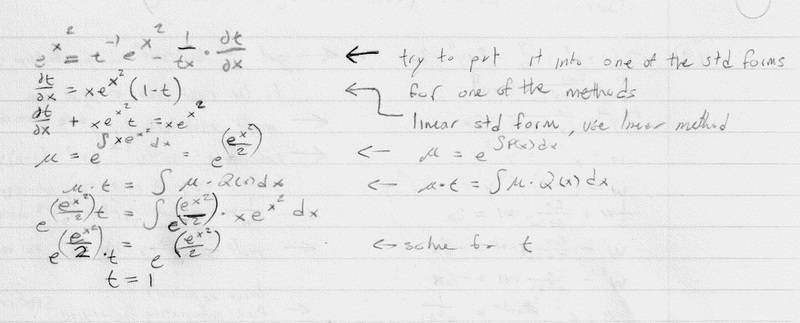
how do you "indicate transient terms" when y just equals 1 ?

t is the dependent variable in this problem and I'm told to "indicate transient terms". Well, t=1 so is this a trick question or did I do something wrong?
Aq1OeEk.jpg
 
Last edited:
Physics news on Phys.org


You seem to have forgotten the "constant of integration". t= 1 is one function satisfying this equation. There are others, involving terms that go to 0 as t goes to infinity.


ok, so t = 1 + c
or t = 1 + c/μ ?
Because the c term should've actually been introduced on the 2nd to last line. If that's true, that e^((e^x^2)/2) function should've also been divided by c when solving for t.
 
Last edited:

Similar threads

  • · Replies 3 ·
Replies
3
Views
4K
  • · Replies 3 ·
Replies
3
Views
2K
  • · Replies 7 ·
Replies
7
Views
3K
  • · Replies 2 ·
Replies
2
Views
4K
  • · Replies 1 ·
Replies
1
Views
3K
  • · Replies 7 ·
Replies
7
Views
4K
  • · Replies 8 ·
Replies
8
Views
2K
  • · Replies 1 ·
Replies
1
Views
2K
  • · Replies 1 ·
Replies
1
Views
3K
  • · Replies 2 ·
Replies
2
Views
3K