How Do You Solve This Organic Chemistry Mechanism Problem?

  • Thread starter Thread starter shiznites
  • Start date Start date
  • Tags Tags
    Mechanism
Click For Summary
SUMMARY

The discussion focuses on solving a complex organic chemistry mechanism involving an epoxide and acid (H+). The initial approach includes protonating the epoxide to form -OH groups, which then act as nucleophiles to attack a carbonyl. The solution progresses through hydrolysis of the epoxide, Fischer esterification to create an ester bridge, and subsequent dehydration to yield the final product. Key steps include preserving specific carbon-oxygen bonds and understanding the structural changes throughout the mechanism.

PREREQUISITES
  • Understanding of organic chemistry mechanisms
  • Familiarity with epoxide chemistry
  • Knowledge of Fischer esterification
  • Proficiency in identifying nucleophiles and electrophiles
NEXT STEPS
  • Study the mechanism of epoxide ring-opening reactions
  • Learn about Fischer esterification in detail
  • Explore dehydration reactions in organic synthesis
  • Review the role of cations in organic mechanisms
USEFUL FOR

Organic chemistry students, educators, and anyone seeking to deepen their understanding of complex reaction mechanisms involving epoxides and acid-catalyzed transformations.

shiznites
Messages
2
Reaction score
0
ORGANIC CHEMISTRY II

Homework Statement


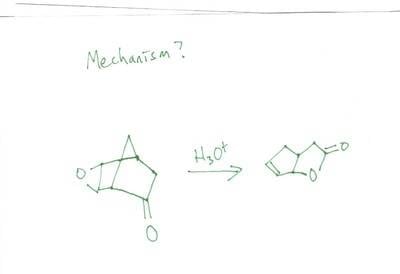
I spent hours trying to figure out how to do this mechanism but I always get stuck. Its tricky and will make you think.. think you can figure it out?
z157831749.jpg


Homework Equations


Figure out the mechanism just using acid (H+)


The Attempt at a Solution


I started out by reducing the epoxide by protinating and was left with a -OH group on each carbon that made up the epoxide. Using one of those -OH groups I attack the carbonyl on the opposite side (using the -OH group as a nucleophile).

Basically I don't know where to go from there or if that's even a correct start. I sat here for awhile staring at my 3D model and came up nowhere. I know that somewhere down the line there will be dehydration somewhere.

Your help is greatly appreciated =]
 
Last edited:
Physics news on Phys.org
Look at the rightmost ring in the product. Assume that the carbonyl carbon is preserved in the reaction. Count the carbons starting with carbonyl then methylene then the two bridged carbons and finally the oxygen. How many units in the ring? How many carbons? Assume that the bridged carbon to oxygen bond in the ring is preserved in your mechanism. Now you know what part of the molecule is unchanged in the mechanism. Start your mechanism by protonating the epoxide as you suggested and then break one of the C-O bonds. Remember that one of those C-O bonds winds up in the product (so don't break that one!) and the carbon attached to it becomes a bridged carbon.
 
I figured it out.

Hydrolysis to the epoxide which breaks it open. Then Fischer esterification which forms the ester bridge. Upon the completion of Fischer the adjacent C-C bond breaks to reform the carbonyl from the intermediate. This leaves a cation. Dehydrate and bam.
 

Similar threads

  • · Replies 28 ·
Replies
28
Views
5K
  • · Replies 1 ·
Replies
1
Views
2K
  • · Replies 4 ·
Replies
4
Views
3K
  • · Replies 3 ·
Replies
3
Views
8K
  • · Replies 2 ·
Replies
2
Views
7K
  • · Replies 4 ·
Replies
4
Views
2K
Replies
7
Views
3K
  • · Replies 1 ·
Replies
1
Views
3K
Replies
2
Views
2K
  • · Replies 1 ·
Replies
1
Views
6K