How Does Bernoulli's Equation Determine Flow and Pressure in a Tank System?

Click For Summary
SUMMARY

This discussion focuses on applying Bernoulli's Equation to determine flow and pressure in a tank system. The discharge rate calculated using Bernoulli's principle is Q_3 = 0.200 m³/s. The gauge pressure at point 2 was initially miscalculated, with the correct value being 70 kPa after applying the continuity equation and Bernoulli's principle correctly. Additionally, the discussion raises the question of how to set up a mass balance for the tank to determine the volume of liquid escaping over time.

PREREQUISITES
  • Understanding of Bernoulli's Equation and its applications
  • Knowledge of fluid dynamics principles, including continuity equation
  • Familiarity with pressure calculations in fluid systems
  • Basic differential equations for mass balance in fluid systems
NEXT STEPS
  • Learn how to derive and apply Bernoulli's Equation in various fluid systems
  • Study the continuity equation in fluid dynamics for different cross-sectional areas
  • Explore mass balance techniques and differential equations for fluid flow analysis
  • Investigate the effects of varying liquid levels in tanks on discharge rates
USEFUL FOR

Students and professionals in engineering, particularly those specializing in fluid mechanics, hydraulic engineering, and anyone involved in designing or analyzing tank systems.

momogiri
Messages
52
Reaction score
0
Water flows steadily from an open tank as in the figure below. The elevation of point 1 is 10.0m, and the elevation of points 2 and 3 is 2.00m. The cross-sectional area at point 2 is 0.0480m^2; at point 3 it is 0.0160m^2. The area of the tank is very large compared with the cross-sectional area of the pipe.
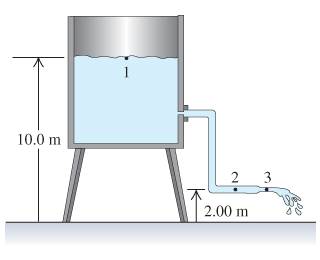
yf_Figure_14_41.jpg


Part A is "Assuming that Bernoulli's equation applies, compute the discharge rate in cubic meters per second."
Which I've solved using Bernoulli's principle

so Q_3 = 0.200m^3/s

Part B is "What is the gauge pressure at point 2?"
Now this one I'm stuck with, but here's what I've done:

A_2*v_2 = A_3*v_3
(0.048)v_2 = (0.2)(0.016)

v_2 = 0.0666667m/s

so using Bernoulli's principle..(and cancelling some stuff)

P_2 + 0.5*rho*v_2^2 = P_3 + 0.5*rho*v_3^2
which becomes
P_2 + (0.5)(1000)(0.0666667)^2 = 101300 + (0.5)(1000)(0.2)^2
thus P_2 = 101317.7778

And I figured since gauge pressure meant P_G = P - atm
I subtracted 101317.7778 by 101300
which got me 17.7778 as my gauge pressure...
So what am I doing wrong? I don't seem to be getting the right answer here...
 
Physics news on Phys.org
For part A, we apply Bernoulli and the continuity equation from point 1 to point 3
A_1 v_1 = A_3 v_3
P_1 + \frac{1}{2} \rho v_1^2 + \rho g h_1 = P_3 + \frac{1}{2} \rho v_3^2 + \rho g h_3
Since the tank is open, P_1 = P_3, so we have
v_3^2 - v_1^2 = 2g (h_1-h_3)
v_3^2 \left(1 - \left( \frac{A_3}{A_1} \right)^2 \right) = 2g (h_1-h_3)
Now, since the area of the tank is very large compared to the area of the jet, 1 - \left( \frac{A_3}{A_1} \right)^2 \approx 1, then
v_3 = \sqrt{2g (h_1-h_3)} = \sqrt{2 \left( 9.8 \ \frac{m}{s^2} \right) (10 \ m - 2 \ m)} = 12.52 \ \frac{m}{s}
So the flow rate is
Q = (0.016 \ m^2) \left(12.52 \ \frac{m}{s} \right) = 0.2 \ \frac{m^3}{s}

For part B, we apply Bernoulli and the continuity equation from point 2 to point 3
A_2 v_2 = A_3 v_3
P_2 + \frac{1}{2} \rho v_2^2 + \rho g h_2 = P_3 + \frac{1}{2} \rho v_3^2 + \rho g h_3
Points 2 and 3 have the same elevation, so we have
P_2 + \frac{1}{2} \rho v_2^2 = P_3 + \frac{1}{2} \rho v_3^2
We can calculate v_2 with the continuity equation
v_2 = \left( \frac{0.016 \ m^2}{0.048 \ m^2} \right) \left( 12.52 \ \frac{m}{s} \right) = 4.17 \ \frac{m}{s}
Now we calculate the pressure at point 2
P_2 = P_3 + \frac{1}{2} \rho (v_3^2 - v_2^2) = 101325 \ Pa + \frac{1}{2} \left(1000 \ \frac{kg}{m^3} \right) \left( \left(12.52 \ \frac{m}{s} \right)^2 - \left(4.17 \ \frac{m}{s} \right)^2 \right) = 171006 \ Pa
Finally, we calculate the gauge pressure
p_2 = P_2 - p_{atm} = 171006 \ Pa - 101325 \ Pa = 70 \ kPa
 
what if there was a part of the question that says
(b)How much liquid will escape in 1 minute?
 
victor oluvic said:
what if there was a part of the question that says
(b)How much liquid will escape in 1 minute?
The correct way of doing it would be to take into account the variation of the liquid level inside the tank with respect to time.

Do you know how to set up the mass balance for the tank in terms of a differential equation?
 

Similar threads

  • · Replies 13 ·
Replies
13
Views
1K
Replies
2
Views
1K
  • · Replies 6 ·
Replies
6
Views
3K
Replies
2
Views
2K
  • · Replies 1 ·
Replies
1
Views
1K
  • · Replies 1 ·
Replies
1
Views
3K
  • · Replies 6 ·
Replies
6
Views
2K
  • · Replies 6 ·
Replies
6
Views
5K
  • · Replies 3 ·
Replies
3
Views
2K
  • · Replies 1 ·
Replies
1
Views
3K