How does convex lens focal length affect water temperature in sunlight?

Join the discussion
Registration is free. Start your own thread to ask a follow-up.
5 replies · 3K views
fernelau
Messages
1
Reaction score
0
New user has been reminded to post schoolwork problems in the Homework Help forum, and to show their work
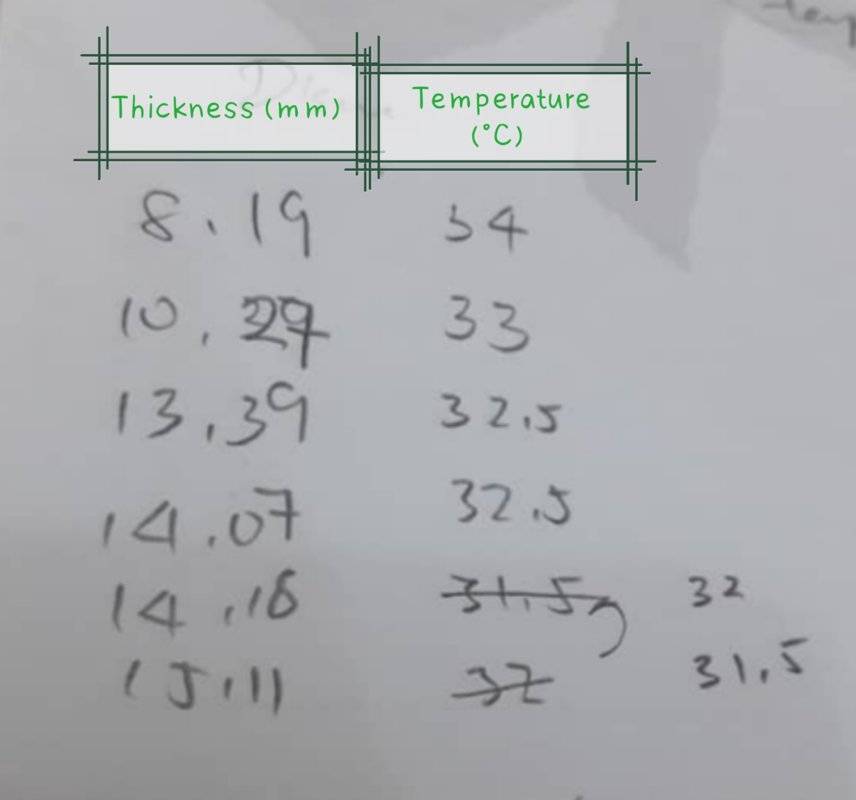
Summary: Hi, I'm doing an assessment for Physics on Optics topics, but I can't really explain how the CV affect the RV

CV : Focal length of convex lens
RV : Temperature of water after 20 minutes under the sun
246630


How I should explain for the temperature difference? 🤔
Please help, Thanks.
 
Physics news on Phys.org
It's difficult to help because you are not giving us enough information:
1) Is that temperature, or temperature rise?
2) Ambient temperature?
3) Sketch of your experimental setup?
4) Necessary dimensions.
5) What is the purpose of your experiment?
6) What variables did I purposely not list?
 
  • Like
Likes   Reactions: Ibix
What counts most is the aperture or energy gathering power of the lens rather than the focal length. A secondary effect may be the thickness (and hence absorption) of the lens.
@jrmichler has pointed out that more detail and explanation is needed if you want sensible answers. (We only know what you write about your experiment.)
 
  • Like
Likes   Reactions: russ_watters
fernelau said:
Summary: Hi, I'm doing an assessment for Physics on Optics topics, but I can't really explain how the CV affect the RV

How I should explain for the temperature difference? 🤔
There are really three questions you need to address
  1. Do I measure a difference
  2. Is it significant
  3. How can I explain results
Number (2) is the important question. If I see a difference is it because my experiment was flawed and/or not precise enough?. One interesting question would be " how various is the result for ten repetitions with the same lens ?" Is my difference bigger than that? The data should be time stamped (sun angle etc...any clouds).
Here is my suggestion for the initial experimental design:
  1. Choose 3 focal lengths
  2. Run nine tests using each lens 3 times in "random" order
  3. Compare the between and within lens variability. A graph will tell you instantly what you need to know.
More repetitions would allow you to see smaller effects.
 
hutchphd said:
There are really three questions you need to address
  1. Do I measure a difference
  2. Is it significant
  3. How can I explain results
Number (2) is the important question. If I see a difference is it because my experiment was flawed and/or not precise enough?. One interesting question would be " how various is the result for ten repetitions with the same lens ?" Is my difference bigger than that? The data should be time stamped (sun angle etc...any clouds).
Here is my suggestion for the initial experimental design:
  1. Choose 3 focal lengths
  2. Run nine tests using each lens 3 times in "random" order
  3. Compare the between and within lens variability. A graph will tell you instantly what you need to know.
More repetitions would allow you to see smaller effects.
Before any of that valuable stuff, you should look at some theory and decide what, if any, level of effect you are expecting.
"See what happens" can involve a lot of time and effort and yield not a lot of information. The area of the objective lens is the prime factor for 'point sources'. If you have a distributed object (as with a normal photograph) then the 'f number' is what counts (f number is aperture / focal length). The sun is not quite a point source so you may find that f number has an effect - so your experiment may show some significant trend. It would be worth while searching "f number in photography" and sind a site that suits you.
If you still have the equipment available, you can try varying aperture (circles cut out of card) to see the effect.
 
  • Like
Likes   Reactions: hutchphd, Bystander and russ_watters
I thought of something else, too. You are heating the water up in a volume that's large, compared with the optical image of the Sun, whatever lens you are using. That makes the optics even less important.
How much sunlight is getting through the water and out the other side?
Details, details, details - all very important in experiments.