How Does Galaxy Rotation and Recession Affect Observed Light Frequencies?

Click For Summary
SUMMARY

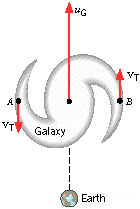
The discussion focuses on the effects of galaxy rotation and recession on observed light frequencies, specifically from a distant galaxy with a center receding at a speed of uG = 1.5e6 m/s. The tangential speed for points A and B, which are equidistant from the center, is vT = 0.3e6 m/s. The emitted frequency of light is 6.400e14 Hz, but the observed frequencies for points A and B differ due to their respective velocities. The relevant equation for calculating the observed frequency is f_o = f_s (1 ± v_rel/c).

PREREQUISITES
  • Understanding of relativistic Doppler effect
  • Familiarity with the equation f_o = f_s (1 ± v_rel/c)
  • Basic knowledge of galaxy dynamics and motion
  • Concept of light frequency and its measurement
NEXT STEPS
  • Calculate the observed frequencies for points A and B using the Doppler effect formula
  • Research the implications of redshift and blueshift in astrophysics
  • Explore the concept of relative velocity in the context of cosmology
  • Investigate the effects of galaxy rotation on light emission and observation
USEFUL FOR

Astronomers, astrophysics students, and anyone interested in the dynamics of galaxies and the implications of light frequency changes due to motion.

gamesandmore
Messages
32
Reaction score
0
A distant galaxy is simultaneously rotating and receding from the earth. As the drawing shows, the galactic center is receding from the Earth at a relative speed of uG = 1.5e6 m/s. Relative to the center, the tangential speed is vT = 0.3e6 m/s for locations A and B, which are equidistant from the center. When the frequencies of the light coming from regions A and B are measured on earth, they are not the same and each is different than the emitted frequency of 6.400e14 Hz.
24_37.gif


Vt = wr
fo = fs (1 +- vrel/c)

No idea where to start
 
Physics news on Phys.org
I am assuming that you have to work out what the measured frequencies of A and B are given their emitted frequency? You have the equation for finding the observed frequency compared to the emitted frequency:

[tex]f_o=f_s \left(1+\frac{v}{c}\right)[/tex]

What is the relative velocity of points A and B from the Earth?
 

Similar threads

  • · Replies 1 ·
Replies
1
Views
2K
Replies
6
Views
2K
  • · Replies 28 ·
Replies
28
Views
3K
  • · Replies 2 ·
Replies
2
Views
8K
  • · Replies 2 ·
Replies
2
Views
8K
  • · Replies 5 ·
Replies
5
Views
3K
  • · Replies 2 ·
Replies
2
Views
2K
  • · Replies 11 ·
Replies
11
Views
2K
  • · Replies 3 ·
Replies
3
Views
3K
  • · Replies 17 ·
Replies
17
Views
3K