How Does Geometry Explain the r/R Ratio of .225 in Sphere Packing?

  • Thread starter Thread starter Saladsamurai
  • Start date Start date
Click For Summary

Homework Help Overview

The discussion revolves around the geometric relationship in sphere packing, specifically focusing on the ratio of the radius of a smaller sphere (r) to that of a larger sphere (R) in a tetrahedral arrangement. Participants are tasked with demonstrating that r/R equals 0.225, based on a problem originating from a Materials Science text.

Discussion Character

  • Exploratory, Conceptual clarification, Mathematical reasoning, Assumption checking

Approaches and Questions Raised

  • Participants explore geometric relationships and dimensions, considering the tetrahedral arrangement of spheres. They discuss the constraints imposed by the radii and the distances involved, questioning how to relate these to angles and ratios. Some participants attempt to derive the ratio using trigonometric relationships and centroid properties.

Discussion Status

The discussion is active, with participants providing insights and attempting to clarify their understanding of the geometric relationships involved. Some have offered guidance on visualizing the problem, while others are exploring different methods to arrive at the ratio. There is a recognition of the complexity of the problem, with various interpretations being discussed.

Contextual Notes

Participants note that the original problem statement lacks certain details, and there is confusion regarding the application of specific geometric principles. The discussion also highlights the challenge of deriving a specific ratio without solving for the individual radii directly.

Saladsamurai
Messages
3,009
Reaction score
7
***First part solved skip to post #11

^^^^^^^^^^^^^^^^^^^^^^^^^^^It's a silly title, but I really need help. The four pink balls surround the purple one and all make contact.

Calling the radius of the purple ball r and the radii of the pink R:

Show that r/R=.225.
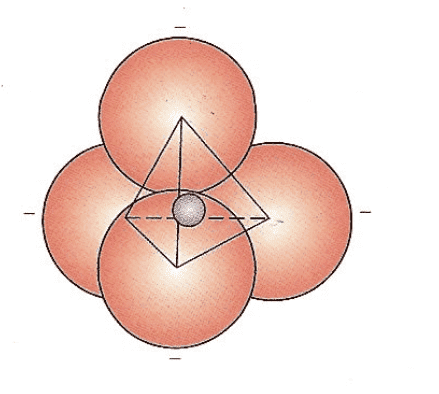
Picture1-22.png

The Attempt at a Solution

I think that this can be done with simple plane trig, but I am having troubles with the visualization.Anybody have any ideas? I am dying here.

edit: I hijacked this image to simplify the problem. The original problem statement had no image and came from a Materials Science text: "Show that the minimum cation-to-anion ratio for a coordination number 4 is .225"
 
Last edited:
Physics news on Phys.org
You already get credit for explaining the problem so that even your grandmother can understand it.

As to the geometry I think you have to figure in several dimensions. But as I visualize it you can go a plane at a time.

For instance you know that the radii constrain the tetrahedral sides to be 2R.

From that I would examine the plane that intersects 2 spheres and the centroid of the tetrahedron, which is where the purple sphere is centered.

The centroid distance to a vertex - R is the radius of purple guy isn't it?
 
Okay LP. So I think I get you. r+R=height correct ?

And length = 2R

I am just not sure how to relate this to an angle?
 
Last edited:
I tried (r+R)/2R =sin 45

but this does not work. The angles should be 45 right?
 
The line from a vertex to the centroid of the opposite face passes through the centroid of the tetrahedron.

It has the delicious property that it is in a ratio of 3 from the vertex to 1 from the opposite face. This 3:1 ratio is quite useful.

Because we can apply that to the height of the tetrahedron which we know (from looking it up) is (2/3)½*(a) = (2/3)½*(2R)

I think that means that r = (3/4)*(2/3)½*(2R) - R
 
LP. Thank you for your help. This gets the correct answer, but I am still having some trouble understanding it because we only have words here. Did you get this info from a book or a particular website I could check out? (I will do some googling).

So the ratio 3:1 is:

(the distance from a Vertex to the centroid of opposite face)/
(distance from vertex to centroid of pyramid)

correct?

and you are saying that Height=(2/3)1/2*2R
 
I guess I am just confused as to where the "3/4" is coming from ?

If h= r + R and h = (2/3)1/2*2R

then r + R = (2/3)1/2*2R

what detail am I missing?
 
That comes from the 3:1 ratio of the distance from the vertex to the centroid of the opposite face.

1+1+1 : 1 is 3/4 of the way doesn't it?

That locates the position of the tetrahedral centroid.
 
  • #10
Oh crapass. Thanks LP! I am with you now!

Casey
 
  • #11
Now, if you were now asked "What are the angle between the the covalent bonds" in this structure (i.e., the lines connecting the center of the purple ball to the centers of the pink ones)?

Wouldn't those just be 90 degrees?
 
  • #12
Saladsamurai said:
Now, if you were now asked "What are the angle between the the covalent bonds" in this structure (i.e., the lines connecting the center of the purple ball to the centers of the pink ones)?

Wouldn't those just be 90 degrees?

No. I think you should draw it out.
 
  • #13
I think you are right. I keep thinking that the centroid of the purple coincides with the centroids of the pinks, but it does not.
 
  • #14
Also, now I have values for r and R... so r/R = .225 no longer applies.

I have that r= .04 and R=.14

Is this going to be a Law of Cosines problem by chance?
 
  • #15
Where c2=a2+b6-2ab*cos(theta)

a = b = r+R

and c = 2R

so theta = 102 degrees.

Anyone confirm?
 
  • #16
Saladsamurai said:
Also, now I have values for r and R... so r/R = .225 no longer applies.

I have that r= .04 and R=.14

Is this going to be a Law of Cosines problem by chance?

That doesn't look right! You should not be able to solve for R and r, only for the ratio r/R. Using a somewhat different method than you, I get [tex]\frac{r}{R}=\frac{\sqrt{6}-2}{2}\approx0.224745[/tex]

What I did was assign a coordinate system such that the center of the purple sphere is along the positive z-axis, 3 of the pink spheres lie in the x-y plane (with one having its center along the positive y-axis) and the 4th pink sphere's center lies along the positive z-axis. I then analyzed the 3 coplanar spheres, finding their equations, then found the equation of the 4th pink sphere, and finally the purple sphere.

Here is a mathematica plot of my solution, with R=3 in this plot:

http://img264.imageshack.us/img264/3426/5balls2yb8.gif
 
Last edited by a moderator:
  • #17
gabbagabbahey said:
That doesn't look right! You should not be able to solve for R and r, only for the ratio r/R. Using a somewhat different method than you,
I get [tex]\frac{r}{R}=\frac{\sqrt{6}-2}{2}\approx0.224745[/tex]

That is apparently the same as the earlier answer.

r = (3/4)*(2/3)½*(2R) - R ;; algebraically simplifies into your result.
 

Similar threads

  • · Replies 8 ·
Replies
8
Views
5K
  • · Replies 1 ·
Replies
1
Views
4K