How Does Metal Hydride Formation Occur?

  • Thread starter Thread starter mess1n
  • Start date Start date
  • Tags Tags
    Formation Metal
Click For Summary
SUMMARY

Metal hydride formation involves the dissociation of molecular hydrogen at the metal surface, where two hydrogen atoms recombine to form H2 during desorption. The concentration of hydrogen in the metal increases at specific pressures due to the autocatalytic dissociation of hydrogen on metal surfaces, as detailed in the referenced literature. The solubility of hydrogen in metals is also temperature-dependent, influencing the diffusion of protons through the metallic crystal structure.

PREREQUISITES
  • Understanding of metal hydride chemistry
  • Familiarity with PCI (Pressure-Composition-Isotherm) plots
  • Knowledge of hydrogen dissociation mechanisms on metal surfaces
  • Basic principles of solubility and diffusion in solid-state materials
NEXT STEPS
  • Study the theory of autocatalytic dissociation of hydrogen in metals
  • Research the temperature dependence of hydrogen solubility in various metals
  • Examine the referenced articles: "Hydrogen dissociation on metal surfaces" and the SpringerLink article
  • Explore advanced topics in surface reactions and their implications in material science
USEFUL FOR

Researchers in material science, chemists studying metal hydrides, and engineers working on hydrogen storage solutions will benefit from this discussion.

mess1n
Messages
24
Reaction score
0
I'm very confused about how metal hydrides form. I'm looking at PCI plots and I see what's happening, but I have no idea why it is. For instance:

"Molecular hydrogen is dissociated at the surface before absorption; two H atoms recombine to H2 in the desorption process."

Why does this happen?
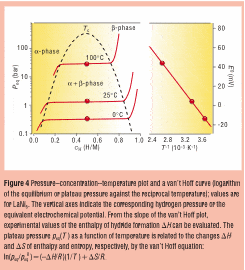
PCI Plot.gif


Also, I've attached a PCI plot. Can anyone explain why the concentration suddenly increases at certain pressures?

I've searched so many books and internet resources to try and find an explanation for these processes, to no avail, please help! :(


Andrew
 
Last edited:
Engineering news on Phys.org
Sorry to bump this, but I'm hoping someone sees it who will be able to help. Is this question in the right section?
 
There is a theory of autocatalytic dissociation of hydrogen in metals.
http://www.springerlink.com/content/f602850hk808h357/

And there is this
Hydrogen dissociation on metal surfaces – a model system for reactions on surfaces
Applied Physics A: Materials Science & Processing
Volume 67, Number 6, 627-635, DOI: 10.1007/s003390050834
A. Gross

Clearly to form hydrides, the proton has to diffuse through the metallic grains/crystal structure. The solubility of hydrogen in a metal is temperature dependent.
 
Thanks so much for the reply, I'll read through those articles now.
 

Similar threads

  • · Replies 8 ·
Replies
8
Views
2K
Replies
43
Views
19K
Replies
4
Views
1K
  • · Replies 5 ·
Replies
5
Views
4K
  • · Replies 10 ·
Replies
10
Views
4K
  • · Replies 2 ·
Replies
2
Views
2K
  • · Replies 1 ·
Replies
1
Views
3K
Replies
1
Views
3K
  • · Replies 2 ·
Replies
2
Views
3K
  • · Replies 7 ·
Replies
7
Views
3K