How does radius affect frequency in uniform circular motion?

Click For Summary

Homework Help Overview

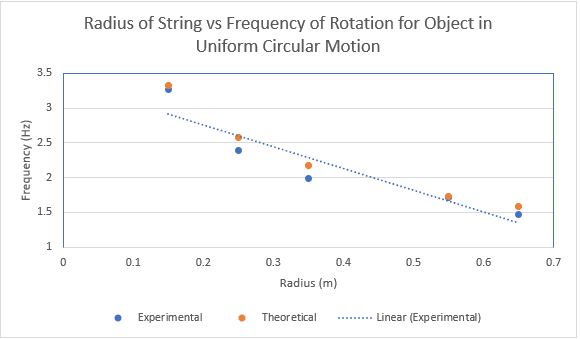
The discussion revolves around the effect of the radius of a string on the frequency of rotation of an object in horizontal uniform circular motion. The original poster is conducting a lab report and hypothesizes that an increase in radius will lead to a decrease in frequency due to an inverse relationship.

Discussion Character

  • Exploratory, Conceptual clarification, Assumption checking

Approaches and Questions Raised

  • Participants inquire about the setup of the experiment, including how the object is constrained to move in a circle and how the radius is adjusted. There are discussions about the influence of other factors on the speed of rotation and the need for a free-body diagram. Questions about the relationship between centripetal force, angular velocity, and frequency are also raised.

Discussion Status

Participants are actively engaging with the original poster's hypothesis and results. Some have offered guidance on understanding the physics involved, while others are exploring different interpretations of the data and the underlying equations. There is a recognition of the need for clarity regarding the relationship between radius and frequency, with suggestions for further analysis.

Contextual Notes

The original poster notes a time constraint for the lab report submission, which may affect the depth of the discussion. There is also mention of specific experimental conditions and parameters that are relevant to the inquiry.

Tannerbobanner
Messages
10
Reaction score
1
Thread moved from the technical forums, so no Homework Template is shown
I am writing a lab report on the effect of the radius of a string on the frequency of rotation on an object in horizontal uniform circular motion.

My hypothesis is:
If the radius of the string from the origin of rotation increases, then the frequency will decrease because frequency has an inverse relationship to the radius.

I have gathered the following results from the experiment and comparing it to the theoretical this is the graph.
c7WD4IA.png

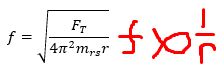
I am trying to write a conclusion explaining why my hypothesis remained true other than the relationship between them in the equation:
8C0auet.png

So my question is, does anyone know about centripetal force and may be able to help me explain my results other than this relationship. If you want a copy of my lab let me know.
 

Attachments

  • c7WD4IA.png
    c7WD4IA.png
    5.2 KB · Views: 7,105
  • 8C0auet.png
    8C0auet.png
    1.1 KB · Views: 2,716
Physics news on Phys.org
Welcome to the PF. :smile:

How was the object constrained to move in a circle? Was it on a frictionless flat surface? How was the circular motion started and maintained? How was the length of the string changed (like was it pulled down through a hole in the center of the frictionless table?

It seems like there is something else that can influence the speed of rotation, even with the same string length. After all, you can spin a ball around on a string at various speeds without changing the length of the string. It seems like you would need to define how the mass got to that spinning speed somehow, no?
 
berkeman said:
Welcome to the PF. :smile:

How was the object constrained to move in a circle? Was it on a frictionless flat surface? How was the circular motion started and maintained? How was the length of the string changed (like was it pulled down through a hole in the center of the frictionless table?

It seems like there is something else that can influence the speed of rotation, even with the same string length. After all, you can spin a ball around on a string at various speeds without changing the length of the string. It seems like you would need to define how the mass got to that spinning speed somehow, no?
Here is a link to my lab: https://files.fm/u/v347hgn5#/
Basically, A rubber stopper was connected to a string, which ran through a glass tube that I would hold on to and the tension came from a mass hanging below and I would swing it and count revolutions for trials.
 
Tannerbobanner said:
I am writing a lab report on the effect of the radius of a string on the frequency of rotation on an object in horizontal uniform circular motion.

My hypothesis is:
If the radius of the string from the origin of rotation increases, then the frequency will decrease because frequency has an inverse relationship to the radius.

I have gathered the following results from the experiment and comparing it to the theoretical this is the graph.
View attachment 223774
I am trying to write a conclusion explaining why my hypothesis remained true other than the relationship between them in the equation:
View attachment 223775
So my question is, does anyone know about centripetal force and may be able to help me explain my results other than this relationship. If you want a copy of my lab let me know.

Did you do a circular motion experiment similar to this:

https://www.thephysicsaviary.com/Physics/Programs/Labs/ClassicCircularForceLab/index.html

Zz.
 
Tannerbobanner said:
Here is a link to my lab: https://files.fm/u/v347hgn5#/
Could you save it as a PDF? Many folks are reluctant to download a DOCX file. Once it is in PDF format, you can use the Upload button at the lower right to Upload it to the PF as an attachment to your post. Thanks.
 
Here it is, note: background information was not required as it is due two days after it was assigned, aka tommorow :)
 

Attachments

Last edited:
  • Like
Likes   Reactions: berkeman
You need to show that you know how to draw the free-body diagram of the system, and then to write down the forces involved.

Zz.
 
ZapperZ said:
You need to show that you know how to draw the free-body diagram of the system, and then to write down the forces involved.

Zz.
Could you elaborate a little bit, and where would the proper place to put a diagram be in a lab formatted like so?
 
  • #10
Tannerbobanner said:
Could you elaborate a little bit, and where would the proper place to put a diagram be in a lab formatted like so?

I don't know. I'm not addressing your lab report. I'm addressing your understanding of the physics. You asked for the explanation of your result. I'm not sure if you know how that equation came about, and why you'd even make a linear fit to the data.

Zz.
 
  • #11
ZapperZ said:
I don't know. I'm not addressing your lab report. I'm addressing your understanding of the physics. You asked for the explanation of your result. I'm not sure if you know how that equation came about, and why you'd even make a linear fit to the data.

Zz.
I understandthe Fg of the mass hanging below the glass tube is the centripetal force and the glass tube is acting as a pully, what I don't understand is how if an object is closer to it's origin of rotation why it spins faster or why more velocity is required etc...
 
  • #12
Are you familiar with the equations of uniform circular motion? How is the centripetal force related to angular velocity?
 
  • #13
Tannerbobanner said:
I understandthe Fg of the mass hanging below the glass tube is the centripetal force and the glass tube is acting as a pully, what I don't understand is how if an object is closer to it's origin of rotation why it spins faster or why more velocity is required etc...

Actually, in the equation that you typed, the hanging mass is FT.

The frequency f is not proportional to 1/r, but rather 1/√r. Look again at that equation.

If you want to do a curve fit to your data, you should fit it to such a function, i.e. something of the form k/√r, where k is the fitting parameter.

If you don't know how to do that in Excel (it appears that you are using that based just looking at your graph), then you can do a linear curve fit, but you have to plot f2 versus 1/r instead.

Zz.
 
  • Like
Likes   Reactions: berkeman
  • #14
berkeman said:
Are you familiar with the equations of uniform circular motion? How is the centripetal force related to angular velocity?
I'm aware of the three centripetal force/acceleration equations and everything that comes before that in physics.
 
  • #15
ZapperZ said:
Actually, in the equation that you typed, the hanging mass is FT.

The frequency f is not proportional to 1/r, but rather 1/√r. Look again at that equation.

If you want to do a curve fit to your data, you should fit it to such a function, i.e. something of the form k/√r, where k is the fitting parameter.

If you don't know how to do that in Excel (it appears that you are using that based just looking at your graph), then you can do a linear curve fit, but you have to plot f2 versus 1/r instead.

Zz.
That was an error on my part, your correct it is 1/√r.
 
  • #16
I really just need a basic explanation of why this trend persists not from a numerical point of view but a scientific point of view, why when it's closer it's faster and why when it's further it's slower so I can then compare the experimental data to the theoretical data and reference my percentage error. That's what I'm trying to do in the last two paragraphs of my lab, however, I cannot find a way of wording it in reference to my hypothesis and then the data independently. That is what I need help with.
 
  • #17
Tannerbobanner said:
I'm aware of the three centripetal force/acceleration equations
Write those out, and look for the relationship between the string radius and the angular speed, given the same tension in the string...
 
  • #18
berkeman said:
Write those out, and look for the relationship between the string radius and the angular speed, given the same tension in the string...
Agh, I have to go study for calculus tommorow, thanks for the help. If you think of anything let me know
 

Similar threads

Replies
55
Views
3K
  • · Replies 7 ·
Replies
7
Views
3K
  • · Replies 12 ·
Replies
12
Views
1K
Replies
11
Views
3K
  • · Replies 10 ·
Replies
10
Views
3K
Replies
2
Views
2K
  • · Replies 2 ·
Replies
2
Views
2K
  • · Replies 6 ·
Replies
6
Views
2K
  • · Replies 11 ·
Replies
11
Views
3K
  • · Replies 14 ·
Replies
14
Views
4K