How does the production of a top quark pair occur in a proton-proton collision?

Click For Summary
SUMMARY

The production of a top quark pair in proton-proton (pp) collisions at the Large Hadron Collider (LHC) primarily occurs through gluon fusion. In this process, gluons from the colliding protons interact to create a quark-antiquark pair, which subsequently forms the top quark pair. Unlike proton-antiproton (p\bar{p}) collisions, where a quark and an antiquark annihilate directly, pp collisions rely on the gluon interactions to facilitate the creation of the top quarks. Understanding this mechanism is crucial for analyzing particle interactions at high-energy physics experiments.

PREREQUISITES
  • Basic understanding of particle physics concepts
  • Familiarity with Feynman diagrams
  • Knowledge of gluon interactions in quantum chromodynamics (QCD)
  • Understanding of top quark properties and production mechanisms
NEXT STEPS
  • Research "gluon fusion" and its role in top quark production
  • Study Feynman diagrams specific to pp collisions
  • Explore the properties and decay channels of the top quark
  • Learn about quantum chromodynamics (QCD) and its implications in high-energy collisions
USEFUL FOR

Students and researchers in particle physics, particularly those interested in high-energy collisions and top quark production mechanisms.

maximus123
Messages
48
Reaction score
0
Hi there,

My homework problem is on particle physics and asks me to draw a feynman diagram for pp→\bar{t} t interaction, which is what I think the LHC is planning to do (or possibly is doing).

For the more traditional interaction; \bar{p} p→\bar{t} t I have this diagram;
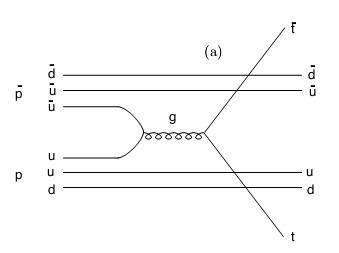
antiproton.jpg


In this case a quark from the proton annihilates with an antiquark of the same flavour in the antiproton into a gluon, which then dissociates into the \bar{t} t pair.

Since in the pp collision there are no antiquarks to annihilate with each other producing the gluon which decays to the top quark pair, how is this step achieved?

Any pointers in the right direction would be greatly appreciated.

Cheers
 
Physics news on Phys.org
I imagine that probably there is something that happens that creates the quark anti quark pair which can then annihilate but all I can think of is a W boson decaying but I'm not sure if that is right as I don't think they will be of the same flavour.

Anybody??
 
I'm not very familiar with particle physics, but you might do a search on "gluon fusion" and see if that helps.
 

Similar threads

Replies
1
Views
2K
  • · Replies 1 ·
Replies
1
Views
2K
  • · Replies 3 ·
Replies
3
Views
6K
  • · Replies 9 ·
Replies
9
Views
982
  • · Replies 1 ·
Replies
1
Views
2K
  • · Replies 5 ·
Replies
5
Views
4K
Replies
5
Views
8K
  • · Replies 4 ·
Replies
4
Views
3K
  • · Replies 1 ·
Replies
1
Views
3K
  • · Replies 4 ·
Replies
4
Views
1K