How does the quadratic formula derivation simplify?

Join the discussion
Registration is free. Ask a follow-up in this thread, or start your own.
9 replies · 4K views
sacred
Messages
4
Reaction score
0
This could be seen as a rather "basic" math question, but it is a topic of curiosity for me. I'm currently a senior in high school, taking a pre-ap pre-cal/trig/AP-Calculus double blocked class. I'm absolutely fascinated by mathematics, and something of keen interest to me is the derivation of the quadratic formula. Not only do I wonder who originally derived it and how they did it, but I want to completely understand it. (Again, I can see how some people would laugh at this, because it's not that hard to understand) However, there is one part that completely blows my mind:
596WQ.png

597mw.png


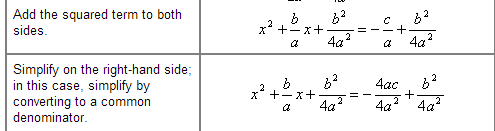
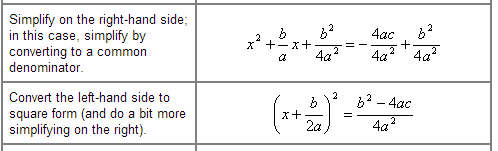
How exactly does this simplify? I've sat here staring at it, attempting to conceptualize it so I can continue... but I just can't. I don't understand it. Would someone care to explain?

Thank you,


sacred


edit: reading some other threads on this board... I feel like a complete idiot... bare with me
edit2: I can understand the right side, but not the left.
 

Attachments

  • 597mw.png
    597mw.png
    3.5 KB · Views: 471
  • 596WQ.png
    596WQ.png
    2.8 KB · Views: 507
Last edited:
Physics news on Phys.org
sacred said:
This could be seen as a rather "basic" math question, but it is a topic of curiosity for me. I'm currently a senior in high school, taking a pre-ap pre-cal/trig/AP-Calculus double blocked class. I'm absolutely fascinated by mathematics, and something of keen interest to me is the derivation of the quadratic formula. Not only do I wonder who originally derived it and how they did it, but I want to completely understand it. (Again, I can see how some people would laugh at this, because it's not that hard to understand) However, there is one part that completely blows my mind:


596WQ.png


How exactly does this simplify? I've sat here staring at it, attempting to conceptualize it so I can continue... but I just can't. I don't understand it. Would someone care to explain?

Thank you,

sacred

In the fraction ##-\frac c a## multiply the numerator and denominator by ##4a##. That makes the two fractions on the right have the same denominator so they can be added.
 

Attachments

  • 596WQ.png
    596WQ.png
    2.8 KB · Views: 476
LCKurtz said:
In the fraction ##-\frac c a## multiply the numerator and denominator by ##4a##. That makes the two fractions on the right have the same denominator so they can be added.

Thank you. :smile: What about the simplification of the otherside?

597mw.png
 

Attachments

  • 597mw.png
    597mw.png
    3.5 KB · Views: 458
Do you mean the lhs? It's a perfect square. Expand it.
 
sacred said:
Thank you. :smile: What about the simplification of the otherside?

597mw.png

Just square out ##\left(x+\frac b {2a}\right)^2## to see it agrees with the previous form.
 

Attachments

  • 597mw.png
    597mw.png
    3.5 KB · Views: 485
LCKurtz said:
Just square out ##\left(x+\frac b {2a}\right)^2## to see it agrees with the previous form.

I did this.

I don't understand how (b/2a)x + (b/2a)x simplifies to just bx/a
 
##\frac{b}{2a}x + \frac{b}{2a}x = \frac{1}{2}\frac{bx}{a} + \frac12\frac{bx}{a}##
 
pwsnafu said:
##\frac{b}{2a}x + \frac{b}{2a}x = \frac{1}{2}\frac{bx}{a} + \frac12\frac{bx}{a} = \frac{bx}{a}##

Fantastic. Thank you.
 
there is another method developed by sridhara(870-930)
ax2+bx+c=0
multiply both side by 4a
4a2x2+4abx+4ac=0
transposing 4ac
4a2x2+4abx=-4ac
add b2 to both sides
4a2x2+4abx+b2=-4ac+b2
then
(2ax+b)2=b2-4ac
2ax+b=√b2-4ac
2ax=-b(plus or minus)√(b2-4ac)
x=(-b(plus or minus)√(b2-4ac))/2a

i don't know why this is not taught in most schools,not having too many fractions this is more easier to understand since you don't take LCM