Sigurdsson
- 24
- 1
The following picture represents the current/voltage graph through a basic p-n junction diode.
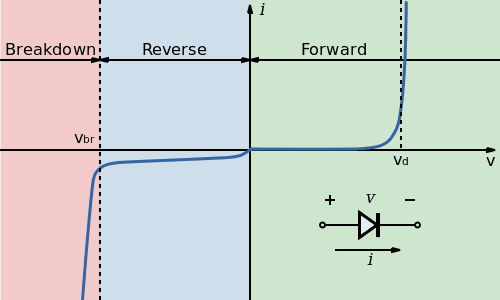
Diodes have a built in potential 0.6 volts. One must overcome this potential to make the diode work. This 0.6V are the nearly flat line in the forward region. Am I right?
My question is:
If you connect a diode in a closed circuit with resistance and a battery (+5V), then would Kirchoff work this way?
0 = 5V - 0.6V - 4.4V
Is the diode simply -0.6V?
And one more thing, what happens if the battery is only +0.5V?
Diodes have a built in potential 0.6 volts. One must overcome this potential to make the diode work. This 0.6V are the nearly flat line in the forward region. Am I right?
My question is:
If you connect a diode in a closed circuit with resistance and a battery (+5V), then would Kirchoff work this way?
0 = 5V - 0.6V - 4.4V
Is the diode simply -0.6V?
And one more thing, what happens if the battery is only +0.5V?