How is the binomial theorem used here?

Click For Summary

Discussion Overview

The discussion centers on the application of the binomial theorem in the context of Analytical Mechanics, specifically regarding the transition between two equations (eq. 3.4.5a and 3.4.5b) in a textbook. Participants are exploring the relevance and correctness of using the binomial theorem in this scenario.

Discussion Character

  • Technical explanation
  • Debate/contested

Main Points Raised

  • One participant asks how the binomial theorem is applied to transition between two specific equations in their textbook.
  • Another participant provides a link to a writeup on the binomial theorem and suggests identifying the variables in the context of the example.
  • A participant expresses skepticism about the application of the binomial theorem to operators, arguing that it does not apply since operators do not generally commute, and suggests that the distributive law is more appropriate in this case.
  • There is a comparison made between the factorization of quadratic equations for numbers and operators, highlighting the differences in their behavior.
  • A later reply indicates that the previous explanation clarified the participant's understanding.

Areas of Agreement / Disagreement

Participants express differing views on whether the binomial theorem is applicable in this context, with some supporting its use and others contesting it based on the nature of operators. The discussion remains unresolved regarding the correct application of the theorem.

Contextual Notes

There are limitations regarding the assumptions made about the commutation of operators and the definitions of terms used in the equations. The discussion does not resolve these aspects.

shanepitts
Messages
84
Reaction score
1
The below image shows a portion of my current Analytical Mechanics textbook.

My inquiry is how is the binomial theorem used to get from eq. 3.4.5a ⇒ 3.4.5b ?

Thanks in advance
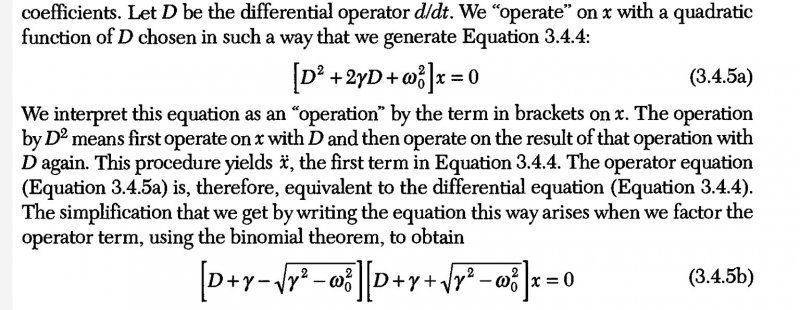
image.jpg
 
Mathematics news on Phys.org
Here's a writeup on the binomial theorem:

https://en.wikipedia.org/wiki/Binomial_theorem

and you can see the (x+y)^2 = x^2 +2xy +y^2

so what is x and what is y in your example?

work it backwards and forwards and you'll see there's a step they didn't tell you with respect to gamma.
 
  • Like
Likes   Reactions: shanepitts
shanepitts said:
The below image shows a portion of my current Analytical Mechanics textbook.

My inquiry is how is the binomial theorem used to get from eq. 3.4.5a ⇒ 3.4.5b ?

Thanks in advance

In fact, that's simply the factorisation of a quadratic equation. You have to be careful as Operators don't always commute, but in this case, as ##\gamma## and ##\omega_0## are constants, you get the same factorisation as if ##D## were a number.

(I'm not sure I would call that the Binomial theorem. The Binomial Theorem does not apply for Operators, as they do not generally commute. I would call it the distributive law: which does apply for Operators as well as numbers.)

As an exercise, you might like to compare:

##(x + y)(x - y)## (for numbers)

and

##(X + Y)(X - Y)## (for operators).
 
Last edited:
  • Like
Likes   Reactions: shanepitts
PeroK said:
In fact, that's simply the factorisation of a quadratic equation. You have to be careful as Operators don't always commute, but in this case, as ##\gamma## and ##\omega_0## are constants, you get the same factorisation as if ##D## were a number.

(I'm not sure I would call that the Binomial theorem. The Binomial Theorem does not apply for Operators, as they do not generally commute. I would call it the distributive law: which does apply for Operators as well as numbers.)

As an exercise, you might like to compare:

##(x + y)(x - y)## (for numbers)

and

##(X + Y)(X - Y)## (for operators).
Thank you

This clarified things
 

Similar threads

  • · Replies 6 ·
Replies
6
Views
2K
  • · Replies 6 ·
Replies
6
Views
2K
  • · Replies 2 ·
Replies
2
Views
3K
Replies
6
Views
4K
  • · Replies 9 ·
Replies
9
Views
2K
  • · Replies 2 ·
Replies
2
Views
4K
  • · Replies 1 ·
Replies
1
Views
2K
  • · Replies 2 ·
Replies
2
Views
2K
  • · Replies 3 ·
Replies
3
Views
3K
  • · Replies 2 ·
Replies
2
Views
4K