How many supports are needed for a symmetrical and antisymmetrical truss?

  • Thread starter Thread starter Dell
  • Start date Start date
  • Tags Tags
    Symmetry
Click For Summary

Discussion Overview

The discussion revolves around the analysis of a symmetrical truss subjected to an asymmetrical load. Participants explore the implications of symmetry and antisymmetry in structural analysis, particularly focusing on boundary conditions and the number of supports required for stability. The conversation includes theoretical considerations and practical applications related to truss design and loading conditions.

Discussion Character

  • Technical explanation
  • Debate/contested
  • Mathematical reasoning

Main Points Raised

  • One participant suggests dividing a symmetrical truss under asymmetrical loading into two separate trusses, one symmetrical and one antisymmetrical, to analyze the structure.
  • Another participant emphasizes the importance of boundary conditions, stating that antisymmetric loading will twist the structure but not cause deflection along the axis of symmetry.
  • There is a discussion about whether one or two supports are necessary at the central line of the truss, with some arguing that only one support is needed to allow for twisting without deflection.
  • Some participants express confusion over the definitions of symmetry, antisymmetry, and asymmetry in the context of the loading and structure.
  • One participant mentions a method taught by their lecturer that involves splitting symmetrical loads into symmetrical and antisymmetrical components, which they find effective.
  • Another participant questions the validity of this method, suggesting that other approaches may be more efficient.
  • Several participants discuss the implications of cutting the truss and the necessity of maintaining the original loading conditions during analysis.
  • There are references to software tools for calculating axial forces in trusses, with participants sharing links and recommendations.

Areas of Agreement / Disagreement

Participants do not reach a consensus on the necessity of supports or the definitions of symmetry and antisymmetry in this context. Multiple competing views remain regarding the analysis methods and boundary conditions.

Contextual Notes

Participants express uncertainty about the application of symmetry and antisymmetry in structural analysis, particularly regarding boundary conditions and the treatment of loads. There are unresolved questions about the implications of cutting the truss and how to properly account for the loading conditions.

Dell
Messages
555
Reaction score
0
given a symmetrical truss, loaded with an assymetrical load, i can divide this truss into 2 separate symmetrical trusses, one with a symmetrical load and one with an antisymmetrical load, then to solve the truss i can solve half of each of these 2 trusses and add/subtract results accordingly.

when i draw the left hand side of each of these trusses what supports do i add at the central line?? as far as i know, the symmetrical truss can have a "y" deflection at this point but the antisymmetrical truss cannot, so i add a support with an 'x' axis reaction to the symmetrical and a "y" reaction to the antisymmetrical

my question is how many supports do i need to add? in all the examples i have seen supports have been added at the corners,- as seen in this example
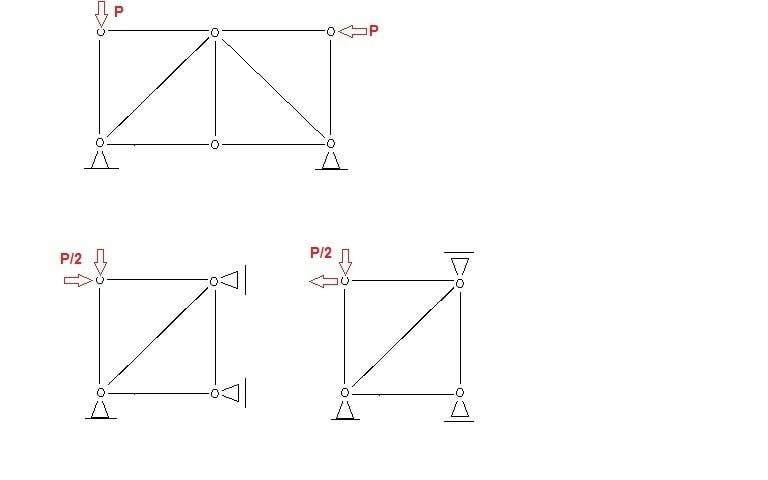
truss.jpg


but i think that adding just one of the supports (top right ) would do the trick as far as the deflection restraints are concerned..

also i have seen in examples with structures other than trusses, sometimes the central bar(if there is one) is ignored completely in the symmetrical half. why is this??
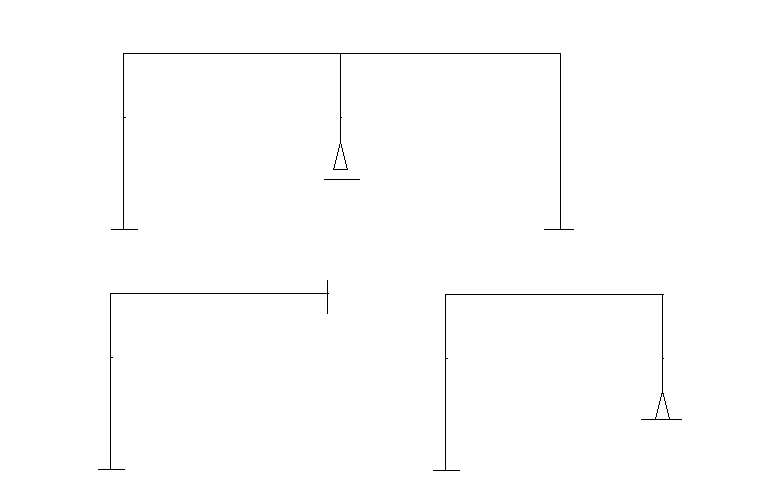
frame.png
 
Physics news on Phys.org
Hey mate,

From what I understand, you are undertaking a course in structural analysis. Yes?

You've identified that you have a symmetric structure under antisymmetric loading. From what you have said, you appear to be getting tripped up with the boundary condition. The condition on the right of your first diagram is the correct boundary condition.

The reasoning behind this is: antisymmetric loading will twist the structure at the axis of symmetry but not cause deflection along this axis.

So, you can either choose to analyse the RHS or LHS of the structure. It's up to you. I don't know what all of this P/2 business is all about though. There is no need to half the loading. Keep it as P. Be mindful that the member that you have cut on the axis of symmetry will have half of its original properties i.e. E/I/A will all be half of there original values.

Your initial structure (LHS/RHS) will be indeterminate to the first degree and you must thus make use of superposition and compatibility to solve it. Once you have solved all of the axial forces multiply them by -1 and that will immediately solve the reflected side of the structure. From this you should be able to see that the middle chord will be zero and that your reactions on the boundary condition will cancel out.

That is your problem finished.
 
correct this is for a course in structural analysis

the reason i have used p/2 is that from what i have learned this is not an antisymmetric structure but an asymmetric structure which i can divide into an antisymmetric structure and a symmetric structure. then when i add the 2 together i get the original structure,

but more specifically my question is about the boundary conditions,
if i do cut it and choose conditions as in the right diagram, causing no deflection along the axis, why can i not just add the top reaction, why do i need both, one is enough to allow twisting of the structure and not allow for any deflection.
 
I'm not sure about it being asymmetric. It has been reflected about the mid-span y-axis which (by definition) makes it symmetric.

Asymmetric_(PSF).png


To answer your question: The boundary condition must satisfy: all nodes along the cut member must be restrained in some manner. This is why the cut member must have the two rollers. Lateral deflection is allowed however deflection normal to the member is fixed due to the nature of the loading.

I don't understand what you mean when you say "i can divide into an antisymmetric structure and a symmetric structure". When you half the structure you should no longer be thinking about symmetry. Once cut you have the boundary condition (as explained) which must be resolved.

Your applied load P must stay intact. You would only ever half the load if it coincided on the reflected axis about which you half the properties of the corresponding member (like I mentioned before). i.e. E/A/I/ and applied load P would all be halved along the boundary.
 
no, the structure is definitely symmetric, but the loading is asymmetric, left hand side has one vertical force, right hand side has one horizontal force
 
Oh damn, sorry Dell, I didn't look at the loading correctly. I have never solved a symmetric structure under an asymmetric loading.

I ran a problem of this nature through the computer:

Loading: (The same as your diagram + loading)
http://i40.tinypic.com/2it1xue.jpg"

Axial Forces:
http://i43.tinypic.com/t6s4z5.jpg"

I can't see a correlation between symmetry, loading and axial forces straight off the bat. Perhaps this can help you work backwards. Sorry about the confusion.
 
Last edited by a moderator:
What's all this fuss about symmetry, antisymmetry, and asymmetrry? Are you trying to draw free body diagrams? Why not just solve the problem directly without cutting the truss in half? You might want to look at each applied load separately and superimpose the results, if you wish, but I don't know what you are trying to do with this -symmetric business. In the original truss, are both supports pinned?
 
jay- the requirements of the question were to draw the left hand side of the cut structure under symmetic and antisymmetric loading

Civil Engg- any symmetric structure under asymmetric loading can be split up into 2 symmetric structures, one with symmetric loading and one with antisymmetric load, the values of the lad are half the values of the original load,
as seen in my example the top left hand corner will have

P/2+P/2=P downwards
P/2-P/2=0 sidewards

and the right hand side will have the opposite,

also, which software did you use to calculate the axial forces in the truss, i have been looking for good free software as an aid and haven't found anything, ideally i would like something that can plot axial, shearing forces, moments and possibly elastic curves for various structurs,
 
As regards the vertical load I can see that the structure is symmetrical, and can be solved without splitting the structure by putting P in the middle (the symmetric case) and upwards P/2 at right end, and downwards P/2 at the left end (unsymmetric load, actually a couple). But Dell, how can you say that under the action of the horizontal load, that the structure has symmetry?
 
  • #10
i don't know what my lecturer is teaching us, but it works, and none of you guys seem to have heard of it,

he says that any symmetrical load can be split up into a symmetrical and anti symmetrical load, each on separate, but identical, symmetric structures, then to find the true forces, i can add these two structures results
 
  • #11
Actually I have heard of it but not used it in practice because other methods are better. It might have a use in computer methods to make the programme run faster but I don't know enough about that to be sure. Can you answer my query: "...how can you say that under the action of the horizontal load, that the structure has symmetry?"?
 
  • #12
Symmerty and antisymmetry proves useful when analysing a truss structure by hand. This is a learning exercise used to demonstrate the concept of energy methods (virtual work) in a system. In your case you have an asymmetric loading which I have never seen before.

If you want the program I used, here is the link:

http://www.line.co.ba/"

It's a simplistic program that does not fuss too much with the material properties.

I hope we've been of some help to you. Good luck! :D

P.S. If all else fails just knock on your lecturers office door.
 
Last edited by a moderator:
  • #13
pongo-
what i have drawn is the left hand side of the structure , once with a symmetrical load and once with an anti symmetrical load, the original truss is:

left hand of truss
L= (symmetric)L + (antisymmetric)L

right hand of truss
R= (symmetric)L - (antisymmetric)L

the symmetrical loaded truss has (p/2)--> on the left side and <--(p/2) on the right side

the anti symmetrically loaded truss has (p/2)<-- on the left side and <--(p/2) on the right side

together i get p/2 -p/2 =0 on the left
-p/2 - p/2 =-p on the right
 

Similar threads

  • · Replies 2 ·
Replies
2
Views
862
  • · Replies 7 ·
Replies
7
Views
4K
  • · Replies 2 ·
Replies
2
Views
3K
  • · Replies 1 ·
Replies
1
Views
2K
  • · Replies 1 ·
Replies
1
Views
3K
Replies
3
Views
5K
Replies
3
Views
2K
  • · Replies 1 ·
Replies
1
Views
2K
Replies
1
Views
2K
  • · Replies 1 ·
Replies
1
Views
9K