How Much Baking Soda Is Needed for a Perfect Reaction with Vinegar?

  • Context: Chemistry 
  • Thread starter Thread starter gary350
  • Start date Start date
  • Tags Tags
    Chemistry
Click For Summary
SUMMARY

The optimal reaction between baking soda (NaHCO3) and vinegar (CH3COOH) occurs in a 1:1 mole ratio, as established by the balanced chemical equation: NaHCO3 + CH3COOH → CO2 + H2O + CH3COONa. To achieve maximum CO2 production, approximately 5 grams of vinegar is required for every gram of baking soda, based on the molar masses of the reactants (NaHCO3: 84 g/mol, CH3COOH: 60 g/mol). Experiments indicate that after a certain point, additional vinegar yields diminishing returns in CO2 production, suggesting that using a stronger acid could enhance efficiency. Cost analysis reveals that adding excessive vinegar beyond a certain threshold is not cost-effective.

PREREQUISITES
  • Understanding of stoichiometry and mole ratios
  • Familiarity with chemical equations and molar mass calculations
  • Basic knowledge of acid-base reactions
  • Experience with laboratory equipment for measuring gas production
NEXT STEPS
  • Research the effects of varying acetic acid concentrations on CO2 production
  • Learn about alternative acids and their efficiency in similar reactions
  • Study methods for accurately measuring gas volumes in chemical reactions
  • Explore cost-benefit analysis techniques for chemical experiments
USEFUL FOR

Chemistry enthusiasts, educators, and anyone conducting experiments involving acid-base reactions, particularly those interested in optimizing CO2 production from baking soda and vinegar.

gary350
Messages
291
Reaction score
83
Homework Statement
Forgot how to do chemistry math?
Relevant Equations
Forgot how to do chemistry math?
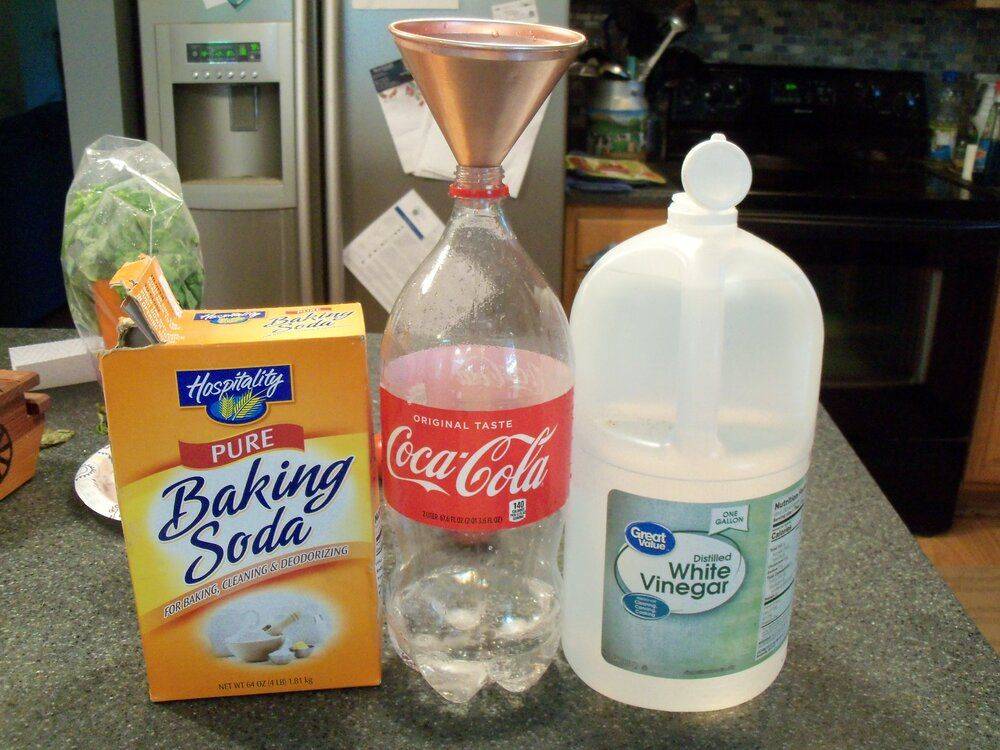
I took chemistry in high school & college 50 years ago. I don't remember how to do chemistry math? If someone knows the answer to my question it will be much easier than for me to figure it out BUT I would like to know how it is done I love technology. I took engineering in college.

vinegar + baking soda = CO2

Vinegar is 95% water and 5% acetic acid = CH3COOH

Baking soda = Sodium Bicarbonate = Sodium hydrogen carbonate = NaHCO3

Question #1, how much NaHCO3 is mixed with CH3COOH to be the perfect mixture to release all the gas?

Just from my experiments it appears I need about 5 times more vinegar than baking soda to release all the gas.

Formula should be something like this, 1 gram of NaHCO3 + 5 grams of CH3COOH = ? amount of C02
100_7410.JPG
 
Last edited:
Physics news on Phys.org
First write out the balanced equation,$$\mathrm{NaHCO_3} + \mathrm{CH_3 COOH} \rightarrow \mathrm{CO_2} + \mathrm{H_2 O} + \mathrm{CH_3 COONa}$$The equation tells you that one mole of ##\mathrm{NaHCO_3}## reacts with one mole of ##\mathrm{CH_3 COOH}##; N.B. that the stoichiometry tells you about the ratio of the numbers of molecules involved in the reaction, and not e.g. the ratios of the masses!

The mole ratio is therefore 1:1. To find the mass ratio, you need to multiply both by their molar masses. These are ##\mathrm{M_r(NaHCO_3)} = 84 \, \mathrm{g \, mol^{-1}}## and ##\mathrm{M_r(CH_3 COOH)} = 60 \, \mathrm{g \, mol^{-1}}##. If you know the concentration of ##\mathrm{CH_3 COOH}## in the vinegar, you can convert between the volume of the solution used and the mass of ##\mathrm{CH_3 COOH}## contained in that solution.
 
  • Like
Likes   Reactions: BvU
Hi,

You want to look up the molecular weight of the components:

1 mol of CH3COOH + 1 mol of NaHCO3 ##\rightarrow## 1 mol of CH3COONa + 1 mol of H2CO3

(82, 60, 84, 62 g/mol, respectively).

The H2CO3 goes to H2O + CO2 (18 and 44 g/mol, respectively).
 
My vinegar is 5% acetic acid. I have to use a lot more vinegar to use up all the baking soda.
 
Presumably that 5% is percentage by mass? So to find the required mass of the diluted solution of ethanoic acid, simply multiply the mass of ethanoic acid (that you deduced from the previous calculation) by 20.

Instead of saying things like "a lot more" (especially ambiguous when mixing a solid with a solution!) it is important to be specific. Are you talking about moles, mass, volume, concentration, something else? Precision in communication is key.
 
And don’t forget that you can test the pH of your neutralized solution as a check to your work. pH test for pool water is available for not too much at Wally World.
You can also measure the evolved CO2 if you have the equipment.

CO2 method:

Measure the most CO2 released by using more vinegar than base. Check by adding vinegar until no further gas is released. The volume of gas released divided by the (accurate) mass of bicarb is a constant. Do that test three times, calculate the individual volume/gram values and average the results.
Weigh out your bicarb and multiply by the constant you just calculated. This is how much gas you can expect from the mass of bicarb you have. Add vinegar slowly until you are 90% percent of the way there. Agitate and remeasure to be sure all the gas is measured. Continue adding vinegar in small portions until no further gas is evolved. Record the volume of vinegar added.

calculate how much vinegar was added and divide by the mass of bicarb. This should be a constant. Repeat the experiment twice more, calculate the vinegar volume / mass of bicarb each time and average the results. Compare to your calculations to this result and try to figure out why its so far off!

Notes:
1. You will need a closed vessel like a soda bottle, a stopper of some kind and a length of tubing. If you can stretch the tubing over the bottle opening, do that!
2. You should collect the CO2 over an acidic liquid like vinegar to minimize error due to the solubility of CO2 in neutral water.
3. This is best performed with a rigid soda bottle, not a squeezable plastic bottle.
4. Adding liquid to the closed bottle will displace some gas (air) in the bottle which will be measured in the grad cyl. Subtract the volume of added vinegar from the gas volume measured in your data.
5. Vinegar should be added by syringe to the closed container. Use the right sized syringe and measure out the right amount of bicarb so you can do the experiment with a single syringe.

Setup might look something like this except the desorption canister would be a soda bottle without an exit valve. You would add vinegar using a syringe/needle through the tubing near the top of the bottle.
1598460486904.png
 
Last edited:
I did an experiment. I figured vinegar would have surface tension because it is 95% water but it has no surface tension. Compared to alcohol there appears to be no difference in surface tension. 5% acetic acid is reducing surface tension or water.

I put 1 teaspoon of baking soda in a clear glass container.

The first 5 teaspoons of vinegar that was added produces very violent foam = CO2. Each teaspoon of vinegar produces less and less foam = CO2. Teaspoon 11, 12, 13, 14, I have to stir the mixture to release more CO2 and the amount of CO2 that is releases is extremely small. After 14 teaspoons of vinegar I tasted the mixture it still has a slight baking soda flavor. 15 teaspoons extremely small noticeable CO2 is released. I tasted the mixture with 15 teaspoons of vinegar it has almost no flavor it is very close to neutral. I have PH paper I could have tested it but this is close enough for me.

I am making CO2. There is such an extremely small amount of CO2 produced after 10 teaspoons of vinegar I think the other 5 teaspoons are wasted vinegar. Those 5 teaspoons 11 to 15 will be more efficient to produce many times more CO2 by mixing them to a new teaspoon of baking soda. It is logical the small release of CO2 for teaspoon 11 to 15 is because vinegar is only 5% acid. If I were to use 40% acid I will probably see a higher amount of CO2 released and only need about 1.9 teaspoons of acid to do the job.

Vinegar is about $2.50 per gallon and baking soda is about $2.50 for 3.5 lbs. I could do math to learn how much 1 teaspoon of baking soda costs and how much 1 teaspoon of vinegar cost but I can see it is not cost effective to add 5 more teaspoons after teaspoon #10 the extra cost of vinegar out weights the amount of CO2 produced. A stronger acid or different acid and lower price acid my prove different results.
 
Last edited:

Similar threads

  • · Replies 2 ·
Replies
2
Views
31K
Replies
2
Views
3K
  • · Replies 8 ·
Replies
8
Views
42K
  • · Replies 1 ·
Replies
1
Views
27K
Replies
16
Views
3K
  • · Replies 1 ·
Replies
1
Views
7K
  • · Replies 1 ·
Replies
1
Views
4K
  • · Replies 7 ·
Replies
7
Views
4K
  • · Replies 13 ·
Replies
13
Views
17K
  • · Replies 3 ·
Replies
3
Views
4K