How to Calculate Heat Generated on R2 After Finding Voltage and Charge?

  • Thread starter Thread starter aang
  • Start date Start date
  • Tags Tags
    Charge Voltage
Join the discussion
Registration is free. Start your own thread to ask a follow-up.
10 replies · 2K views
aang
Messages
29
Reaction score
3
Homework Statement
c1=c3=2,c2=4.switch s1 is closed while s2 is open. A long time after s2 is closed and s1 is opened.

A long time after S2 IS CLOSED,

Find the charge in c3.

The sum of energy stored in c2 and c3.

Heat generated in R2.
Relevant Equations
V=IR,Q=CV,W=1/2CV2
I WAS ABLE TO FIND THE voltage in c1 ,c2 which are 4,2.THE CHARGES ARE THE SAME(8).
I DONOT KNOW HOW TO CONTINUE.
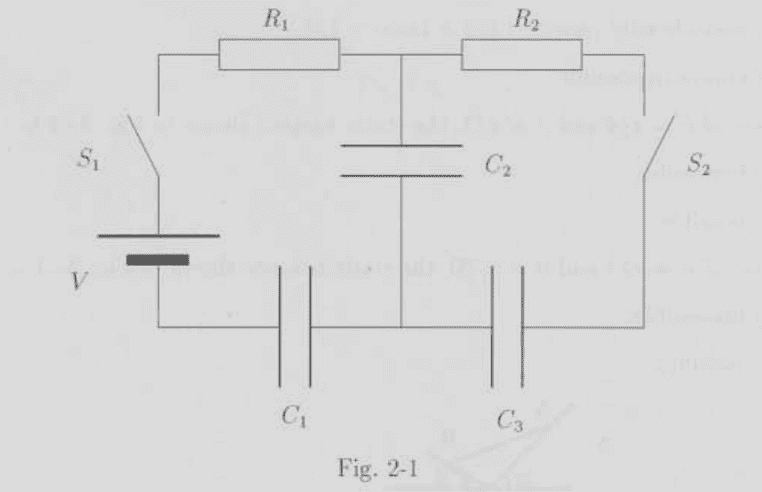
Screenshot 2021-05-30 112348.png
 
  • Like
Likes   Reactions: Delta2
Physics news on Phys.org
Hello again,

Please help me understand the problem statement (by rendering it completely ?). So far I have the scenario
  • all capacitors are uncharged. s1 and s2 are open
  • s1 is closed -- this charges C1 and C2
  • s1 is opened
  • s2 is closed -- this redistributes the charge from C2 over C2 and C3
Did I get it correctly ?

Also, how can you get numerical results (4,2 things of what ? Charge 8 of what?)

##\ ##
 
yeah. you got it correct.
Things of what in the sense if you are referring to the units v and c.(I don't know what you are asking.
)
 
First of all you got to mention the units (as @BvU said) of capacitance ,voltage and charges. Are they 2 and 4 Farads respectively and 4V (Volts) and 2 V respectively and 8 Coulomb charge each?

Second , to answer what happens after S2 is closed (and S1 opened) you have to use conservation of charge and equality of voltages. Long time after S2 is closed, there is no current through the resistor ##R_2##, hence by applying KVL we get that $$V_2=V_3\iff \frac{Q_2}{C_2}=\frac{Q_3}{C_3}$$.

What do you get if you apply conservation of charge for the moment before S2 is closed (S1 opened) at which all the charge ##Q## is inside ##C_2## and for the final moment which is long time after S2 is closed and the initial charge ##Q## of ##C_2## has been redistributed in ##Q_2## (final charge on ##C_2## ) and ##Q_3## (final charge on ##C_3##)?
 
I NEED MORE INFORMATION ABOUT how to apply conservation of charge.
units YOU mention are correct.
 
aang said:
I NEED MORE INFORMATION ABOUT how to apply conservation of charge.
Well, in order to apply any conservation principle one has to discriminate between two moments in time: (##t_1## and ##t_2##) and then equate the conserved quantity (which here is the charge) as ##charge (t_1)=charge (t_2)##
Here in this problem we have:
  • time ##t_1##: BEFORE S2 is closed the charge Q=8Coulomb is all in ##C_2##
  • time ##t_2##:long time AFTER S2 is closed we have charge ##Q_2## in ##C_2## and ##Q_3## in ##C_3##
what conservation of charge tell us for the relation between ##Q##, ##Q_2## and ##Q_3##