How to calculate (mechanical) clutch forces

Click For Summary
To calculate the forces involved in a mechanical clutch system, the force applied at the clutch pedal is multiplied by the mechanical advantage ratios of the pedal and cable lengths. For example, if a force of 200 N is applied to the pedal with a 3:1 ratio, the force on the clutch cable would be 600 N. Further mechanical advantage from the cable to the throwout bearing can increase this force to approximately 1800 N, depending on the design. A load cell can be used to measure the force exerted at the pedal for accurate baseline data. Understanding these relationships is crucial for designing a clutch cable testing machine effectively.
kanibal
Messages
2
Reaction score
0
Hello
i am working on a small clutch cable testing machine this machine can give the lifetime of clutch cable
i need some assistance to figure out how much forces i need to apply on this mechanism , and because the cable related directly in the clutch I'm asking if the force in the clutch in the same us what we give to the pedal example : if i push the pedal with 200 N how mach force is applied into release the clutch it is the same 200 N or more and why !
Automo74_ypagcc.jpg


this is the mechanism i made
 
Engineering news on Phys.org
Simple solution is to attach a load cell to the clutch pedal and press it down slowly and release it slowly, it will give you force in PSI at its peek in both directions of travel. Just repeat till you have a base line and average it, then adjust the machine accordingly.
 
  • Like
Likes kanibal
kanibal said:
if i push the pedal with 200 N how mach force is applied into release the clutch it is the same 200 N or more and why !

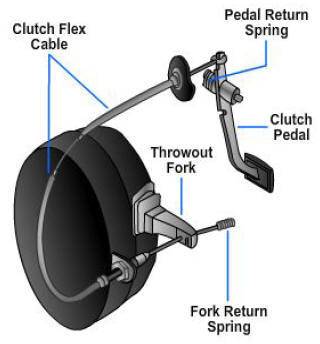
With regard to the above question the force on the clutch is first increased at the clutch pedal assembly. The force you place on the pedal is multiplied by the ratio of the clutch arm length between the pivot and the pedal and the clutch arm length between the clutch cable connection and the pivot.
ie. F clutch cable = F foot x L foot pedal / L cable connection
Additionally, the actual force on the clutch may also be increased over the cable force by a similar design on the throwout fork between the clutch plate bearing contact point(s) and the clutch cable attachment point
 
  • Like
Likes kanibal
Its worth noting that the PSI will peek and then drop as the clutch pedal is pressed due to the (release point) on the diaphragm spring. I am assuming that "peek" is what you are looking for. When the throw-out Bearing is pressed against the diaphragm spring passed the middle point of travel it (breaks) and becomes easier to push once its passed that point due to less resistance in the spring.
 
  • Like
Likes kanibal
thank you both of you for the answer

How the machine would look like if I asked you making this machine if possible with a simplified drawing to make it easier to understand
 
Looking at your drawing, and making some rough guesses.

If the ratio of the distance from the clutch pedal 'pad' to the cable attachment point is 3:1, that will be the mechanical advantage you have on the cable, so 200N of force on the pedal will be 600N of force on the cable.. Then once more you look at the mechanical advantage the cable has on the throwout bearing.. Most designs similar to what you show have about a 3:1 ratio again, so the 600N of force on the cable is multiplied to 1800N

@qjonesy I think you mean "peak" (Maximum) not "peek" (take a look at)
 
Had my central air system checked when it sortta wasn't working. I guess I hadn't replaced the filter. Guy suggested I might want to get a UV filter accessory. He said it would "kill bugs and particulates". I know UV can kill the former, not sure how he thinks it's gonna murder the latter. Now I'm finding out there's more than one type of UV filter: one for the air flow and one for the coil. He was suggesting we might get one for the air flow, but now we'll have to change the bulb...

Similar threads

  • · Replies 21 ·
Replies
21
Views
3K
  • · Replies 4 ·
Replies
4
Views
6K
  • · Replies 1 ·
Replies
1
Views
1K
  • · Replies 3 ·
Replies
3
Views
2K
  • · Replies 13 ·
Replies
13
Views
126K
  • · Replies 10 ·
Replies
10
Views
14K
  • · Replies 9 ·
Replies
9
Views
2K
  • · Replies 5 ·
Replies
5
Views
6K
Replies
2
Views
2K
  • · Replies 3 ·
Replies
3
Views
634