How to calculate natural frequency of timing belt

Click For Summary
SUMMARY

The discussion focuses on calculating the natural frequency of a timing belt in a belt pulley system designed to operate at 8000 RPM. Key factors include belt pretension and the tension differences on each side of the belt during operation. Participants suggest treating the unsupported lengths of the belt as vibrating strings and calculating resonant frequencies based on pulley speeds and engagement rates. Useful resources include links to Wikipedia and specific technical manuals for timing belts.

PREREQUISITES
  • Understanding of belt pulley systems and their dynamics
  • Knowledge of natural frequency and resonance concepts
  • Familiarity with timing belt specifications and limitations
  • Basic mechanics of string vibration and tension analysis
NEXT STEPS
  • Research "timing belt natural frequency calculations" for detailed methodologies
  • Explore "vibrational analysis of belt systems" to understand resonance effects
  • Learn about "belt pretensioning techniques" to optimize performance
  • Investigate "pulley design considerations" for maximum speed and efficiency
USEFUL FOR

Mechanical engineers, design engineers, and anyone involved in the design and analysis of belt-driven systems will benefit from this discussion.

friscoboya
Messages
6
Reaction score
1
Hello

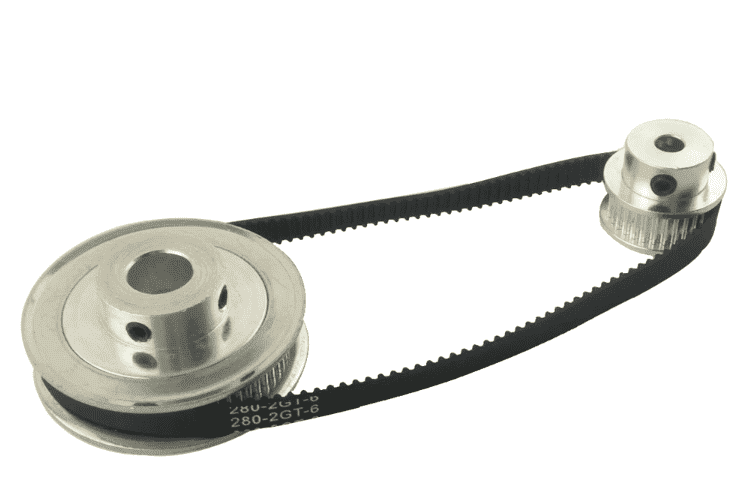
I am designing a shaft and it will be powered via belt pulley system. The ideal RPM of the shaft is 8000 RPM. How do I calculate the natural frequency of the timing belt to ensure resonance is never met? From what I read online it has to do with belt pretension, but even then I am little lost. Equations and links would be helpful.
upload_2018-11-28_17-17-46.png

Thank you
 

Attachments

  • upload_2018-11-28_17-17-46.png
    upload_2018-11-28_17-17-46.png
    25.3 KB · Views: 2,192
Engineering news on Phys.org
Not really my field but if I had to approach this problem I would look at this...

https://en.m.wikipedia.org/wiki/String_vibration

Treat each unsupported length of belt as a potentially vibrating string. Remember the tension in each side is different when its running. Calculate likely resonant frequencies for both sides.

Then think about possible drivers at or near those frequencies? For example the rate at which teeth engage or disengage with the ends of an unsupported length? Perhaps the pulley speeds (in revolutions per second) or perhaps the whole belt speed (in revolutions per second)?

But perhaps there is a more formal method?
 

Similar threads

  • · Replies 5 ·
Replies
5
Views
1K
Replies
4
Views
3K
  • · Replies 10 ·
Replies
10
Views
2K
  • · Replies 8 ·
Replies
8
Views
2K
  • · Replies 1 ·
Replies
1
Views
5K
  • · Replies 9 ·
Replies
9
Views
2K
  • · Replies 5 ·
Replies
5
Views
5K
Replies
8
Views
3K
  • · Replies 8 ·
Replies
8
Views
4K
Replies
1
Views
1K