How to calculate the gravity on a hill?

Click For Summary

Homework Help Overview

The discussion revolves around calculating the gravitational force acting on a box resting on an inclined hill with a specified angle. The original poster presents a scenario involving a box with a mass of 40 kg on a 25-degree slope and seeks clarification on how to determine the gravitational component acting along the incline.

Discussion Character

  • Conceptual clarification, Mathematical reasoning, Assumption checking

Approaches and Questions Raised

  • The original poster attempts to calculate the gravitational force and its component along the incline, questioning the use of sine and cosine in their calculations. Some participants clarify the geometric interpretation of the problem and suggest drawing the correct triangle to visualize the forces involved.

Discussion Status

Participants are actively engaging in clarifying the concepts of vector components and the correct application of trigonometric functions in the context of inclined planes. There is a productive exchange of ideas, with some guidance provided on how to approach the problem geometrically.

Contextual Notes

There is an emphasis on understanding the relationship between the angle of the slope and the components of gravitational force, with participants exploring the implications of different angles on the calculations. The original poster expresses confusion regarding the correct method, indicating a need for further clarification on the topic.

caspeerrr
Messages
9
Reaction score
0
Member advised to use the homework template for posts in the homework sections of PF.
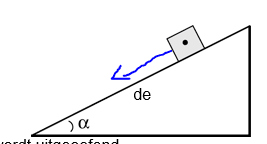
The question is about a box with no movement standing on a hill. The hill has an angle of 25 degrees. The box has a mass of 40 kg.
1. Calculte the gravity
This I still get: F= M x A = 40 x 9,81 = 3,9 x 10^2
The next question tough:
2. Calculate the component Fgravity,x off the gravity alongside the hill.
The component I think they ment is marked on the picture included.

What I did was 390 / sin(25) because the opposite is known (the gravity) and you want to calculate the hypotenuse. The answer indicates this as the right answer tough: Fgravity,x = Fgravity sin(a) = 165,8

Why do they multiply when you should divide?
Am I missing something?
Thanks in advance!
Knipsel.PNG
 
Physics news on Phys.org
caspeerrr said:
What I did was 390 / sin(25) because the opposite is known (the gravity) and you want to calculate the hypotenuse.
You want the component of the weight acting down the incline. When finding the component of a vector using a right triangle, the full vector is always the hypotenuse. (The components are always smaller than the full vector.)

You're using the wrong triangle: Draw the weight vector acting straight down. That's the hypotenuse of the correct triangle.
 
Doc Al said:
You want the component of the weight acting down the incline. When finding the component of a vector using a right triangle, the full vector is always the hypotenuse. (The components are always smaller than the full vector.)

You're using the wrong triangle: Draw the weight vector acting straight down. That's the hypotenuse of the correct triangle.
Doc Al said:
You want the component of the weight acting down the incline. When finding the component of a vector using a right triangle, the full vector is always the hypotenuse. (The components are always smaller than the full vector.)

You're using the wrong triangle: Draw the weight vector acting straight down. That's the hypotenuse of the correct triangle.

Aaah I get it, thank you!
 
If you find yourself in an exam and can't remember if it's sin or cos... consider what happens if the angle of the slope is reduced towards zero degrees (no slope). The force you calculate down the slope should approach zero. Your calculator will tell you sin(0)=0 but cos(0)=1.
 

Similar threads

  • · Replies 11 ·
Replies
11
Views
3K
  • · Replies 2 ·
Replies
2
Views
2K
Replies
4
Views
2K
Replies
19
Views
5K
Replies
3
Views
2K
  • · Replies 2 ·
Replies
2
Views
2K
Replies
6
Views
3K
Replies
5
Views
4K
Replies
1
Views
3K
Replies
2
Views
2K