How to conclude a mathematical expression with the provided background

  • Context: Graduate 
  • Thread starter Thread starter mcastillo356
  • Start date Start date
  • Tags Tags
    Expression Mathematical
Click For Summary

Discussion Overview

The discussion revolves around the mathematical expression for the natural logarithm and its relationship to areas under the curve of the function \( y = \frac{1}{t} \). Participants explore the implications of the definition of the natural logarithm and how it relates to the derivative of the logarithm function, particularly in the context of the theorem presented in a calculus textbook.

Discussion Character

  • Exploratory
  • Technical explanation
  • Debate/contested
  • Mathematical reasoning

Main Points Raised

  • Some participants question whether one can conclude that \( \ln(x+h) - \ln(x) \) represents the area under the curve based solely on the definition of the natural logarithm.
  • Others propose that the relationship between the areas and the logarithmic function follows from the integral definition of the natural logarithm, specifically \( \int_a^b \frac{dt}{t} = \ln(b) - \ln(a) \).
  • A participant distinguishes three cases based on the values of \( x \) and \( h \) to analyze the area under the curve and its implications for the logarithmic function.
  • Some participants express confusion regarding the proof structure and the assumptions made in the textbook regarding the area representation.
  • There are discussions about the validity of certain mathematical statements and whether they hold true under the defined conditions.

Areas of Agreement / Disagreement

Participants do not reach a consensus on whether the area represented by \( \ln(x+h) - \ln(x) \) can be concluded from the provided definitions. Multiple competing views remain regarding the interpretation of the logarithm's definition and the associated areas.

Contextual Notes

Some participants note the absence of references to the Riemann integral or the Fundamental Theorem of Calculus in the textbook's proof, which may affect the clarity of the argument presented. Additionally, the discussion highlights the need for careful consideration of the cases where \( x \) and \( h \) fall relative to 1, as this influences the interpretation of the logarithmic function.

mcastillo356
Gold Member
Messages
660
Reaction score
364
Hi PF

In my textbook, the Spanish 6th edition of "Calculus", by Robert A. Adams, at Chapter 3.2, Theorem 1 states:

If ##x>0##.

$$\dfrac{d}{dx}\ln{x}=\dfrac{1}{x}$$

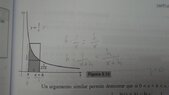
PROOF For ##x>0## and ##h>0##, ##\ln{(x+h)}-\ln{(x)}## is the area of the shaded part (...) Regard the shaded area at Figure 3.10
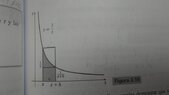
PF 1.jpg
All of this is right. My question is: let's put I know nothing but what I've read until this page: could anybody conclude that ##\ln{(x+h)}-\ln{(x)}## is the area pointed out? As far as I know, the starting point is the Definition 6 of natural logarithm:

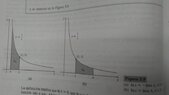
"For ##x>0##, be ##A_x## the flat area bounded by ##y=1/t##, the ##t## axis, ##t=1## and ##t=x##. Function ##\ln x## is defined this way:

$$\ln x=\begin{cases}{A_x}&\text{if}& x\geq{1}\\-A_x & \text{if}& 0<x<1\end{cases}$$

As shown in Figure 3.9
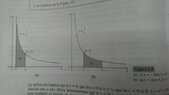
PF 0.jpg
Greetings
 
Last edited by a moderator:
Physics news on Phys.org
I'm not sure where you are heading with your question. Could you elaborate a bit more? Is it that you question the area being ln(x)?
 
Last edited:
  • Informative
Likes   Reactions: mcastillo356
Yes, ##0<x<1## for the ##-A_x## (mentor note: edited first post to fix this typo)

I will add my opinion about why I have the doubt.

I distinguish three possible cases, based on the definition:

1- For ##1>x>0## and ##1>h>0##, the area bounded by ##y=1/t##, ##y=0##, and ##t=x## y ##t=x+h##, would be ##-(\mbox{ln}\;(x+h)+\mbox{ln}\;x)##;

2- for ##x>1## and ##1>h>0##, ##\mbox{ln}\;(x+h)-\mbox{ln}\;x##;

3- for ##x>1## and ##h>1##, ##\mbox{ln}\;(x+h)+\mbox{ln}\;x##.
 
Last edited by a moderator:
mcastillo356 said:
My question is: let's put I know nothing but what I've read until this page: could anybody conclude that ##\ln{(x+h)}-\ln{(x)}## is the area pointed out?
I'm not sure. In your textbook, has it already been proven that ##\int_a^b \frac {dt} t = \ln (b) - \ln(a)##? It seems to me that the author is using this fact to conclude that the area shown is ##\ln(x + h) - \ln(x)##.
 
  • Like
Likes   Reactions: jedishrfu
No trace of Riemann, or Fundamental Theorem of Calculus, needed to face this conclusion. But... I've got algebra:
Instead of ##f(x)=1/t##, let's imagine ##f(x)=1##. Be ##g:=f(x)(x-1)##. We have ##g(1)=0##.
If ##x>1##, ##g(x)## is the area below ##f(x)## from 1 to ##x##. If ##0<x<1##, ##g(x)=f(x)(x-1)=-f(x)(1-x)##, minus the area below ##f(x)## from ##x## to 1? What does it mean this last sentence? How do I use this example to explain ##\ln(x+h)-\ln (x)##?:confused:
 
I would imagine the first step is to prove that ##\frac{d}{dx}\ln x = \frac 1 x## using the chain rule; then, using the FTC show that the antiderivative of ##\frac 1 x## is ##\ln | x |+ C##.

I don't understand at all what the book is doing.
 
  • Informative
Likes   Reactions: mcastillo356
I think you are overcomplicating everything, just from the definition of ln (as given in the book) the property follows trivially, @mcastillo356 is not far when doing
mcastillo356 said:
I distinguish three possible cases, based on the definition:

1- For ##1>x>0## and ##1>h>0##, the area bounded by ##y=1/t##, ##y=0##, and ##t=x## y ##t=x+h##, would be ##-(\mbox{ln}\;(x+h)+\mbox{ln}\;x)##;

2- for ##x>1## and ##1>h>0##, ##\mbox{ln}\;(x+h)-\mbox{ln}\;x##;

3- for ##x>1## and ##h>1##, ##\mbox{ln}\;(x+h)+\mbox{ln}\;x##.
But, first of all, your three cases are not really good, for example the two possibilities x=0.5, h={0.1, 0.6} are both in case 1, but ##\ln{(x+h)}## is defined differently for each case because ##x+h=0.6<1## in the first case but ##x+h=1.1\geq1## in the second one.
So let's see if you can split the ##x## and ##h## space in a better way.
Then you should also look more carefully at the definition of ln (splitting into cases correctly help you with this) and you will see that indeed the area they tell you is exactly equal to the difference ##\ln{x+h}-\ln{x}##.
 
  • Like
  • Informative
Likes   Reactions: jedishrfu and mcastillo356
Hello
This post is written as a doubt, a question, rather than a statement . I start quoting the book, and then comes my attempt to fit the mathematical expression ##\ln (x+h)-\ln x## with the context.
"DEFINITION 6 Natural logarithm
For ##x>0##, be ##A_x## the flat area bounded by the curve ##y=1/t##, the ##t## axis and ##t=1##, and ##t=x##. The function ##\ln x## is defined this way:
$$\ln x\begin{cases}{A_x}&\text{if}& x\geq{1}\\-A_x & \text{if}& 0<x<1\end{cases}$$
shown in this figure
1 y 2.jpg
(a)##\ln x=-\mbox{area}\;A_x##, if ##0<x<1##
(b)##\ln x=\mbox{area}\;A_x##, if ##x\geq{1}##
The definition implies ##\ln 1=0##; ##\ln x>0## if ##x>1##; ##\ln x<0## if ##0<x<1## and is a one-to-one function. Now we will prove that if ##y=\ln x##, then ##y'=1/x##. The proof of this result is similar to the proof of the Theorem Fundamental of Calculus (...)
THEOREM 1 If ##x>0## then
$$\frac{d}{dx}\ln x=\dfrac{1}{x}$$
PROOF For ##x>0## and ##h>0##, ##\ln(x+h)-\ln x## is the flat area bounded by ##y=1/t##, ##y=0##, and vertical lines ##t=x## and ##t=x+h##. Regard the shaded area shown in this figure..."
3.jpg
My try:
For ##1>x>0## and ##1>h>0##
##-\ln x<0##
##-\ln (x+h)<0##
$$-(\ln (x+h)+\ln x)<0$$
For ##x>1## and ##1>h>0##
##\ln x>0##
##1<\ln (x+h)<0##
$$\ln (x+h)<\ln x$$
For ##x>1## and ##h>1##
##\ln x>0##
##\ln (x+h)>0##
$$\ln (x+h)>\ln x$$

Greetings
 
mcastillo356 said:
My try:
For ##1>x>0## and ##1>h>0##
##-\ln x<0##
##-\ln (x+h)<0##
$$-(\ln (x+h)+\ln x)<0$$
This is not true, you yourself have noticed few lines before that ##0<x<1 \Longrightarrow \ln{x}<0## but now you're saying that ##0<x<1 \Longrightarrow -\ln{x}<0##, how could that be possible?
I have already given you an argument why ##-\ln (x+h)<0## is false in my previous post.
Therefore clearly your final expression is wrong.

mcastillo356 said:
For ##x>1## and ##1>h>0##
##\ln x>0##
##1<\ln (x+h)<0##
$$\ln (x+h)<\ln x$$
Does ##1<\ln (x+h)<0## even make sense?
mcastillo356 said:
For ##x>1## and ##h>1##
##\ln x>0##
##\ln (x+h)>0##
$$\ln (x+h)>\ln x$$
The first two are correct, but writing one statement below another without any connection is not a valid proof in mathematics.

I would recommend you to read again my previous post.
 
  • Informative
Likes   Reactions: mcastillo356
  • #10
Mark44 said:
I'm not sure. In your textbook, has it already been proven that ##\int_a^b \frac {dt} t = \ln (b) - \ln(a)##? It seems to me that the author is using this fact to conclude that the area shown is ##\ln(x + h) - \ln(x)##.
The way I understand it is that the book, essentially uses the equation $$\int_1^x \frac{dt}{t}=\ln x-\ln1$$ as the definition of the function ##f(x)=\ln x##.
 
  • Like
Likes   Reactions: mcastillo356
  • #11
Delta2 said:
The way I understand it is that the book, essentially uses the equation $$\int_1^x \frac{dt}{t}=\ln x-\ln1$$ as the definition of the function ##f(x)=\ln x##.
That's more or less what I was asking about in post #4...
 
  • Like
Likes   Reactions: mcastillo356 and Delta2
  • #12
There are 3 cases (x,h are both greater than zero)
x<1,x+h<1
x<1,x+h≥1
x≥1,x+h≥1
Try drawing a picture for each of the cases of the areas under the 1/x curve from the definition of ln
 
  • Like
Likes   Reactions: Delta2
  • #13
caz said:
There are 3 cases (x,h are both greater than zero)
x<1,x+h<1
x<1,x+h≥1
x≥1,x+h≥1
Try drawing a picture for each of the cases of the areas under the 1/x curve from the definition of ln
Hello, PF
I've drawn each case with Geogebra, but I've had to use, for example and for the first case, ##x<1## and ##(x+h)<1## the command "Integral(1/x,0.6,0.8)", and so on.
Let's write down the text again (the following is to read over...)
DEFINITION 6 The natural logarithm
For ##x>0##, be ##A_x## the shaded flat surface bounded by ##y=1/t## curve, the ##t## axis and the vertical line ##t=1## and ##t=x##. ##\ln x## function is defined this way:

$$\ln x\begin{cases}{A_x}&\text{if}& x\geq{1}\\-A_x & \text{if}& 0<x<1\end{cases}$$

shown in Figure 3.9

The definition implies that for ##\ln 1=0##, ##\ln x>0## if ##x>1##, ##\ln x<0## if ##0<x<1##, and is a one-to-one function. We will prove that if ##y=\ln x##, then ##y'=1/x##. The proof of this theorem is similar to the demonstration of the TFC we will provide in section 5.5.

THEOREM 1 If ##x>0##, then

$$\dfrac{d}{dx}\ln x=\dfrac{1}{x}$$

DEMONSTRATION For ##x>0## and ##h>0##, ##\ln(x+h)-\ln x## is the area of the flat surface bounded by ##y=1/t##, ##y=0##, and the vertical lines ##t=x## and ##t=x+h##. Belongs to the shaded area in Figure 3.10. Comparing this area with the one of the two rectangles it follows that

$$\dfrac{h}{h+x}<\mbox{shaded area}=\ln(x+h)-\ln x<\dfrac{h}{x}$$

(Then comes the well-known figure)...

The fact is that I'm not sure whether is it using Fundamental Theorem of Calculus or not, but I've done the homework (draw all the cases with Geogebra). Nothing works to conclude from the background that "For ##x>0## and ##h>0##, ##\ln(x+h)-\ln x## is the area of the flat surface bounded by ##y=1/t##, ##y=0##, and the vertical lines ##t=x## and ##t=x+h##", unless I say: ##\ln x## is a strictly increasing function. Then is trivial.
 
  • #14
I have a meeting in 5 minutes, so I’ll give a hint and check back later
ln(x+h) is the area under 1/x from 1 to x+h
ln(x) is the negative of the area under 1/x from x to 1
What is the difference between them?

edit: for case 2
 
Last edited:
  • Informative
Likes   Reactions: mcastillo356
  • #15
See picture

IMG_20210805_0005.jpg


The other two cases are similar
 
  • Like
  • Wow
Likes   Reactions: Delta2 and mcastillo356
  • #16
I disagree. It works your example...Let me see... Please, forgive me...I must think it over.
Thanks! :smile:
 
  • #17
I disagree with your disagreement. :-p

IMG_20210805_0009.jpg


Notice that there is an overlap region in both of these cases
 
Last edited:
  • Like
Likes   Reactions: PhDeezNutz, mcastillo356 and Delta2
  • #18
:doh: I have no words to express my gratitude.:partytime:. Thanks!
Greetings
 
  • Love
  • Like
Likes   Reactions: PhDeezNutz, Frabjous and Delta2

Similar threads

  • · Replies 1 ·
Replies
1
Views
1K
  • · Replies 1 ·
Replies
1
Views
3K
  • · Replies 1 ·
Replies
1
Views
3K
  • · Replies 4 ·
Replies
4
Views
2K
  • · Replies 2 ·
Replies
2
Views
1K
  • · Replies 1 ·
Replies
1
Views
2K
  • · Replies 11 ·
Replies
11
Views
3K
  • · Replies 1 ·
Replies
1
Views
1K
  • · Replies 3 ·
Replies
3
Views
1K
  • · Replies 2 ·
Replies
2
Views
2K