How to control heavy ball in x and y direction?

Click For Summary
SUMMARY

This discussion focuses on controlling the movement of a heavy ball using two motors and rubber bands in the X and Y directions. The configuration resembles a computer mouse with a ball, where friction between the ball and rubber rollers is a significant concern. Suggestions include placing rollers farther out to lower the center of gravity for improved stability. The conversation also references the concept of a floating granite ball fountain as an alternative design approach.

PREREQUISITES
  • Understanding of mechanical design principles
  • Familiarity with motor control systems
  • Knowledge of friction dynamics in mechanical systems
  • Basic concepts of stability in engineering
NEXT STEPS
  • Research motor control techniques for precise movement
  • Explore friction reduction methods in mechanical systems
  • Investigate design principles for stability in rolling mechanisms
  • Learn about floating ball fountain mechanisms and their applications
USEFUL FOR

Engineers, hobbyists, and designers interested in mechanical movement systems, particularly those working with motorized devices and friction management.

_Patrick_
Messages
1
Reaction score
0
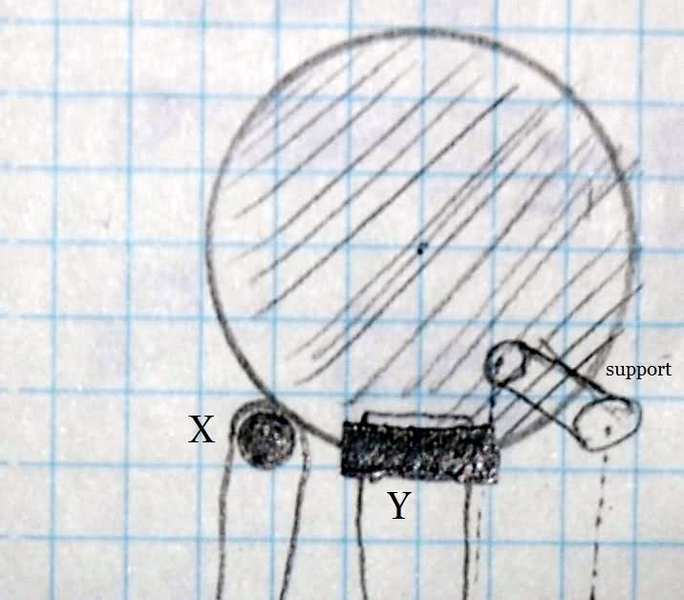
Hi there - I'm trying to build a decorational device that holds a rather heavy ball and I want to be able to control it's "movement/roll" in the X and Y directions (they are horizontal as well as orthogonal).
2w1wp3l.jpg


The two black cylinders (X and Y) aren't floating, but I forgot to draw their support pillars. They are wrapped into a rubber band each, which both are attached to two differrent motors in order to make them rotate.

The support is just an attempt to not drop the ball and is placed "behind" it from our point of view.

I have 2 questions:

1) If only the X-motor runs, will there be such a great friction between the ball and the Y-rubber that this configuration won't work?

2) Do you have any other ideas where the motion will come from external motors and rubber bans?
 
Engineering news on Phys.org
Welcome to PF, Patrick.
Your questions confuse me a bit, and I'm no expert in the matter anyhow, but I have one suggestion which might be an answer to #1. If you place your rollers farther out around the circumference of the ball, you will lower its centre of gravity and thus make the system more stable.
 
_Patrick_ said:
1) If only the X-motor runs, will there be such a great friction between the ball and the Y-rubber that this configuration won't work?

Hard to say but in principle, yes. There is definitely a lot of friction here.

Your device is identical to the computer mouse with a ball configuration. Two rollers at 90 degrees with a 3rd for support. However, yours is upside down from a mouse. That means all the weight of your ball rests on the rollers. With a heavy ball and rubber rollers, you will definitely have a lot of problems with friction.

Mouse-mechanism-cutaway.png
 
Would something like this work?

rotating+globe.jpg
 
You could do something similar to a floating granite ball fountain, but with motorized wheels to spin it in the needed directions.

http://www.hydrodramatics.com/floating_granite_ball_fountains.htm
floating_granite_ball.jpg
 

Similar threads

Replies
1
Views
2K
  • · Replies 6 ·
Replies
6
Views
4K
  • · Replies 3 ·
Replies
3
Views
2K
  • · Replies 4 ·
Replies
4
Views
4K
  • · Replies 6 ·
Replies
6
Views
6K
  • · Replies 3 ·
Replies
3
Views
2K
  • · Replies 1 ·
Replies
1
Views
4K
  • · Replies 1 ·
Replies
1
Views
3K
  • · Replies 8 ·
Replies
8
Views
5K
  • · Replies 3 ·
Replies
3
Views
3K