Brian82784
- 19
- 0
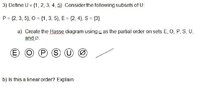
Linear order happens when for every two sets, one is a subset of the other. Is this true for $P$ and $O$? You also have not listed inclusions...Kristen said:So this would be in a linear order?
I wrote in post #2:Kristen said:You also have not listed inclusions... What do you mean by this?
It's a good idea, if a response to your post is not clear, to ask questions about it right away. Otherwise we may give you a lot of recommendations and be under impression that you got them while this may not be so.Evgeny.Makarov said:Can you list other set inclusions among $P$, $O$, $S$ and $E$ (i.e., what is a subset of what)?
You need to master the concept of set inclusion. A set $A$ is a called subset of a set $B$, and this is denoted by $A\subseteq B$, if every element of $A$ is also an element of $B$. For example, $\{1,3\}\subseteq\{1,2,3,4\}$, but $\{1,3\}\nsubseteq\{2,3,4,5\}$ because $1\in\{1,3\}$, but $1\notin\{2,3,4,5\}$. In this topic, we don't say that sets are matching; it's not a technical term.Kristen said:So are you saying that it wouldn't be linear because P and O are not matching. P has a 2 whereas O has a 1?