Discussion Overview
The discussion revolves around deriving the energy of a parabolic confining potential in a wire, with references to harmonic oscillator models and the incorporation of magnetic vector potentials. Participants explore various approaches and equations related to this topic.
Discussion Character
- Exploratory
- Technical explanation
- Mathematical reasoning
Main Points Raised
- One participant seeks guidance on deriving the energy expression for a parabolic confining potential in a wire, referencing a specific equation from a source.
- Another participant inquires whether the book provides a Hamiltonian for the particles in the wire.
- A question is raised about how to incorporate a magnetic vector potential into the Hamiltonian.
- A participant mentions that the book provides a simple harmonic oscillator (SHO) equation in Landau gauge, questioning its applicability in the derivation.
- One participant suggests using the form for parabolic magnetic confinement provided in the source, indicating that it may eliminate the need for the vector potential.
- There is a discussion about whether to use a specific form of the potential, V(x) = mw0x^2/2, and how it relates to the equations being referenced.
- A participant asks if an expression for the wave function u(x) is necessary to solve for the energy of the confining potential.
- Another participant confirms that the potential can be expressed using a redefined origin and suggests that it resembles a SHO Hamiltonian.
Areas of Agreement / Disagreement
Participants express uncertainty about the appropriate form of the potential and the necessity of incorporating the magnetic vector potential. There is no consensus on the best approach to derive the energy expression.
Contextual Notes
Participants reference specific equations and definitions from a source document, indicating that the derivation may depend on these definitions and the context of the problem. There are unresolved aspects regarding the integration of the magnetic vector potential and the exact form of the potential used in the derivation.
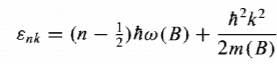 where
where

