How to Derive the Expression for \(\delta W = -E dP\)?

  • Thread starter Thread starter appmathstudent
  • Start date Start date
Click For Summary
SUMMARY

The discussion focuses on deriving the expression for \(\delta W = -E dP\) in the context of electrostatics, specifically when dealing with a dielectric slab. The initial equation presented is \(W = U = \frac{q^2}{2C}\), which simplifies to \(\delta W = \frac{E}{2} dP\). The key insight is that during the charging process, the charge \(q\) is variable while the distance \(d\) remains constant, leading to the conclusion that \(dP = d(dq)\) and ultimately allowing for the elimination of the factor of 2 in the denominator.

PREREQUISITES
  • Understanding of electrostatics and capacitance
  • Familiarity with dielectric materials and their properties
  • Knowledge of calculus, specifically differentiation
  • Basic grasp of electric field concepts and their relation to work
NEXT STEPS
  • Study the derivation of energy stored in capacitors, focusing on \(W = \frac{q^2}{2C}\)
  • Learn about the behavior of electric fields in dielectric materials
  • Explore the implications of variable charge in electrostatic systems
  • Investigate the relationship between electric displacement \(D\) and electric field \(E\) in dielectrics
USEFUL FOR

Students and professionals in physics, particularly those specializing in electromagnetism, electrical engineers, and anyone studying the behavior of capacitors and dielectrics in electrostatic contexts.

appmathstudent
Messages
6
Reaction score
2
Homework Statement
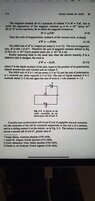
This is exercise 3-12 form Sears and Salinger Thermodynamics : Show that $$\delta W = -E dP$$ by calculating the work necessary to charge a parallel plate capacitor containing a dielectric.
Relevant Equations
$$W = U = \frac{q^2}{2C}$$
$$ C = \frac{\kappa \epsilon_0 A}{d}$$
$$P = qd $$ (dipole moment of slab)
$$ E = \frac{q}{\epsilon_0 \kappa A}$$
$$W = U = \frac{q^2}{2C} =\frac{q q d}{2 \kappa \epsilon_0 A} = \frac{E P}{2}$$

Then , since E is constant we have that :

$$\delta W = \frac{dW}{dP} dP = \frac{E}{2} dP$$.

My question is how can I make this 2 on the denominator disappear in order to obtain the required expression ?

ps : In the book (Chapter 3 page 67) he mentions that $$\delta W$$ is the work when $$E$$ is changed in a dielectric slab.
 
Last edited:
Physics news on Phys.org
dP=d(qD)=(dq) D+ q (dD)
where D is distance between the capacitor plates introduced to distinguish it with differential d.
Which is your case changing charge or changing distance or the both ?
 
Last edited:
I think q is changing, since the work is done to change E.
 

Attachments

  • 20211002_125815.jpg
    20211002_125815.jpg
    30 KB · Views: 175
appmathstudent said:
I think q is changing, since the work is done to change E.
So you are saying E is not constant during the charging process.
 
appmathstudent said:
I think q is changing, since the work is done to change E.
q is changing, d is constant so
dP=d(dq)
\frac{dW}{dP}=\frac{1}{d}\frac{dW}{dq}
Try it.
 
  • Like
Likes   Reactions: appmathstudent

Similar threads

Replies
5
Views
2K
  • · Replies 1 ·
Replies
1
Views
1K
Replies
1
Views
2K
Replies
2
Views
2K
Replies
1
Views
2K
  • · Replies 16 ·
Replies
16
Views
3K
Replies
4
Views
2K
  • · Replies 3 ·
Replies
3
Views
2K
  • · Replies 4 ·
Replies
4
Views
1K
  • · Replies 1 ·
Replies
1
Views
3K