Markus Kahn
- 110
- 14
- TL;DR
- I'm confused about how to determine, given the definition of the spin 1/2 fields and the photon field, which Spinor belongs where in a Feynman diagram.
Consider Moller scattering, that is $$e^-(\vec p_1, \alpha)+e^-(\vec p_2, \beta) \quad\longrightarrow\quad e^-(\vec q_1, \gamma)+e^-(\vec q_2, \delta),$$
where the ##\vec{p}_i,\vec q_i## label the momenta of the in and outgoing electrons and the greek letter the spin state.
The two relevant Feynman diagrams at second order in ##e## (electric charge) are
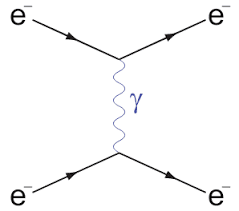
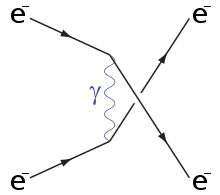
(taken directly from the above linked Wikipedia page)
From QFT we know that we can write the photon and spinor fields as
$$
\begin{align*}
A_\mu(x) &= \int \frac{d^3p}{(2\pi)^32e(\vec p)}[c_a^\dagger(\vec p) {\varepsilon_\mu^a}^*(\vec p)e^{-ip\cdot x} + c_a(\vec p) \varepsilon_\mu^a(\vec p)e^{ip\cdot x}],\\
\psi(x) &= \int \frac{d^3p}{(2\pi)^32e(\vec p)}[a_\alpha^\dagger(\vec p) v_\alpha(\vec{p}) e^{-ip\cdot x} + b_\alpha(\vec p) u_\alpha(\vec p)e^{ip\cdot x}], \\
\bar\psi(x) &= \int \frac{d^3p}{(2\pi)^32e(\vec p)}[a_\alpha(\vec p) \bar v_\alpha(\vec{p}) e^{ip\cdot x} + b_\alpha^\dagger(\vec p) \bar u_\alpha(\vec p)e^{-ip\cdot x}],
\end{align*}
$$
where ##a^\dagger## creates electrons and ##b^\dagger## creates positrons. Note, I'm aware that this deviates from common conventions, but my lecturer wants it that way...
We can now write down the matrix elements of the first Feynman diagram (##t##-channel) using the Feynman rules for QED
$$M_{\alpha\beta\gamma\delta} = \left\{\bar{v}_{\alpha}(\vec p_{1})(-e\gamma^\mu)v_\gamma(\vec q_1)\right\}[-iG_{\mu\nu}(p_1-q_1)] \left\{\bar{v}_\beta (\vec p_2) (-e\gamma^\nu) v_\delta(\vec q_2)\right\}.$$
As I understand it, the expressions in the two curly brackets ##\{\hspace{2mm}\}## are ##\mathbb{C}##-numbers, so we could technically swap them without changing the value of the matrix element.
Question
I don't really understand how the expressions in the curly brackets are supposed to be read. Let's take as an example
$$\left\{\bar{v}_{\alpha}(\vec p_{1})(-e\gamma^\mu)v_\gamma(\vec q_1)\right\}.$$
Why do we know that we have to use the spinors ##\bar v_\alpha## and ##v_\gamma## and why not ##v_\alpha## and ##\bar v_\gamma##? I do understand that we only need ##v_\sigma## and not ##u_\rho##, since we have no positrons, my problem is that I don't really understand the logic when we are supposed to choose the spinor with a bar and when the spinor without a bar.
I tried reading it up in Peskins book, but unfortunately, he just writes it down and says it follows directly from the Feynman rules (see section 5.1, p. 131). I don't really have access to another book at the moment...
where the ##\vec{p}_i,\vec q_i## label the momenta of the in and outgoing electrons and the greek letter the spin state.
The two relevant Feynman diagrams at second order in ##e## (electric charge) are
(taken directly from the above linked Wikipedia page)
From QFT we know that we can write the photon and spinor fields as
$$
\begin{align*}
A_\mu(x) &= \int \frac{d^3p}{(2\pi)^32e(\vec p)}[c_a^\dagger(\vec p) {\varepsilon_\mu^a}^*(\vec p)e^{-ip\cdot x} + c_a(\vec p) \varepsilon_\mu^a(\vec p)e^{ip\cdot x}],\\
\psi(x) &= \int \frac{d^3p}{(2\pi)^32e(\vec p)}[a_\alpha^\dagger(\vec p) v_\alpha(\vec{p}) e^{-ip\cdot x} + b_\alpha(\vec p) u_\alpha(\vec p)e^{ip\cdot x}], \\
\bar\psi(x) &= \int \frac{d^3p}{(2\pi)^32e(\vec p)}[a_\alpha(\vec p) \bar v_\alpha(\vec{p}) e^{ip\cdot x} + b_\alpha^\dagger(\vec p) \bar u_\alpha(\vec p)e^{-ip\cdot x}],
\end{align*}
$$
where ##a^\dagger## creates electrons and ##b^\dagger## creates positrons. Note, I'm aware that this deviates from common conventions, but my lecturer wants it that way...
We can now write down the matrix elements of the first Feynman diagram (##t##-channel) using the Feynman rules for QED
$$M_{\alpha\beta\gamma\delta} = \left\{\bar{v}_{\alpha}(\vec p_{1})(-e\gamma^\mu)v_\gamma(\vec q_1)\right\}[-iG_{\mu\nu}(p_1-q_1)] \left\{\bar{v}_\beta (\vec p_2) (-e\gamma^\nu) v_\delta(\vec q_2)\right\}.$$
As I understand it, the expressions in the two curly brackets ##\{\hspace{2mm}\}## are ##\mathbb{C}##-numbers, so we could technically swap them without changing the value of the matrix element.
Question
I don't really understand how the expressions in the curly brackets are supposed to be read. Let's take as an example
$$\left\{\bar{v}_{\alpha}(\vec p_{1})(-e\gamma^\mu)v_\gamma(\vec q_1)\right\}.$$
Why do we know that we have to use the spinors ##\bar v_\alpha## and ##v_\gamma## and why not ##v_\alpha## and ##\bar v_\gamma##? I do understand that we only need ##v_\sigma## and not ##u_\rho##, since we have no positrons, my problem is that I don't really understand the logic when we are supposed to choose the spinor with a bar and when the spinor without a bar.
I tried reading it up in Peskins book, but unfortunately, he just writes it down and says it follows directly from the Feynman rules (see section 5.1, p. 131). I don't really have access to another book at the moment...