How to Find Fourier Coefficients for a Given Function

Join the discussion
Ask a follow-up here, or get your own question answered by working scientists, mathematicians and engineers — people, not an autocomplete.
Real named experts · corrections over time · the nuance an AI answer skips
11 replies · 2K views
Kqwert
Messages
160
Reaction score
3
Homework Statement
Finding fourrier coefficients by observation
Relevant Equations
No eq. posted
Hello,

I need help with question #2 c) from the following link (already LateX-formatted so I save some time...):
https://wiki.math.ntnu.no/_media/tma4135/2017h/tma4135_exo1_us29ngb.pdf
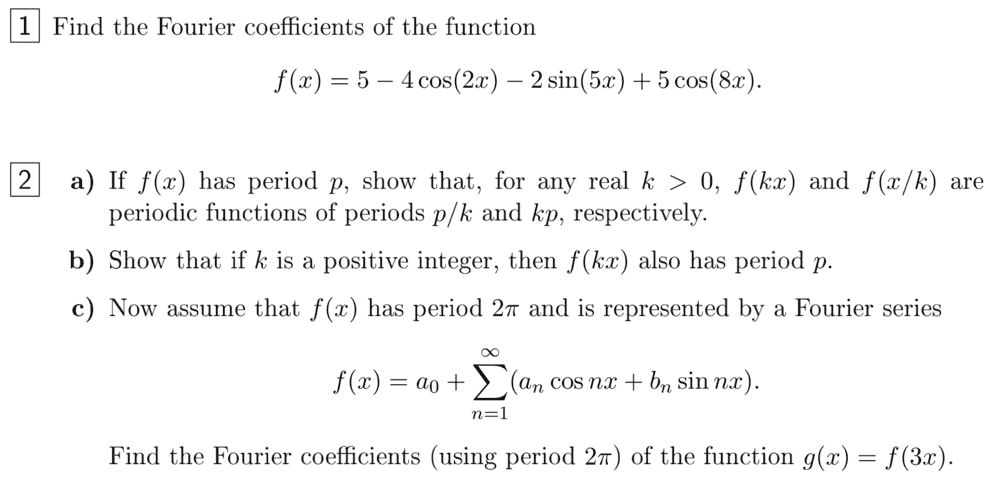
ft.png


I do understand that the a0 for both expressions must be the same, but what about an and bn? I don't understand how you find them, given that we'll have an*cos(nx)/bn*sin(nx) in the first case while we will have an*cos(3nx)/bn*sin(3nx) in the second case.
 
Last edited by a moderator:
Physics news on Phys.org
Kqwert said:
we'll have an*cos(nx)/bn*sin(nx) in the first case while we will have an*cos(3nx)/bn*sin(3nx) in the second case
I don't see them in your attempt at solution

anyway, posts that show no attempt can't be assisted in: PF rules
 
Okay,

so
[tex] g(x) = ao_{0} + \sum_{n=1}^{inf} ao_{n}cos(nx)+bo_{n}sin(nx)[/tex]
[tex] f(3x) = a_{0} + \sum_{n=1}^{inf} a_{n}cos(3nx)+b_{n}sin(3nx)[/tex]

and [tex]g(x) = f(3x)[/tex]

I understand that
[tex]ao_{0} = a_{0}[/tex], but not sure what to do with the an and bn parts, to make them equal??

Anyways,

think we have to compare the sin and cos terms?

i.e.

[tex] ao_{3}cos(3x) = a_{1}cos(3x)[/tex]
so [tex]ao_{3} = a_{1}[/tex] ?
 
Last edited:
You make life difficult for yourself:
Kqwert said:
what to do with the an and bn parts, to make them equal?
You don't want to make the ##a_n## equal at all !
Try using ##m## as summation variable in the second expression and find a relationship between ##a_n## and ##a_m##
 
I edited post #3. Is that correct?
 
That makes the thread rather difficult to follow, but I think you get the idea, yes.

It's really a very simple exercise if you look 'through' it, isn't it !
 
Thanks! not sure how to check that though?
 
[tex] cos(x) = \sum_{n = 1}^{inf} a_{n}cos(nx)[/tex]
where every [tex]a_{n}[/tex] apart from [tex]a_{1}[/tex] is zero..?

Similarly,

we'll have
[tex] cos(3x) = a_{3}cos(3x)[/tex]
 
BvU said:
In your notation, the alternative ##ao_{n} = a_{3n}## looks more sensible
again: check with ##f=\cos x##
o:) The above is of course bogus. As you debunked correctly in #11:
If ##f(x) = \cos x \Rightarrow a_1 = 1## and all other ##a_n = 0## then
##\ \ g(x) = f(3x)## has ## a_3 = 1## and all other ##a_n = 0##
which you can easily generalize.

In other words ##\ \ ao_{3n} = a_n \ \ \forall n\ \ ## -- as you concluded in the edited post #3.