How to interpret N(E) vs. E graphs when performing Auger spectroscopy

  • Context: Graduate 
  • Thread starter Thread starter Ethan Mullen
  • Start date Start date
  • Tags Tags
    Graphs Spectroscopy
Click For Summary

Discussion Overview

The discussion revolves around the interpretation of N(E) and N'(E) graphs in the context of Auger spectroscopy, focusing on their definitions and the implications for measuring electron yield and intensity. The conversation includes technical aspects of measurement conditions and the use of electron multipliers in experimental setups.

Discussion Character

  • Technical explanation
  • Exploratory
  • Debate/contested

Main Points Raised

  • Ethan expresses confusion about the definitions of N(E) and N'(E), noting that they are referred to variably as electron yield, intensity, and dI/dV in literature.
  • Some participants suggest that N(E) may represent electron count or intensity plotted against kinetic energy, but clarity remains elusive.
  • One participant mentions that the differential mode, dN(E)/dE, is preferred under high background conditions, indicating that measurement choice depends on specific experimental circumstances.
  • Ethan posits that the relative change in electron count may be more significant than the absolute count itself, seeking validation for this assumption.
  • A later reply clarifies that the output signal is proportional to the count rate of electrons, suggesting a relationship between N(E) and the rate of detected electrons over time.

Areas of Agreement / Disagreement

Participants do not reach a consensus on the precise definitions of N(E) and N'(E), and there are multiple interpretations of their significance in Auger spectroscopy. The discussion remains unresolved regarding the clarity of these terms.

Contextual Notes

Participants highlight the dependence on measurement conditions and the potential ambiguity in terminology related to electron count and intensity. There are unresolved questions about how current is measured and translated into voltage in the context of the experimental setup.

Ethan Mullen
Messages
5
Reaction score
0
TL;DR
TL;DR : Can't figure out what N(E) vs. E graph means in AES
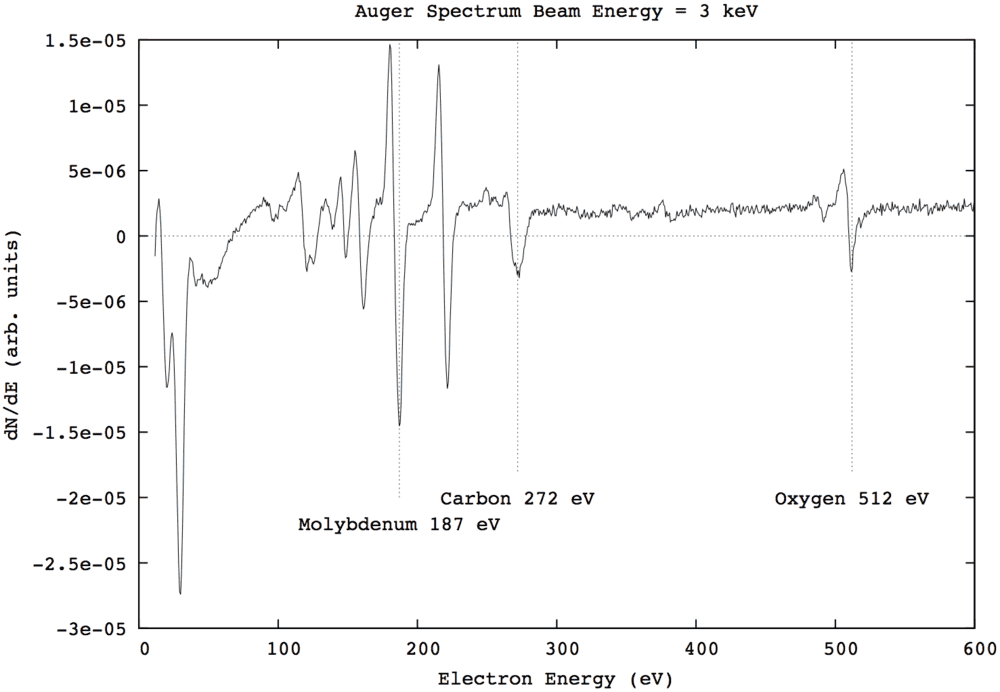
Hi all, my name's Ethan and I'm an undergraduate physics student conducting research on work functions this summer. I've been trying to understand the graphs of N(E) or N'(E) vs. auger electron energy for several days now, but I can't find in the literature what exactly N(E) or N'(E) are. I've seen N(E) referred to as electron yield, intensity, and even dI/dV, but nowhere have I seen a clear definition. I understand why N'(E) is often used instead of N(E), since the peaks where Auger electrons are emitted are often difficult to see on the N(E) graph, I just don't understand what either actually are. I've attached a picture below that shows an N'(E) vs. E graph for some more context. Thanks!
244673
 
Physics news on Phys.org
Please see p.396 of this short pdf for further context. This is an example of a source that does not quite clarify what N(E) and N'(E) are.
 

Attachments

Lord Jestocost said:
Maybe, this might be of help:
PDF]AES - Auger Electron Spectrosopy - Uni Ulm

Ah, thank you. I see that the author of this doc mentions that either the electron count or intensity is plotted vs. the kinetic energy. From what I've read about my particular setup, I will be using an electron multiplier to produce a greater number of electrons incident on the phosphor screen. I suppose, then, that the electron count itself isn't what's important. Rather, the relative change in the electron count is. Does this seem like a good assumption?
 
Whether on prefers to measure N(E) or dN(E)/dE isn’t related to “importance”, but depends on the measurement conditions. The differential mode, dN(E)/dE, is preferred when there is a high background of secondary electrons, thus allowing a better assignment of the characteristic lines.
 
  • Like
Likes   Reactions: Ethan Mullen
Lord Jestocost said:
Whether on prefers to measure N(E) or dN(E)/dE isn’t related to “importance”, but depends on the measurement conditions. The differential mode, dN(E)/dE, is preferred when there is a high background of secondary electrons, thus allowing a better assignment of the characteristic lines.
Thank you, but can you describe what N(E) actually is? I know that my system has a preamp hooked up to the apparatus, which means that my computer receives a digitized analog voltage, so how is the "current" actually being measured? I assume that N(E) is this mysterious "current" just translated to a voltage, but how is the current actually measured?
 
The output signal is generally proportional to the count rate of electrons, dN(E)/dt: the number of electrons, dN(E), with a given energy, E, which are counted by the detector in a given time interval, dt.
 

Similar threads

  • · Replies 35 ·
2
Replies
35
Views
11K
  • · Replies 24 ·
Replies
24
Views
4K
  • · Replies 13 ·
Replies
13
Views
10K