How to Prove Sin Equations with Given Constraints?

  • Context: High School 
  • Thread starter Thread starter anemone
  • Start date Start date
Join the discussion
Ask a follow-up here, or get your own question answered by working scientists, mathematicians and engineers — people, not an autocomplete.
Real named experts · corrections over time · the nuance an AI answer skips
2 replies · 2K views
anemone
Gold Member
MHB
POTW Director
Messages
3,851
Reaction score
115
Here is this week's POTW:

-----

Given that $A+B=C+D=E+F=\dfrac{\pi}{3}$ and $\dfrac{\sin A}{\sin B}\times \dfrac{\sin C}{\sin D} \times \dfrac{\sin E}{\sin F}=1 $.

Prove that $\dfrac{\sin (2A+F)}{\sin (2F+A)}\times \dfrac{\sin (2E+D)}{\sin (2D+E)} \times \dfrac{\sin (2C+B)}{\sin (2B+C)}=1$-----

Remember to read the https://mathhelpboards.com/showthread.php?772-Problem-of-the-Week-%28POTW%29-Procedure-and-Guidelines to find out how to https://mathhelpboards.com/forms.php?do=form&fid=2!
 
Physics news on Phys.org
Hi to all members of MHB!I realized last week POTW is quite challenging and I therefore decided to give members one more week to try the problem out.In the mean time, this week POTW will only be posted tomorrow, as I am feeling under the weather today.(Puke)
Thanks for reading and your continued support!
 
No one answered last two week's POTW.(Sadface)

Here is the solution of other:

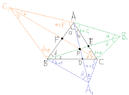
View attachment 8560

Consider an equilateral triangle $ABC$, and let $D$ be on $BC$ so that $\angle BAD=a$, so $\angle DAC=\dfrac{\pi}{3}−a=b$.

Let $E$ be on $AC$ so that $\angle CBE=c$, so $\angle EBA=\dfrac{\pi}{3}−c=d$.

Let $F$ be on $AB$ so that $\angle ACF=e$, so $\angle FCB=\dfrac{\pi}{3}−e=f$.

By the sine version of Ceva's theorem and the given condition $\dfrac{\sin A}{\sin B}\times \dfrac{\sin C}{\sin D} \times \dfrac{\sin E}{\sin F}=1 $, $AD,\,BE$ and $CF$ are concurrent at a point, which we shall call it $P$.Extend $AD$ to points $A_1$ and $A_2$ such that $\angle A_1CB=a+f$ and $\angle A_2BC=b+c$.

We have $\angle CA_1A=\pi−\angle A_1CA−∠A_1AC=\pi−b−(e+f+a+f)=e$.

Similarly $\angle BA_2A=d$. Thus $\triangle APC$ is similar to $\triangle ACA_1$ and $\triangle APB$ is similar to $\triangle ABA_2$.

$\therefore \dfrac{AA_1}{AC}=\dfrac{AC}{AP}=\dfrac{AB}{AP}=\dfrac{AA_2}{AB}$, so $AA_1=AA_2$, so $A_1=A_2$.

Now $\dfrac{\sin{(b+2c)}}{\sin{(a+2f)}}=\dfrac{\frac{A_1P}{\sin{(a+2f)}}}{\dfrac{A_2P}{\sin{(b+2c)}}}=\dfrac{\dfrac{CP}{\sin{e}}}{\dfrac{BP}{\sin{d}}}=\dfrac{CP\sin{d}}{BP\sin{e}}$

Similarly, we get

$\dfrac{\sin{(d+2e)}}{\sin{(c+2b)}}=\dfrac{AP\sin{f}}{CP\sin{a}}$

$\dfrac{\sin{(f+2a)}}{\sin{(e+2d)}}=\dfrac{BP\sin{b}}{AP\sin{c}}$

By multiplying the three gives the desired equality$\dfrac{\sin{(2a+f)}}{\sin{(2f+a)}}\cdot\dfrac{\sin{(2e+d)}}{\sin{(2d+e)}}\cdot\dfrac{\sin{(2c+b)}}{\sin{(2b+c)}}=1 $
 

Attachments

  • potw 337.png
    potw 337.png
    4.7 KB · Views: 177