How to Simplify Complex Problems: Expert Tips and Tricks
- Context: MHB
- Thread starter Canzy
- Start date
-
- Tags
- Simplify
Click For Summary
SUMMARY
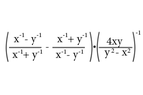
This discussion focuses on techniques for simplifying complex mathematical fractions, specifically the expression \(\frac{\frac{1}{x} - \frac{1}{y}}{\frac{1}{x} + \frac{1}{y}}\). The initial step involves clearing complex fractions by multiplying by \(xy\), resulting in \(\frac{y - x}{y + x}\). The next strategy includes multiplying the fraction by \(\frac{y - x}{y - x}\) to transform the denominator into the difference of squares, \(y^2 - x^2\), facilitating further simplification.
PREREQUISITES- Understanding of basic algebraic fractions
- Familiarity with the concept of multiplying by a conjugate
- Knowledge of the difference of squares formula
- Ability to manipulate algebraic expressions
- Study the method of simplifying complex fractions in algebra
- Learn about the difference of squares and its applications
- Practice multiplying fractions by their conjugates
- Explore advanced algebraic techniques for simplifying expressions
Students, educators, and anyone seeking to enhance their skills in algebraic simplification and problem-solving techniques.
Similar threads
- · Replies 1 ·
- · Replies 1 ·
- · Replies 4 ·
- · Replies 5 ·
- · Replies 9 ·
- · Replies 5 ·
- · Replies 4 ·
- · Replies 6 ·
- · Replies 2 ·