How to Solve Angle Equivalence in Cyclic Quadrilaterals?

  • Topic:
  • Thread starter mathlearn
  • Start date
  • Tags Tags
    Cyclic
24 replies · 6K views · last reply
mathlearn
Messages
331
Reaction score
0
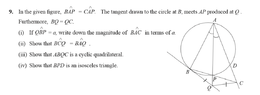
Here's the problem (Wait) (Sweating)

View attachment 5939

So, Any Ideas on how to begin ? (Happy)
 
Attachments
  • Geometry problem 9 with parts (i) to (iv) about a circle through A and B, a tangent at B meeting AP produced at Q, with BQ = QC, and points P, D and C labelled on the figure.
    cyclic.png
    22.3 KB · Views: 186
Begin by reviewing the theory in your textbook about inscribe angles. Or see the theorem and its corollary in Wikipedia (you don't have to read the proof for now). Also read about cyclic quadrilaterals.
 
mathlearn said:
For I, Alternate segment theorem?
Yes.
 
Evgeny.Makarov said:
Yes.

$\therefore \angle QBP = \angle BAP = \angle QAC$

Therefore angle BAC would be $2a$

ii.Show that angle BCQ = angle BAQ

$\angle QBP = \angle BAP = \angle QAC$

$ \angle BAQ = \angle QBP$

$\therefore \angle BCQ = \angle BAQ $

Now how can ABQC proved a cyclic quadrilateral in iii.

Many Thanks :)
 
mathlearn said:
$\therefore \angle QBP = \angle BAP = \angle QAC$

Therefore angle BAC would be $2a$
Agree.

mathlearn said:
$\angle QBP = \angle BAP = \angle QAC$

$ \angle BAQ = \angle QBP$

$\therefore \angle BCQ = \angle BAQ $
I would recommend not to name the same angle differently within the same reasoning. This makes the proof hard to follow. Thus, use only one of $\angle BAP$ and $\angle BAQ$. More importantly, your two first lines in the last quote do not mention $\angle BCQ$, so it is not clear how it appears in the conclusion.

mathlearn said:
Now how can ABQC proved a cyclic quadrilateral in iii.
The converse of the inscribed angle theorem also holds: since $\angle BCQ = \angle BAQ$, point $C$ must lie on the circle passing through $A$, $B$ and $Q$.
 
Including the new information found above , I updated the diagram

View attachment 5998

For ABQC to be a cyclic quadrilateral opposite angles should add up to 180 degrees.

Attempting.....

$\angle QBP + \angle PBA + \angle QCP + \angle PCD = 180 ^\circ $

$\angle BAQ + \angle PAC + \angle QBP + \angle QCP= 180 ^\circ $

Subtracting the two

$ \angle PBA + \angle PCD + \angle BAQ + \angle PAC = 0^\circ $

$ \angle PBA + \angle BAQ = \angle PCD + \angle PAC $...

Hmm. I am stuck with the proof any help with the proof would be appreciated (Happy)
 
Attachments
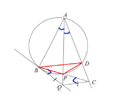
  • Geometry diagram: a circle with points A at the top, B on the left arc, D on the right arc, and C outside the circle to the lower right. Lines from A reach B, P and C, with P inside the circle near the bottom. Tangent line through B and Q below P. Arc marks show equal angles at A and at B, P and C, with tick marks on BQ and QC.
    cyclic.png
    6.5 KB · Views: 161
Last edited:
mathlearn said:
$\therefore \angle QBP = \angle BAP = \angle QAC$

Therefore angle BAC would be $2a$

You're almost there! $\angle{BAC}=2a$ and what is $\angle{BQC}$ in terms of $a$?

Then what is $\angle{BAC}+\angle{BQC}$?
 
greg1313 said:
You're almost there! $\angle{BAC}=2a$ and what is $\angle{BQC}$ in terms of $a$?

Then what is $\angle{BAC}+\angle{BQC}$?

Thanks (Yes) both of you

$\angle{BQC}$ in terms of $a$ would be...

Well , There's a problem I am unable to state $\angle{BQC}$ in terms of a , But I am not confident of the use of the alternate segment theorem here

But if it was used

$\angle BQP = \angle QCP $ (alternate segment theorem)

But the other instance would be a problem,

Bringing in an definition for the alternate segment theorem from google

Alternate segment theorem. The angle between the tangent and chord at the point of contact is equal to the angle in the alternate segment.

I not sure of it's application on this instance, But what I am going to intend here is that

$\angle CQP = \angle QBP$ (alternate segment theorem)

Then if I had the rest correct $\angle BQC$ would be 2a
 
You're told that $\angle{QBP}=a$. Given that, what is $\angle{BQC}$? Recall that the angles of a triangle sum to 180$^\circ$ and that $\triangle{BQC}$ is isosceles.
 
greg1313 said:
You're told that $\angle{QBP}=a$. Given that, what is $\angle{BQC}$? Recall that the angles of a triangle sum to 180$^\circ$ and that $\triangle{BQC}$ is isosceles.

So Now building and expression for $\angle BQC$ with the help of the angles of

$ 2a+ \angle BQC = 180 ^ \circ $

$\angle BQC = 180 ^ \circ - 2a$

greg1313 said:
You're almost there! $\angle{BAC}=2a$ and what is $\angle{BQC}$ in terms of $a$?

Then what is $\angle{BAC}+\angle{BQC}$?

Now as Greg1313 suggested,

$\angle{BAC}+\angle{BQC}$

$2a+180^\circ-2a$=$180^\circ$

As the positive and negative 2a cancels out $180 ^ \circ =180 ^ \circ $

So therefore this is a cyclic quadrilateral correct :) ?
 
So now I would consider moving to iv,

Prove that $\triangle BPD$ is an isosceles triangle

I very enthusiastically updated the diagram,

View attachment 5999

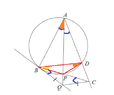
I have highlighted the $\triangle BPD$ using red coloured lines.

& I have no idea in the method this should be accomplished.

But I know how this should be done either to prove that $\angle PBD = \angle PDB$ or BP=PD.

I highly value your suggestion & advice. (Happy)(Smile)
 
Attachments
  • Geometry diagram of a circle through points A, B, D and P, with tangent line through B and Q, and line AC meeting the circle at D; triangle BPD is highlighted in red, with equal angle arcs marked at A, B, Q and C and tick marks on segments BQ and QC.
    cyclic.png
    6.2 KB · Views: 132
Last edited:
Look at $\angle{BAD}$. Think "inscribed angle theorem" and that $\overline{AP}$ bisects $\angle{BAD}$.
 
greg1313 said:
Look at $\angle{BAD}$. Think "inscribed angle theorem" and that $\overline{AP}$ bisects $\angle{BAD}$.

(Yes) Thank you very much ,

As $\overline{AP}$ bisects $\angle BAD$ , The line that is equal in length AB and AD is PB.. It's meeting with the arc makes $BP=PD$, Correct ? :) or have i done wrong ? (Thinking)
 
greg1313 said:
Look at $\angle{BAD}$. Think "inscribed angle theorem" and that $\overline{AP}$ bisects $\angle{BAD}$.

Look for equal angles.
 
greg1313 said:
Look at $\angle{BAD}$. Think "inscribed angle theorem" and that $\overline{AP}$ bisects $\angle{BAD}$.

I guess the inscribed angle theorem here means the "Arrow theorem" as I would call it.(Giggle)

greg1313 said:
Look for equal angles.

$\angle PBD = \angle PDB$ , I Guess?
 
That is correct, hence $\triangle{BPD}$ is isosceles. :)
 
(Happy) Thank you very much again for your reply,

$\angle PBD = \angle PDB$

(Giggle) But the problem is I don't know it's derivation, It was a guess.

Glad you can help (Smile)
 
Last edited:
By the inscribed angle theorem, $\angle{BAP}=\angle{BPD}$. Can you finish?

(Recall that $\angle{BAP}=\angle{DAP}$).
 
greg1313 said:
By the inscribed angle theorem, $\angle{BAP}=\angle{BPD}$. Can you finish?

(Recall that $\angle{BAP}=\angle{DAP}$).

First of all I would like to appreciate your patience (Smile)

(Party)(Party) Hope these will be the final steps.

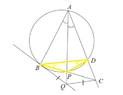
Using the sketch I see the angles marked in Orange equal

View attachment 6003

But the other angle marked in yellow still remains a problem... Any help to make it equal to the other and and to prove that the triangle is isosceles would be appreciated
 
Attachments
  • Geometry diagram: circle through points A, B and D, with lines from A to B and A to D, a tangent line at B meeting line AD at C, point P on AC, Q on the tangent, and red segments BD, BP, DP. Orange arcs mark equal angles at A and D; yellow marks an angle at B; tick marks show equal lengths.
    cyclic.png
    6.9 KB · Views: 152
Last edited:
Sorry, I should have written $\angle{BAP}=\angle{BDP}$.

By the inscribed angle theorem, what angle is the same in measure as $\angle{DBP}$?
 
greg1313 said:
Sorry, I should have written $\angle{BAP}=\angle{BDP}$.

By the inscribed angle theorem, what angle is the same in measure as $\angle{DBP}$?

It should be $\angle PDB$ but to be exact which inscribed angle theorem are you intending here? (Happy)
 
No, I intended $\angle{DBP}$. Use your diagram and go over all the angles and see which ones you can find equivalence for using the inscribed angle theorem. This may help you to find your answer.
 
greg1313 said:
No, I intended $\angle{DBP}$. Use your diagram and go over all the angles and see which ones you can find equivalence for using the inscribed angle theorem. This may help you to find your answer.

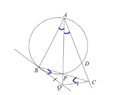
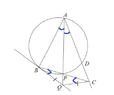
These are the angles that I find equal for now,

View attachment 6012

$\angle QBP = \angle BAP $ Alternate segment theorem

$\angle QBP = \angle QCP $ Angles in the same segment

$\angle QBP = \angle PAC $ Proved above

So these angles are equal $\angle QBP = \angle BAP = \angle QCP = \angle PAC$

How should I be saying that

View attachment 6013
 
Attachments
  • Geometry diagram of a circle with points A, B, D on it, a tangent line through B meeting line AC at P and Q, and point C outside the circle, with tick marks and angle arcs marked in blue.
    cyclic.png
    6.5 KB · Views: 144
  • Geometry diagram: a circle through points A, B, D and P with a tangent line through B meeting line AP extended at Q, and line AD extended to C; triangle BPD is highlighted in yellow, with equal angle arcs marked at A, B and C.
    cyclic (1).png
    6.3 KB · Views: 135