How to Solve Forces in Mechanics Problem B and C in Norway?

  • Thread starter Thread starter eivert
  • Start date Start date
  • Tags Tags
    Mechanics
Click For Summary
SUMMARY

The discussion focuses on solving forces in mechanics problems at points B and C, specifically addressing the need for additional equations to resolve support reactions. Participants emphasize the importance of isolating the structure and using free body diagrams to identify '2 force' members that only take axial loads. The correct approach involves summing moments about point C and ensuring accurate direction for reaction forces, particularly at point D. The conversation highlights the necessity of creating separate diagrams for each rod to clarify force interactions.

PREREQUISITES
  • Understanding of static equilibrium principles, including the three equilibrium equations.
  • Familiarity with free body diagrams and their application in mechanics.
  • Knowledge of axial loads and '2 force' member concepts.
  • Basic skills in isolating structural components for analysis.
NEXT STEPS
  • Study the method of isolating structures in mechanics problems.
  • Learn how to create and interpret free body diagrams for complex structures.
  • Research the principles of axial loads and their implications in structural analysis.
  • Explore advanced topics in static equilibrium, including additional equations for support reactions.
USEFUL FOR

This discussion is beneficial for students preparing for mechanics exams, engineers involved in structural analysis, and anyone seeking to enhance their understanding of force resolution in static systems.

eivert
Messages
2
Reaction score
0
Hello everyone

Iam practicing for my exam in mechanics and I can't figure out how to solve this problem. I need to find the forces in B and C.

Please help..

Greetings from cold norway
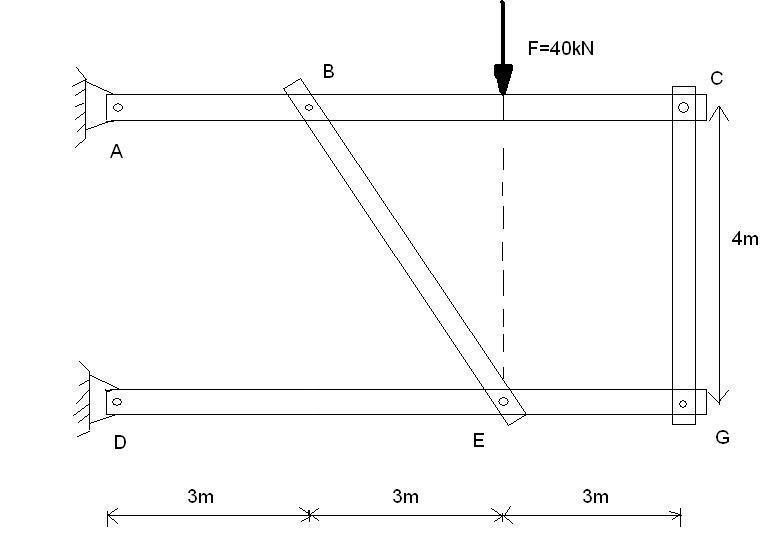


mekanikk.JPG
 
Physics news on Phys.org
mekanikk.JPG


This is how I think the forces is working. Cant figure out if this is correct
 
the reactions at the supports look correct. you need to isolate the top portion of the structure (sum moments about C) to start getting answers.
 
When you attempt to solve the external reaction forces, you have 4 unknowns at those supports, but only the 3 equilibrium equations (sum of forces in x direction = 0, sum of forces in y direction = 0, and sum of moments about any point = 0). Thus, you'll need another equation to solve for all the support reactions. As haynewp has noted, you've got to start disassembling the frame with free body diagrams of the members in order to get the 4th equation you need, taking advantage in identifying the '2 force' members that will take axial load only.
 
I went ahead and solved it. There is actually one other step I used prior to summing moments about point C. You still have to isolate part of the structure as noted above which is the most important idea for this problem. I also found your vertical reaction at D looks like it is going in the wrong direction (should be pointing down). But I only knew this for sure after I went through the rest of the required process.
 
Welcome to PF!

Hi eivert! Welcome to PF from warm but rainy England! :smile:

I'm sorry, but your diagram will not help.

(For example, on your diagram at B, there should be the force of BE on AC and the equal and opposite force of AC on BE)

You need separate diagrams for each of the rods.

Start with rods CG and BE (as PhanthomJay suggests). :smile:
 

Similar threads

  • · Replies 1 ·
Replies
1
Views
3K
  • · Replies 3 ·
Replies
3
Views
2K
  • · Replies 4 ·
Replies
4
Views
2K
  • · Replies 8 ·
Replies
8
Views
2K
Replies
5
Views
4K
  • · Replies 49 ·
2
Replies
49
Views
5K
  • · Replies 2 ·
Replies
2
Views
3K
  • · Replies 6 ·
Replies
6
Views
2K
Replies
10
Views
2K
  • · Replies 4 ·
Replies
4
Views
2K