Discussion Overview
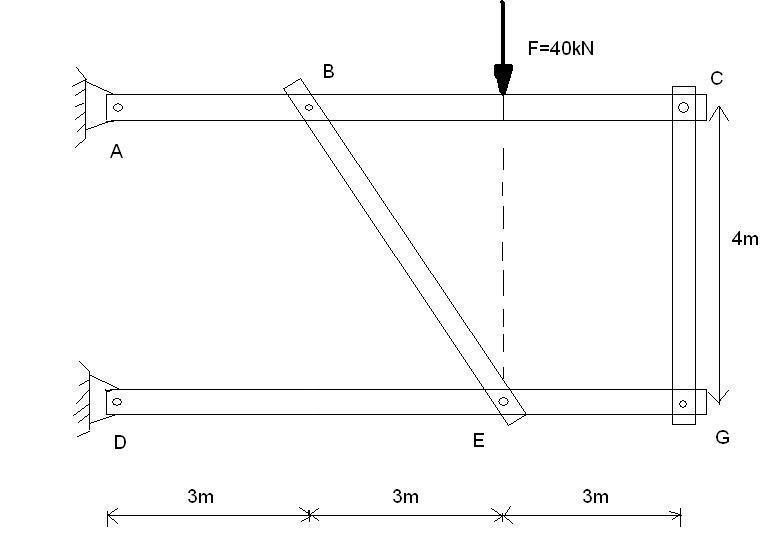
The discussion revolves around solving a mechanics problem involving forces at points B and C within a structural framework. Participants are exploring methods to analyze the forces and reactions at various supports, focusing on equilibrium equations and free body diagrams.
Discussion Character
- Technical explanation
- Mathematical reasoning
- Debate/contested
Main Points Raised
- One participant expresses difficulty in determining the forces at points B and C and seeks assistance.
- Another participant suggests that isolating the top portion of the structure and summing moments about point C is a necessary step.
- A different participant notes the presence of four unknowns at the supports but only three equilibrium equations, indicating the need for an additional equation to solve for all support reactions.
- One contributor mentions that identifying '2 force' members can help in obtaining the fourth equation needed for solving the problem.
- A participant claims to have solved the problem but points out a potential error in the direction of the vertical reaction at point D, suggesting it should be downward.
- Another participant advises that the initial diagram provided may not be helpful and recommends creating separate diagrams for each rod involved in the structure.
Areas of Agreement / Disagreement
Participants express differing views on the approach to solving the problem, with no consensus on the correct method or the accuracy of the initial diagram. Multiple competing views remain regarding the analysis of forces and the necessary steps to take.
Contextual Notes
The discussion highlights limitations in the initial problem setup, including the need for additional equations and the potential misrepresentation of forces in the diagram. Specific assumptions about the structure and its members are not fully detailed.
Who May Find This Useful
Students preparing for mechanics exams, individuals interested in structural analysis, and those seeking to understand equilibrium in engineering contexts may find this discussion relevant.